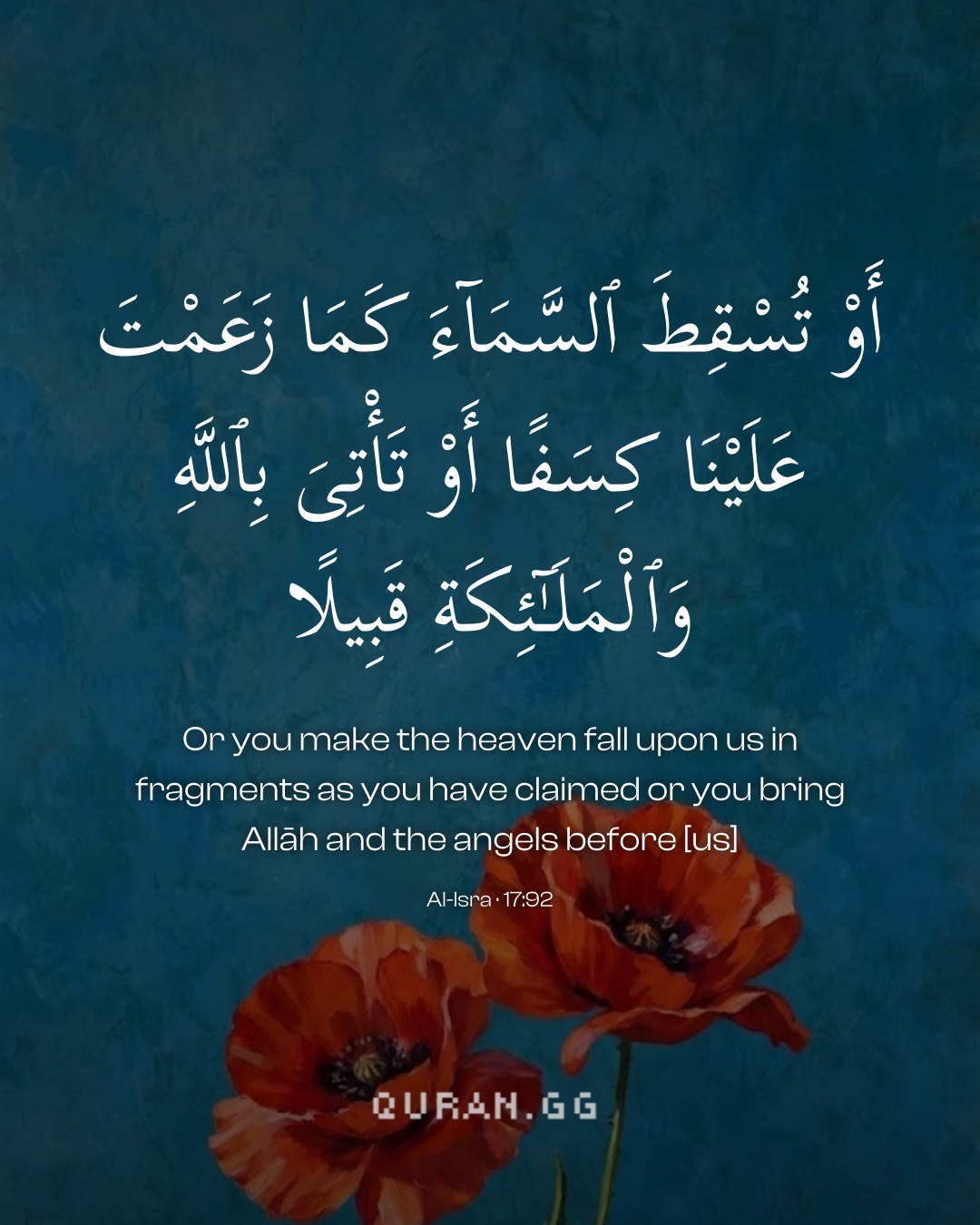
The Demand of Quraysh for a specific Sign, and the Rejection of that
Ibn Jarir recorded from Muhammad bin Ishaq, "An old man from among the people of Egypt who came to us forty-odd years ago told me, from `Ikrimah, from Ibn `Abbas, that `Utbah and Shaybah -- the two sons of Rabi'ah, Abu Sufyan bin Harb, a man from Bani `Abd Ad-Dar, Abu Al-Bakhtari -- the brother of Bani Asad, Al-Aswad bin Al-Muttalib bin Asad, Zam`ah bin Al-Aswad, Al-Walid bin Al-Mughirah, Abu Jahl bin Hisham, `Abdullah bin Abi Umayyah, Umayyah bin Khalaf, Al-`As bin Wa'il, and Nabih and Munabbih - the two sons of Al-Hajjaj As-Sahmin, gathered all of them or some of them behind the Ka`bah after sunset. Some of them said to others, `Send for Muhammad and talk with him and argue with him, so that nobody will think we are to blame.' So they sent for him saying, `The nobles of your people have gathered for you to speak to them.' So the Messenger of Allah ﷺ came quickly, thinking that maybe they were going to change their minds, for he was very keen that they should be guided, and it upset him to see their stubbornness. So he came and sat with them, and they said, `O Muhammad, we have sent for you so that nobody will think we are to blame. By Allah we do not know any man among the Arabs who has brought to his people what you have brought to your people. You have slandered our forefathers, criticized our religion, insulted our reason, slandered our gods and caused division. There is no objectionable thing that you have not brought between us. If you are preaching these things because you want wealth, we will collect some of our wealth together for you and make you the wealthiest man among us.
A prophetic answer to hostile questions sounding absurd
The questions asked and the demands made in these verses from the Holy Prophet ﷺ were virtually conditions on the fulfillment of which his antagonists were supposed to believe. These conditions are such that anyone who hears them would find them nothing but some sort of weird mockery and certainly a very absurd excuse for not believing. While having to respond to such questions, one becomes naturally angry and retorts in the same manner. But, the answer that Allah Ta’ ala taught His prophet ﷺ to give against their impertinent questions reported in this verse is something significant for everyone. Particularly so, for the leaders and reformers of the Muslim community who would do well to always remember it making it a regular feature of their work among people. Is it not that, in answer to all that, nothing was said about their lack of sense, nor mention was made of their hostile mischief, nor there was any verbal duel fought against them? Instead, the truth of the matter was made clear to them in very simple words. In effect, they were told: Perhaps, you think that a person who comes as a messenger of Allah should also be the possessor of all Divine powers and should be able to control everything. This is a mistaken notion. The duty of a Messenger of Allah ﷺ is only to convey the Divine message. It is a different matter that Allah would also send many miracles to prove the veracity of the mission of His apostles, prophets and messengers. But, that takes place exclusively with the power and under the control of Allah Ta’ ala. A rasul (messenger) is not given Divine powers. He is a human being and is never outside the framework of human power - except that Allah Ta` ala alone were to manifest His great subduing power to help him.
The Quran used to be revealed to the Prophet Muhammad at particular times. Apart from this, the Prophet had no power to compose words such as those of the Quran; his own personal way of expressing himself was always quite different in style. The Prophet was quite disturbed when for a long time no revelations were made to him. But it was not possible for him to compose verses like those of the Quran on his own or with the help of his Companions. It is a fact that there is a great difference between the language and style of the Hadith and the Quran. This difference can be seen even today by any Arabic scholar. This is a clear proof of the fact that the Quran is not a composition of the Prophet Muhammad: it has come from a mind far superior to the human mind. Those who believed that the Quran was composed of human words, were asked to compose such words as those of the Quran. If what they believed was true, and it was a human composition, they too should have had the power to compose such scriptures. They might even seek the help of others, and strive to produce verses like those of the Quran. But no one was able to answer this challenge at that time. Even in later times, no stylist or scholar has been able to produce any composition paralleling the verses of the Quran. Events show that a number of people did in fact strive very hard, but they could not produce a single verse like that of the Quran.
Uthmani text of the Madinah mushaf (King Fahd Complex). Translation: Saheeh International. Tafsir via Quran.com.