Surah Al-Jathiyah Ayah 16 (45:16) — Meaning & Tafsir | Quran.GG

Surah Al-Jathiyah, Ayah 16

45:16 · Meaning and tafsir

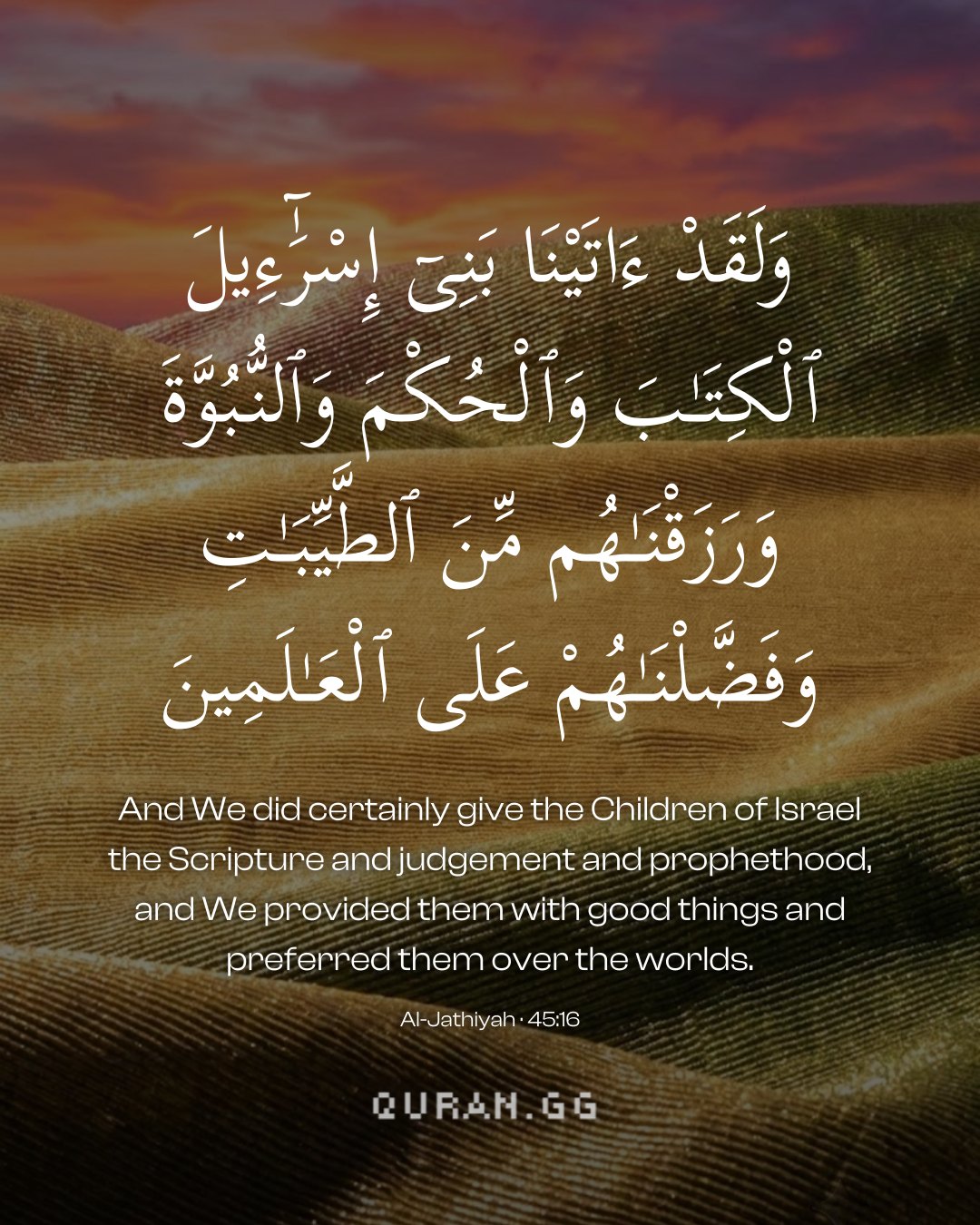
وَلَقَدْ ءَاتَيْنَا بَنِىٓ إِسْرَٰٓءِيلَ ٱلْكِتَـٰبَ وَٱلْحُكْمَ وَٱلنُّبُوَّةَ وَرَزَقْنَـٰهُم مِّنَ ٱلطَّيِّبَـٰتِ وَفَضَّلْنَـٰهُمْ عَلَى ٱلْعَـٰلَمِينَ ١٦

And We did certainly give the Children of Israel the Scripture and judgement and prophethood, and We provided them with good things and preferred them over the worlds.

Surah Al-Jathiyah 45:16 in Arabic with its translation: “And We did certainly give the Children of Israel the Scripture and judgement and prophethood, and We provided…”

Make something with this ayah

Turn it into a video for Stories, Reels or TikTok, recited by the reciter you pick, or an image on a background you choose. Free, in your browser.

Download this image

Tafsir Ibn Kathir (abridged)

Preference of Allah to the Children of Israel and their dispute thereafter

Allah the Exalted mentions the favors He granted the Children of Israel, such as revealing the Divine Books to them, sending the Messengers to them and granting them kingship. Allah said,

وَلَقَدْ ءَاتَيْنَا بَنِى إِسْرَءِيلَ الْكِتَـبَ وَالْحُكْمَ وَالنُّبُوَّةَ وَرَزَقْنَـهُمْ مِّنَ الطَّيِّبَـتِ

(And indeed We gave the Children of Israel the Scripture, and the understanding of the Scripture and its laws, and the prophethood; and provided them with good things,) such as foods and drinks,

وَفَضَّلْنَـهُمْ عَلَى الْعَـلَمينَ

(and preferred them above the nations.) of their time,

وَءاتَيْنَـهُم بَيِّنَـتٍ مِّنَ الاٌّمْرِ

(And gave them clear proofs in matters.) `We gave them evidences, proofs and unequivocal signs.' Therefore, the proof has been established against them, yet they differed among themselves after the proof came to them, out of transgression against each other,

إِنَّ رَبَّكَ

(Verily, your Lord) `O Muhammad',

يَقْضِى بَيْنَهُمْ يَوْمَ الْقِيَـمَةِ فِيمَا كَانُواْ فِيهِ يَخْتَلِفُونَ

(will judge between them on the Day of Resurrection about that wherein they used to differ. ) He will judge between them by His just judgement.

Warning to this Ummah against following the Ways of the Children of Israel

This Ayah contains a warning to the Muslim Ummah as well. It warns them not to take the path the Jews took nor adopt their ways. This is why Allah said,

ثُمَّ جَعَلْنَـكَ عَلَى شَرِيعَةٍ مِّنَ الاٌّمْرِ فَاتَّبِعْهَا

(Then We have put you on a (legal) way of commandment. So follow you that.) `follow what was revealed to you from your Lord, O Muhammad, there is no true deity except Him, and turn away from the idolators.' Allah said,

وَلاَ تَتَّبِعْ أَهْوَآءَ الَّذِينَ لاَ يَعْلَمُونَإِنَّهُمْ لَن يُغْنُواْ عَنكَ مِنَ اللَّهِ شَيْئاً وَإِنَّ الظَّـلِمِينَ بَعْضُهُمْ أَوْلِيَآءُ بَعْضٍ

(and follow not the desires of those who know not. Verily, they can avail you nothing against Allah. Verily, the wrongdoers are protecting friends of one another,) Allah says, `what will the loyalty that the idolators give each other avail them' Indeed, all they will earn from their protecting friends is more loss, destruction and demise,

وَاللَّهُ وَلِىُّ الْمُتَّقِينَ

(but Allah is the Protector of those who have Taqwa.) and He will deliver them from the darkness to the light. In contrast, all the false deities are the protecting friends of those who disbelieve, taking them out of the light to the darkness. Allah said,

هَـذَا بَصَـئِرُ لِلنَّاسِ

(This is a clear insight and evidence for man- kind,) in reference to the Qur'an,

وَهُدًى وَرَحْمَةً لِّقَوْمٍ يُوقِنُونَ

(and a guidance and a mercy for people who have faith with certainty.)

Ma'arif al-Qur'an

قُل لِّلَّذِينَ آمَنُوا يَغْفِرُ‌وا لِلَّذِينَ لَا يَرْ‌جُونَ أَيَّامَ اللَّـهِ ("Tell those who believe that they should forgive those who do not believe in Allah's days ...14) ". There are two narrations recorded relating to its cause of revelation. According to one narration, a pagan in Makkah reviled Sayyidna ` Umar ؓ and the latter intended to retaliate, but this verse came down and asked the believers to forgive the unbelievers and endure their harm that they direct against them. According to this incident the verse is Makki. Another narration reports that on the occasion of the battle of Bani-l-Mustaliq, the Prophet of Allah ﷺ and his Companions ؓ pitched their tent at a well called Muraisi'. ` Abdullah Ibn 'Ubayy, the leader of the hypocrites, was with the Muslims. He sent his servant to fetch water from the well. He was delayed in returning. ` Abdullah Ibn 'Ubayy asked him to give reason why he was late. He replied that one of Sayyidna ` Umar's ؓ servants was sitting on the bank of the well. He did not permit anyone to draw water unless the water-skins of the Prophet of Allah ﷺ and Sayyidna Abu Bakr ؓ were filled. ` Abdullah Ibn 'Ubayy cynically quoted the following proverb: سمّن کلبک یأکلک "Fatten your dog and it will eat you up." Sayyidna ` Umar ؓ heard about it, he armed himself with his sword and went towards ` Abdullah Ibn 'Ubayy. This verse was revealed on that occasion. According to this incident, the verse is Madani. (Qurtubi and Ruh-ul-Ma'ani). If both the chains of transmitters can be authenticated, the two incidents can be synchronized thus: In the first instance, the verse was originally revealed in Makkah. Then a similar incident took place on the occasion of the battle of Bani-l-Mustaliq. The Messenger of Allah recited the verse and applied it to the second incident. This often happened in cases of the causes of Qur'anic revelation. Another likelihood is that when the incident of the battle of Bani-l-Mustaliq took place, Sayyidna Jibra'il (علیہ السلام) might have come down with the verse the second time and reminded that this is an occasion to act upon it. In the technical parlance of Tafsir, it is called نزول مکرر or ` repeated revelation'. The verse contains the expression أَيَّامَ اللَّـهِ , (Allah's days) which, according to most commentators, refers to ` reward and punishment' which Allah will requite on the Day of Requital. The word ayyam (days) in the Arabic language is abundantly used in the sense of ` turn of events'.

Continue reading the tafsir of ayahs 14–16

Tazkirul Quran

Those who do not firmly believe that the Day of Judgement is going to dawn on them, venture to oppress others. They harass the preacher of Truth in every possible way. At that time feelings of revenge may develop in the heart of the preacher, but he should be forgiving towards his addressees. He should concentrate all his attention on the work of his mission and leave the matter of dealing with others’ evil deeds in the hands of God. The value of the preacher’s efforts is not assessed on the basis of the number of persons he has influenced and brought on to the path of Truth. The value of his performance in the eyes of God depends upon the extent to which he remained steadfastly dedicated to the Truth; and to what degree he himself exemplified the behaviour expected of him.

Uthmani text of the Madinah mushaf (King Fahd Complex). Translation: Saheeh International. Tafsir via Quran.com.