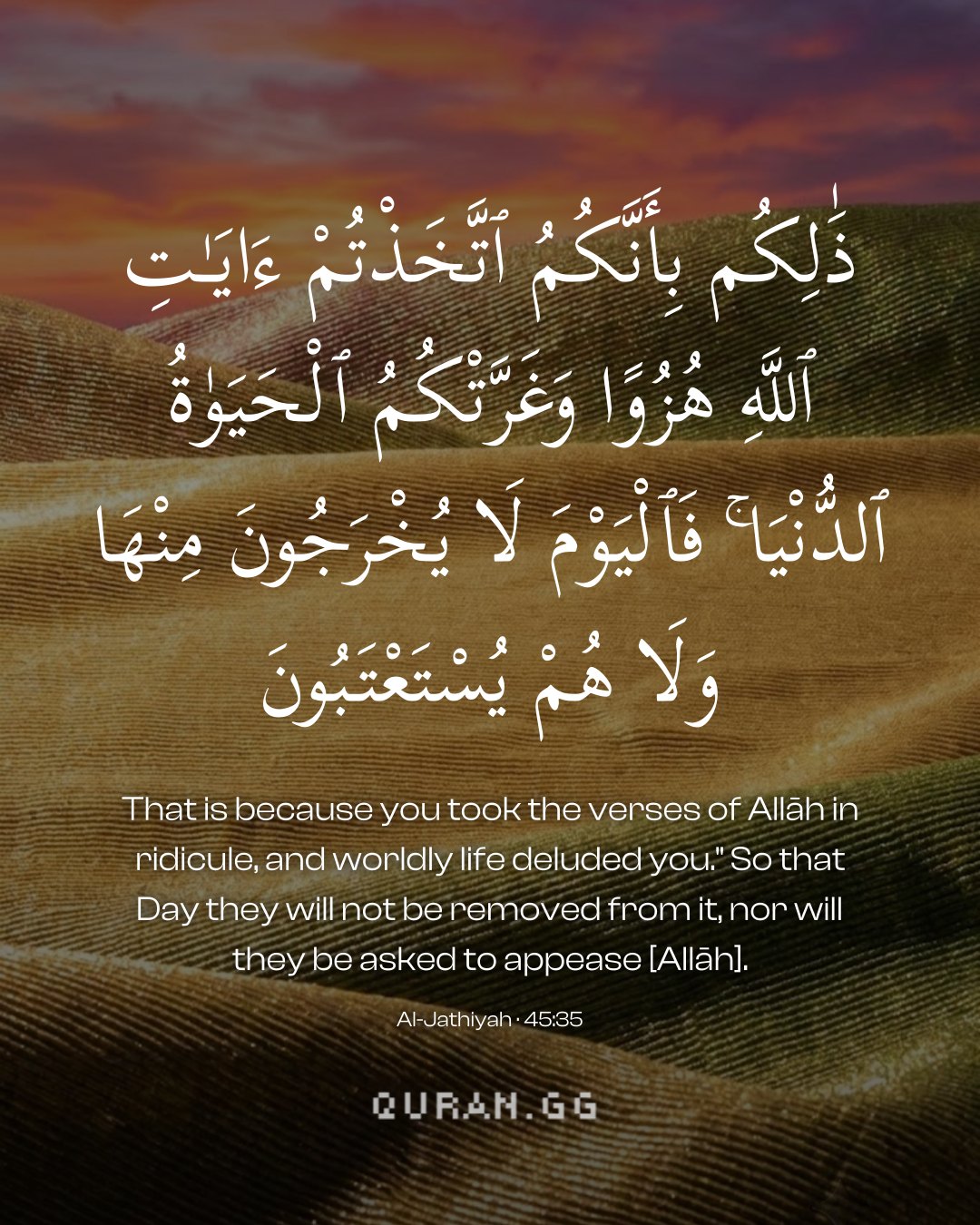
That is because you took the verses of Allāh in ridicule, and worldly life deluded you." So that Day they will not be removed from it, nor will they be asked to appease [Allāh].
(Then, as for those who believed and did good deeds,) Those whose hearts believed and their limbs performed good deeds, in sincerity to Allah and conforming with Islamic legislation;
فَيُدْخِلُهُمْ رَبُّهُمْ فِى رَحْمَتِهِ
(their Lord will admit them to His mercy. ) and that is Paradise. In the Sahih, Allah said to Paradise;
«أَنْتِ رَحْمَتِي، أَرْحَمُ بِكِ مَنْ أَشَاء»
("You are My mercy, with which I grant mercy to whom I will,") Allah said;
ذَلِكَ هُوَ الْفَوْزُ الْمُبِينُ
(That will be the evident success.) clear and apparent. Allah said,
وَتَرَىٰ كُلَّ أُمَّةٍ جَاثِيَةً ("And you will see every community kneeling down...45:28" ). The word jathiyah is derived from جُثُو juthuww. It means ` to sit with knees upon the ground'. Sayyidna Sufyan ؓ says that the word means ` to sit in such a way that only the knees and the toes of the feet rest on the ground'. The latter type of sitting will be on account of awe, horror and fear. The words, كُلُّ أُمَّةٍ "every community" means that horrors of Resurrection will be felt by all on the plain - believers, non-believers, and righteous and unrighteous, all of them. There are other verses and traditions that exclude the Prophets and the righteous from experiencing the horrors of the Plains of Resurrection. The present verse is not in conflict with them. It is possible that the Prophets (علیہم السلام) and the righteous will experience the horrors of the Plains of Resurrection for a short period of time - the period of time will be so short as if it never existed. It is also possible that the word hull is not used in the sense of "every" but in the sense of ` most' - as is used occasionally. From this point of view, the phrase would mean not all the people on the Plain of Resurrection but ` most people' will experience horror, thus the prophets and the righteous are excluded. Some of the scholars take the position that the word jathiyah means ` to sit like the sitting posture in salah'. If this be taken for granted, the difficulty automatically disappears because such a sitting is not out of fear or horror. It is out of respect and honour.
In the present world when a man commits evil, its bad results do not at once appear before him. This serves to embolden him. When he is warned about his bad deeds, he is not prepared to give any serious attention to this. But, in the Hereafter, the consequences of his misdeeds will appear before his eyes and he will be completely engulfed in them. At that time he will accept the Truth, which he had formerly ridiculed as being worthless. In the Hereafter, man will accept the Truth which he denied in this world. But this will carry no weight there, as it is only acceptance of Truth at the ‘unseen’ level which is of value, not acceptance after the revelation of Reality.
Uthmani text of the Madinah mushaf (King Fahd Complex). Translation: Saheeh International. Tafsir via Quran.com.