Admonishing the Jews and challenging Them to wish for Death
Allah the Exalted admonishes the Jews who were entrusted with the Tawrah and were ordered to abide by it. However, they did not abide by it, and this is why Allah resembled them to the donkey that carries volumes of books. Surely, when the donkey carries books, it will not understand what these books contain because it is only carrying these books using its strength. This is the example of those who were entrusted with the Tawrah; they read its letter but did not understand its meanings nor abided by them. Rather, they even corrupted and changed the Tawrah. Therefore, they are worse than the donkey, because the donkey cannot understand. They, on the other hand, could have understood using their minds, but their minds were of no benefit. This is why Allah the Exalted said in another Ayah,
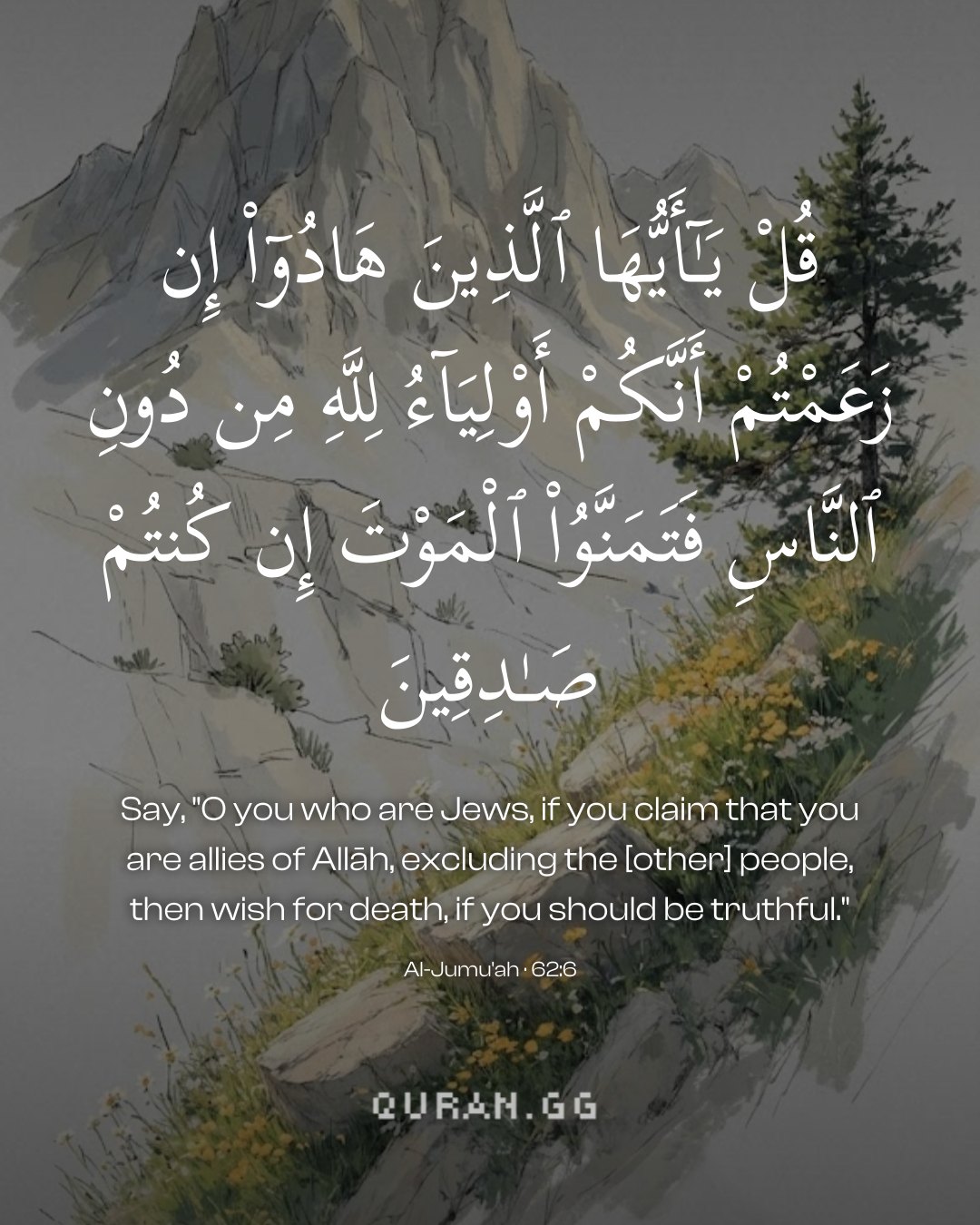
(Say, "0 those who are Jews, if you claim that you are the friends of Allah to the exclusion of all other people, then express your desire for death, if you are true…62:6)
Friends of Allah to the exclusion of all other people, then express your desire for death, if you are true…62:6)
Despite their kufr, shirk and moral aberration, the Jews claimed نَحْنُ أَبْنَاءُ اللَّـهِ وَأَحِبَّاؤُهُ (…We are the sons of Allah and His favourites) [ 5:18] and they also claimed لَن يَدْخُلَ الْجَنَّةَ إِلَّا مَن كَانَ هُودًا (…no one shall ever enter Paradise unless he is a Jew) [ 2:111]. In other words, they believed themselves to be safe and immune from the punishment of the Hereafter, and thought that the blessings of Paradise are their personal property. Obviously, if a person believes that the blessings of the Hereafter are a zillion times better than the blessings of this world, he must, of necessity, wish for death, so that he is able to enter Paradise sooner and start enjoying its blessings forthwith. He sees with his own eyes that this world is not free from miseries, sorrows and hardships and one has to suffer from certain diseases as long as he is living here. Then if he believes that, as soon as he dies, he will certainly receive those numerous and eternal blessings, a wise man should naturally wish for death in his heart, so that he may be set free from this miserable world and reach the next world where he will reside forever in eternal peace and comfort. That is why the Messenger of Allah ﷺ is instructed in the present verse to challenge that if they are Allah’ s children and His beloved ones they do not have any fear of punishment in the Hereafter, then the reason demands that they should wish for death. Then the Holy Qur’ an itself falsified them in the following words:
Tazkirul Quran
Maulana Wahiduddin KhanOn ayahs 4–7
To send the prophets for the guidance of human beings is the expression of the same attributes of God at the level of humanity as those expressed in relation to material things at the level of the universe. The task of the Prophet Muhammad and other prophets was twofold—first, to convey the message of God to the people and, second, to awaken the consciousness of the people, so that they might understand godly matters and connect them with their real life. In future also, the work relating to dawah (the call for Truth) and reform will be twofold, i.e. the teaching of the Quran and intellectual and spiritual development.
Uthmani text of the Madinah mushaf (King Fahd Complex). Translation: Saheeh International. Tafsir via Quran.com.