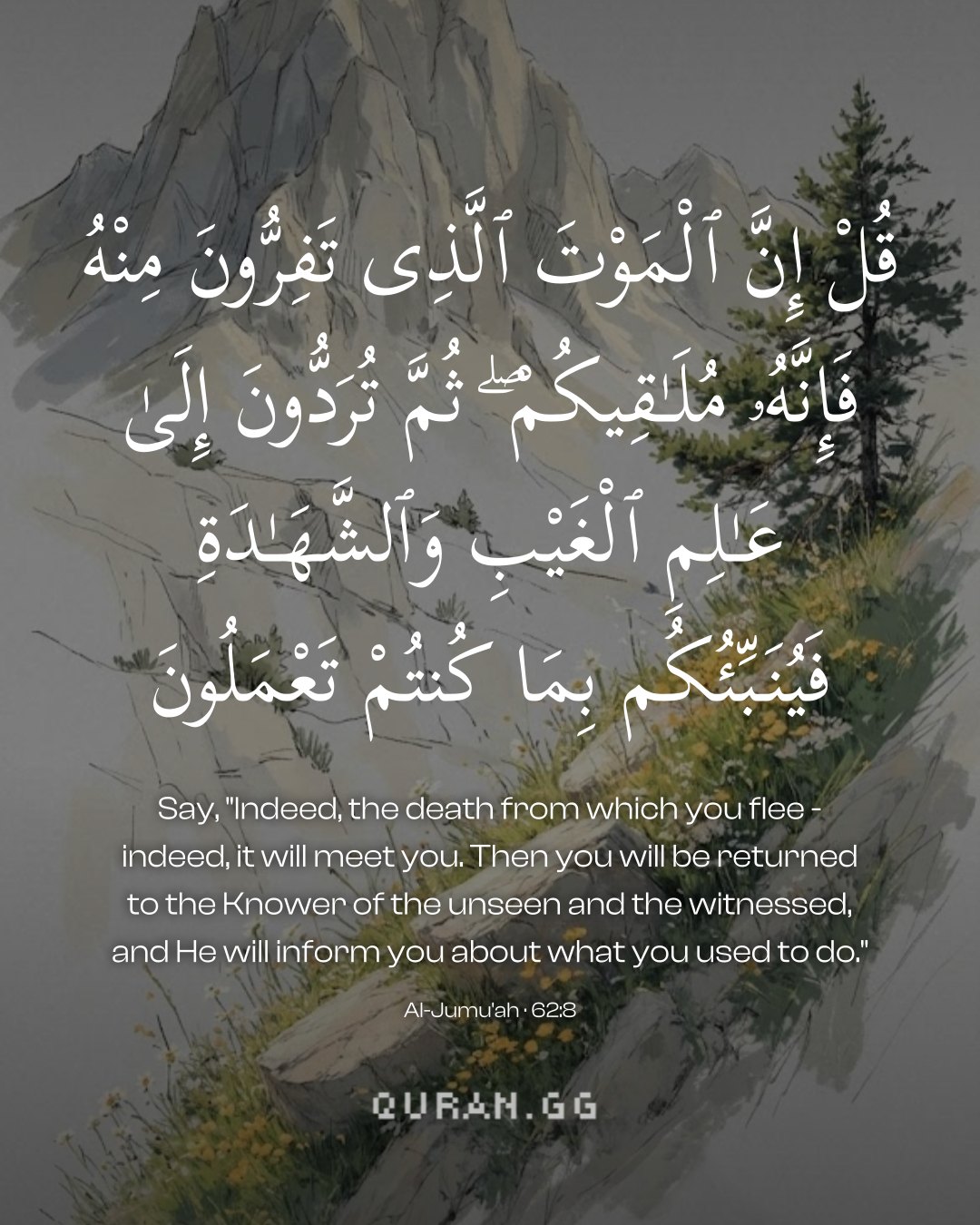
Say, "Indeed, the death from which you flee - indeed, it will meet you. Then you will be returned to the Knower of the unseen and the witnessed, and He will inform you about what you used to do."
Admonishing the Jews and challenging Them to wish for Death
Allah the Exalted admonishes the Jews who were entrusted with the Tawrah and were ordered to abide by it. However, they did not abide by it, and this is why Allah resembled them to the donkey that carries volumes of books. Surely, when the donkey carries books, it will not understand what these books contain because it is only carrying these books using its strength. This is the example of those who were entrusted with the Tawrah; they read its letter but did not understand its meanings nor abided by them. Rather, they even corrupted and changed the Tawrah. Therefore, they are worse than the donkey, because the donkey cannot understand. They, on the other hand, could have understood using their minds, but their minds were of no benefit. This is why Allah the Exalted said in another Ayah,
قُلْ إِنَّ الْمَوْتَ الَّذِي تَفِرُّونَ مِنْهُ فَإِنَّهُ مُلَاقِيكُمْ (Say, “ Indeed, the death from which you [ try to ] run away has to visit you,…62:8). In other words, the Jews’ running away from longing for death despite their aforesaid claim is tantamount to running away from death itself. The Holy Prophet ﷺ is instructed in the verse to tell them that the death from which they are fleeing would inevitably catch up with them. If that would not happen instantly, it would certainly happen sometime later. Thus it is impossible for anyone to avoid or avert death in any way.
Laws pertaining to Avoiding the Causes of Death
There are many normal causes of death, from which both reason and Shari’ ah require man to avoid. Once the Holy Prophet ﷺ passed under a bent wall [ as if it was about to fall down or collapse ] and he passed it quickly, lest it should fall down or collapse on him. Likewise, if fire breaks out at some place, both reason and shari’ ah dictate that one should run away from there. These circumstances of fleeing from death do not fall under fleeing from death denounced in the above verse, if our faith is sound and we believe that when the predetermined time of our death will approach, we will not be able to escape. Since we do not know for sure whether fire, or poison, or some other obnoxious thing will be the destined cause of our death in a particular situation, running away from them would not amount to fleeing from death that is denounced in the verse.
As for as bubonic plague or epidemic is concerned, it is a separate issue. The details appear in books of jurisprudence and Hadith which may be consulted. The author of Ruh-ul-Ma’ ani has on this occasion discussed this issue exhaustively and clarified it to a great degree. Some of its details have already been given in this book under the verses 2:243 to 244. See vol. 1, pp. 619-622.
Tazkirul Quran
Maulana Wahiduddin KhanOn ayahs 8–10
When a book of God is given to a community, it is given for the purpose of its being followed. But a community which does not become the bearer of the book in that sense is like a donkey on which academic books are loaded without its being aware of what they are. The Jews did not follow the teachings of their religion, but they had made it a sign of pride for themselves. But this sort of pride is not going to be of any use to anybody. Such pride is always false pride, and the proof of this is that no proud person is ready to make sacrifices for the religion which he had made a matter of pride. However, when death overtakes such people, they will come to know that the pride on which they were living in the world will bring them nothing but dishonour in the Hereafter.
Uthmani text of the Madinah mushaf (King Fahd Complex). Translation: Saheeh International. Tafsir via Quran.com.