(Say: "Shall We tell you the greatest losers in respect of (their) deeds") `Are they the Haruriyyah' He said, `No, they are the Jews and Christians. As for the Jews, they disbelieved in Muhammad ﷺ, and as for the Christians, they disbelieved in Paradise and said that there is no food or drink there, and the Haruriyyah are those who break Allah's covenant after ratifying it.' Sa`d used to call them Al-Fasiqin (the corrupt). `Ali bin Abi Talib, Ad-Dahhak and others said: "They are the Haruriyyah," so this means, that according to `Ali, may Allah be pleased with him, this Ayah includes the Haruriyyah just as it includes the Jews, the Christians and others. This does not mean that the Ayah was revealed concerning any of these groups in particular; it is more general than that, because the Ayah was revealed in Makkah, before the Qur'an addressed the Jews and Christians, and before the Khawarij existed at all. So the Ayah is general and refers to everyone who worships Allah in a way that is not acceptable, thinking that he is right in doing that and that his deeds will be accepted, but he is mistaken and his deeds will be rejected, as Allah says:
The last sentence in the same verse (105): فَلَا نُقِيمُ لَهُمْ يَوْمَ الْقِيَامَةِ وَزْنًا (and We shall not assign to them any weight) means that their deeds may appear to be great outwardly, but when placed on the balance of reckoning, they will carry no weight. The reason is that these deeds will be of no use and will not carry any weight because of kufr (disbelief) and shirk (ascribing of partners to Allah).
According to a Hadith of Sayyidna Abu Hurairah ؓ appearing in the Sahih of al-Bukhari and Muslim, the Holy Prophet ﷺ said: On the day of Qiyamah, there will come a tall and heavy man who, in the sight of Allah, will not be worth the weight of a mosquito.' Then he said: 'If you wish to verify it, recite this verse of the Qur'an: فَلَا نُقِيمُ لَهُمْ يَوْمَ الْقِيَامَةِ وَزْنًا (and We shall not assign to them any weight).'
Sayyidna Abu Said al-Khudri says: ' (on the day of Qiyamah) deeds as big as the mountains of Tihamah will be brought in. But, they will carry no weight on the balance of justice.' (Qurtubi)
Tazkirul Quran
Maulana Wahiduddin KhanOn ayahs 106–107
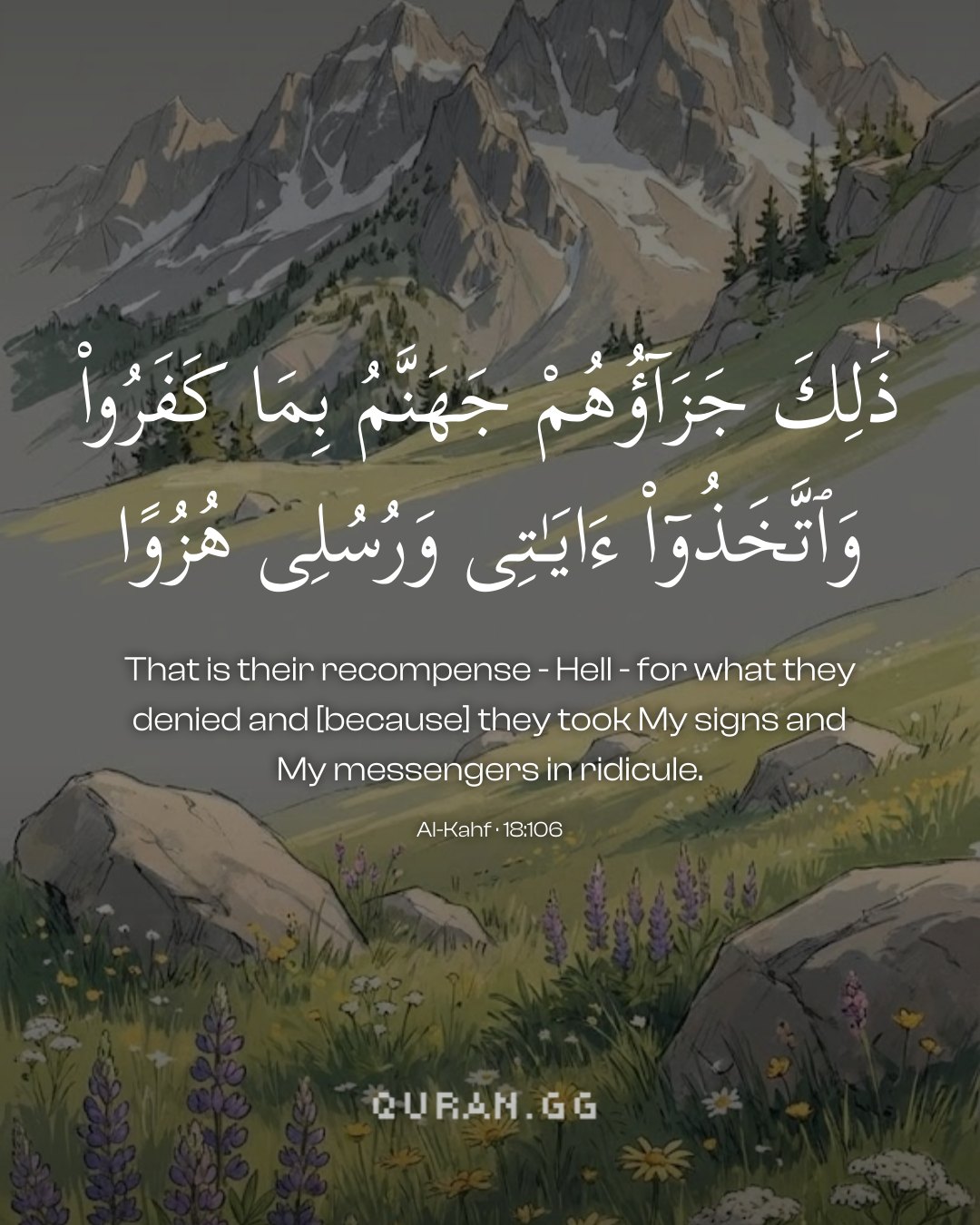
Man strives in this world and observes that, as a result, he gains wealth and honour. He does not see his work marred in any manner, therefore, he considers himself a successful man. But, this is highly irrational. In the plan of God, the criterion of a successful life is in terms of the life of the Hereafter. Therefore, to consider success in this worldly life as real success amounts to taking a view of life which omits the life hereafter altogether. This is tantamount to substituting our own plan in place of God’s plan and obviously those who do so can never be successful in the life hereafter. God reveals His signs. But these signs of the life hereafter have no effect on those whose minds are preoccupied with the thoughts of this world. God discloses His arguments, but the arguments of the life hereafter do not appeal to those who are lost in the affairs of this world. Such people fail to accept guidance, even though they may be standing next to a guide. If they do not give any weight to God’s word, how can they expect God to take their candidature into account for any divine consideration?
Uthmani text of the Madinah mushaf (King Fahd Complex). Translation: Saheeh International. Tafsir via Quran.com.