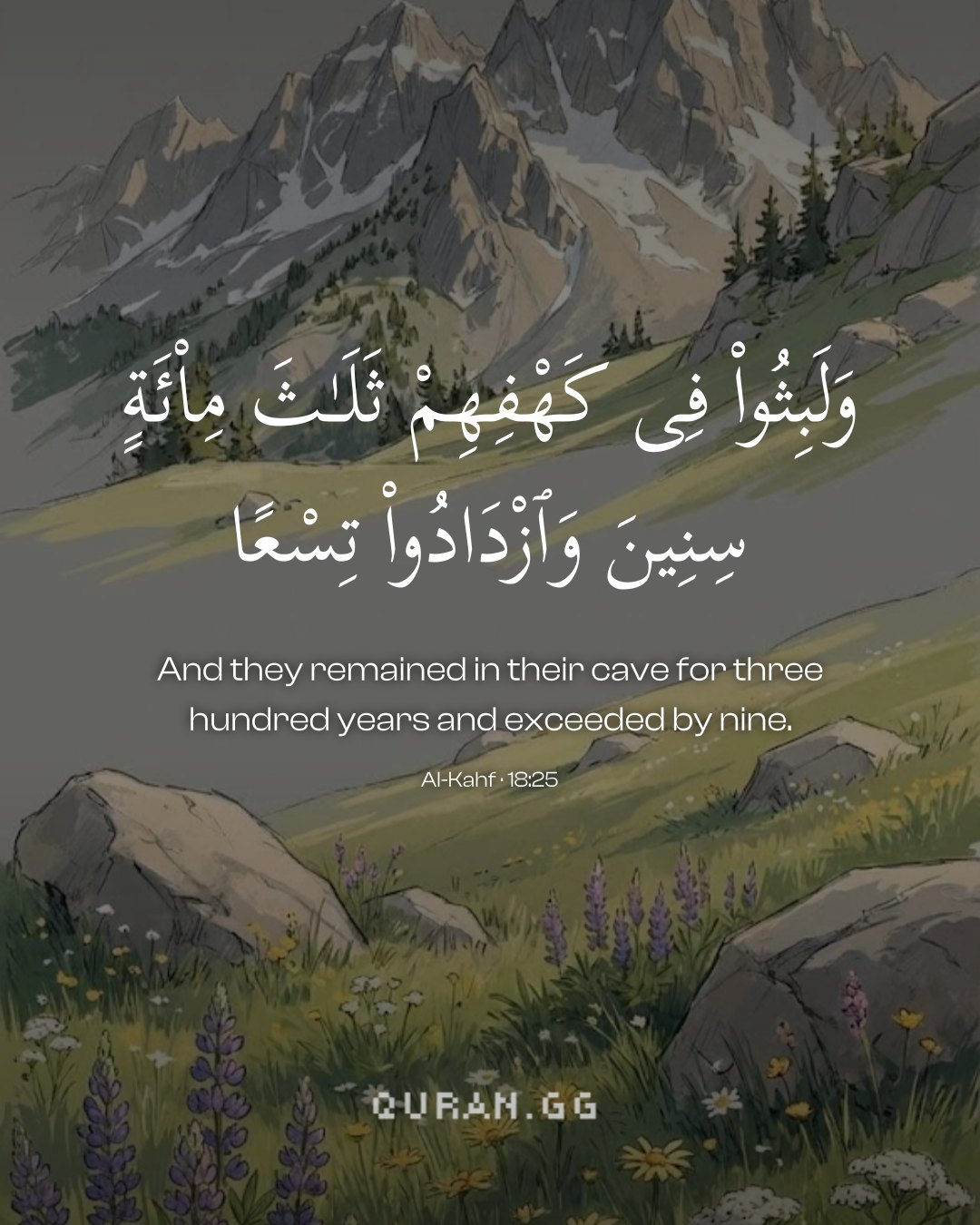
The Length of their Stay in the Cave
Here Allah tells His Messenger the length of time the people of the Cave spent in their cave, from the time when He caused them to sleep until the time when He resurrected them and caused the people of that era to find them. The length of time was three hundred plus nine years in lunar years, which is three hundred years in solar years. The difference between one hundred lunar years and one hundred solar years is three years, which is why after mentioning three hundred, Allah says, `adding nine.'
قُلِ اللَّهُ أَعْلَمُ بِمَا لَبِثُواْ
(Say: "Allah knows best how long they stayed...") `If you are asked about how long they stayed, and you have no knowledge of that and no revelation from Allah about it, then do not say anything. Rather say something like this:
اللَّهُ أَعْلَمُ بِمَا لَبِثُواْ لَهُ غَيْبُ السَّمَـوَتِ وَالاٌّرْضِ
(Allah knows best how long they stayed. With Him is (the knowledge of) the Unseen of the heavens and the earth.)" meaning, no one knows about that except Him, and whoever among His creatures He chooses to tell. What we have said here is the view of more than one of the scholars of Tafsir, such as Mujahid and others among the earlier and later generations.
وَلَبِثُواْ فِى كَهْفِهِمْ ثَلاثَ مِئَةٍ سِنِينَ
(And they stayed in their cave three hundred years,) Qatadah said, this was the view of the People of the Book, and Allah refuted it by saying:
قُلِ اللَّهُ أَعْلَمُ بِمَا لَبِثُواْ
(Say: "Allah knows best how long they stayed...") meaning, that Allah knows better than what the people say. This was also the view of Mutarraf bin `Abdullah. However, this view is open to debate, because when the People of the Book said that they stayed in the cave for three hundred years, without the extra nine, they were referring to solar years, and if Allah was merely narrating what they had said, He would not have said,
وَازْدَادُواْ تِسْعًا
(adding nine.) The apparent meaning of the Ayah is that Allah is stating the facts, not narrating what was said. This is the view of Ibn Jarir (may Allah have mercy on him). And Allah knows best.
أَبْصِرْ بِهِ وَأَسْمِعْ
(How clearly He sees, and hears (everything)!) He sees them and hears them. Ibn Jarir said, "The language used is an eloquent expression of praise." The phrase may be understood to mean, how much Allah sees of everything that exists and how much He hears of everything that is to be heard, for nothing is hidden from Him! It was narrated that Qatadah commented on this Ayah:
أَبْصِرْ بِهِ وَأَسْمِعْ
(How clearly He sees, and hears (everything)!) "No one hears or sees more than Allah."
مَا لَهُم مِّن دُونِهِ مِن وَلِىٍّ وَلاَ يُشْرِكُ فِى حُكْمِهِ أَحَدًا
(They have no protector other than Him, and He makes none to share in His decision and His rule.) meaning, He, may He be glorified, is the One Who has the power to create and to command, the One Whose ruling cannot be overturned; He has no adviser, supporter or partner, may He be exalted and hallowed.
Ma'arif al-Qur'an
Mufti Muhammad Shafi
As for the period of sleep in the Cave given as three hundred nine years in the third verse (27), this statement concerning the time duration, as evident from the sequential arrangement of the Qur’ an, is but from Allah Ta’ ala. Ibn Kathir has declared this to be the position of the majority of commentators, earlier and later. Abu Hayyan and al-Qurtubi have also adopted this view. But, they have also reported another saying from Qatadah and others. It holds that this statement of three hundred nine years is also the saying of some of those who had differed and that the saying of Allah was what was said later: اللَّـهُ أَعْلَمُ بِمَا لَبِثُوا (Allah knows best how long they stayed - 26). The reason is, had the earlier statement giving the duration as three hundred nine years been the word of Allah, there would have been no occasion for saying: اللَّـهُ أَعْلَمُ بِمَا لَبِثُوا (Allah knows best how long they stayed) after that. But, the majority of commentators have said that both these sentences are the word of Allah. The first one describes reality as it is. The second one warns those who differ with it. They have been told that once the statement giving the duration has come from Allah, accepting it is mandatory. Since He is the One who really knows, trying to differ with Him on the basis of mere conjectures and opinions is (to make an understatement) unreasonable. The question that arises here is about the manner in which the Holy Qur'an has described the duration of stay. First it mentions three hundred years. After that, it has said that added to those three hundred there are nine. The number three hundred nine was not given initially. According to commentators, there is a reason for it. Since the Jews and Christians followed the Solar Calendar, their count remained three hundred years. And since Islam goes by the Lunar Calendar in which three more years are added every hundred years, therefore, three hundred years of Solar Calendar become nine more years in accordance with the Lunar Calendar. It was to tell the difference between the two years that this expressive diction was employed.
The Quraysh of Makkah sent Nadar ibn Harith and ‘Uqbah ibn Mu‘it to Madinah to meet the Jewish scholars and ask for information about the Prophet Muhammad, because the Jews had knowledge about prophets. The Jews advised these emissaries to ask the Prophet Muhammad about three things, adding that if he could give information about these things, then he was the Prophet; otherwise he was merely a glib talker. Of these questions, one was about the young ‘Men of the Cave’, the second related to ‘Dhul Qarnayn’ and the third was about the spirit. Before the age of the press the common people did not know about the ‘Men of the Cave.’ This story was recorded in certain Syrian manuscripts, a fact known only to particular scholars. When this question was put to the Prophet Muhammad, he said that he would give the required information the next day, in the hope that Gabriel would appear the next day and give him the necessary information, which he would then pass on to the questioners. But, Gabriel’s arrival was delayed. He took fifteen days to bring the chapter entitled ‘The Cave’ (al-Kahf). Due to this delay in revelation, The Prophet Muhammad’s Makkan antagonists had a good opportunity to malign his name on this issue. God said, ‘On the pretext of a small, ordinary incident, you are trying to make people doubtful about the truthfulness of a person whose truthfulness is going to be vouchsafed by far better and much more convincing arguments.’ (Tafsir al-Mazhari, vol. 6, p. 27 ). Now that so many arguments have accumulated to substantiate the truthfulness of the prophethood of the Prophet Muhammad, no sensible person could deny it. Today, his prophethood is a well established fact and not merely a claim.
Continue reading the tafsir of ayahs 23–25 Uthmani text of the Madinah mushaf (King Fahd Complex). Translation: Saheeh International. Tafsir via Quran.com.