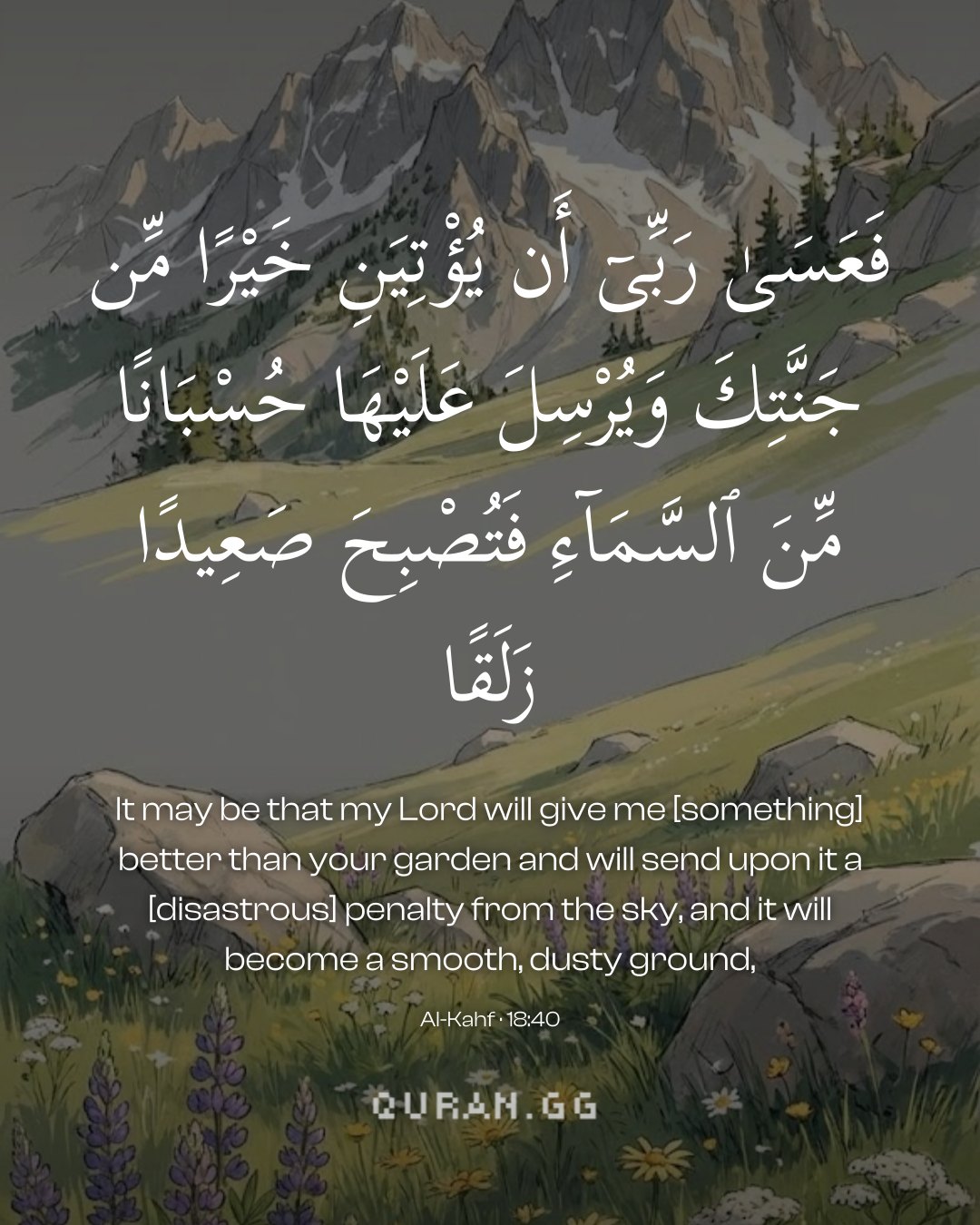
It may be that my Lord will give me [something] better than your garden and will send upon it a [disastrous] penalty from the sky, and it will become a smooth, dusty ground,
Allah tells us how the rich man's believing companion replied to him, warning and rebuking him for his disbelief in Allah and allowing himself to be deceived.
أَكَفَرْتَ بِالَّذِى خَلَقَكَ مِن تُرَابٍ
(Do you disbelieve in Him Who created you out of dust...) This is a denunciation, pointing out the seriousness of his rejection of his Lord Who created and formed man out of dust -- that is, refering to Adam -- then made his offspring from despised liquid, as Allah says:
(How can you disbelieve in Allah Seeing that you were dead and He gave you life) 2:28 meaning, how can you reject your Lord and His clear signs to you, which every one recognizes in himself, for there is no one among His creatures who does not know that he was nothing, then he came to be, and his existence is not due to himself or any other creature. He knows that his existence is due to his Creator, beside Whom there is no other god, the Creator of all things. So the believer said:
The word: حُسبانا - (husbana) in verse 40 has been explained by Qatadah as 'punishment' in an absolute sense, by Sayyidna Ibn ` Abbas ؓ as 'fire' and by some as 'stoning.' As for what appears after that in the Qur'an: أُحِيطَ بِثَمَرِهِ (And its produce was struck by destruction from all sides - 42), it obviously means that some major calamity hit his gardens, wealth and things of luxury reducing everything to ruins. The Qur'an does not mention any particular calamity explicitly. It appears that, some fire came down from the skies and burnt the whole thing - as it appears in the Tafsir of 'husban' by Sayyidna Ibn 'Abbas ؓ who has explained it as 'fire.' And Allah knows best.
Tazkirul Quran
Maulana Wahiduddin KhanOn ayahs 36–40
Take the example of a lush green garden which, due to a sudden natural calamity, is completely destroyed. This, figuratively speaking, will be the fate of one who achieves wealth and position in this world and becomes proud as a result. Whatever share of wealth and position a man receives in this world is, in fact, a test from God. But an unjust and transgressing man takes it to be the result of his own efforts. Consequently he develops an attitude of arrogance. He looks down upon a person whose share of wealth and position in this world is comparatively inferior. He develops a certain type of mindset by which he thinks that his world will never come to an end, and that even if this world ends and another world comes into existence, there is no reason why he should not enjoy the same comfortable conditions as he is enjoying here. He fails to differentiate between the world of trial and the world of reward.
Uthmani text of the Madinah mushaf (King Fahd Complex). Translation: Saheeh International. Tafsir via Quran.com.