Surah Al-Kahf Ayah 6 (18:6) — Meaning & Tafsir | Quran.GG

Surah Al-Kahf, Ayah 6

18:6 · Meaning and tafsir

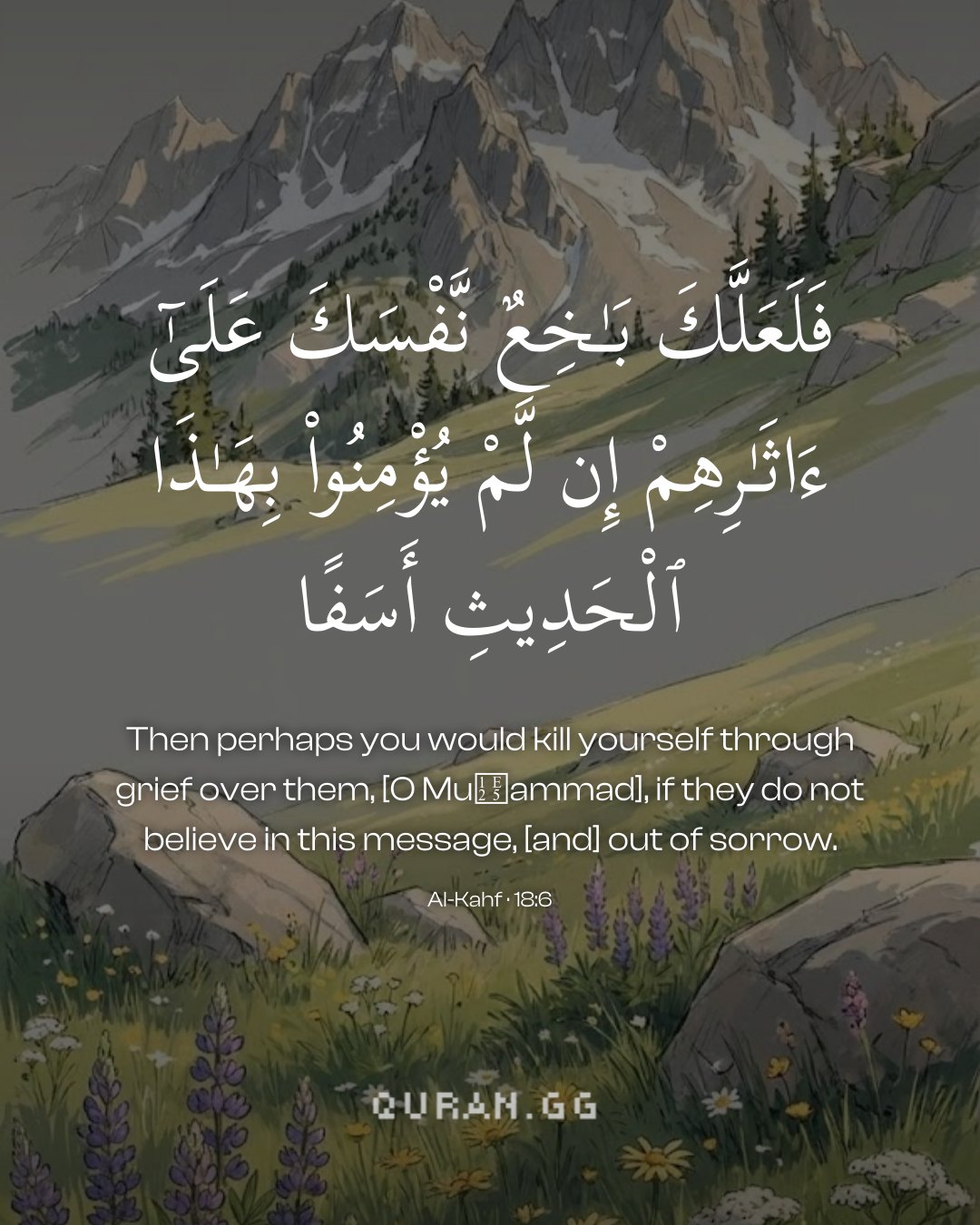
فَلَعَلَّكَ بَـٰخِعٌ نَّفْسَكَ عَلَىٰٓ ءَاثَـٰرِهِمْ إِن لَّمْ يُؤْمِنُوا۟ بِهَـٰذَا ٱلْحَدِيثِ أَسَفًا ٦

Then perhaps you would kill yourself through grief over them, [O Muḥammad], if they do not believe in this message, [and] out of sorrow.

Surah Al-Kahf 18:6 in Arabic with its translation: “Then perhaps you would kill yourself through grief over them, [O Muḥammad], if they do not believe in this…”

Make something with this ayah

Turn it into a video for Stories, Reels or TikTok, recited by the reciter you pick, or an image on a background you choose. Free, in your browser.

Download this image

Tafsir Ibn Kathir (abridged)

Do not feel sorry because the Idolators do not believe Allah consoles His Messenger for his sorrow

فَلاَ تَذْهَبْ نَفْسُكَ عَلَيْهِمْ حَسَرَتٍ

(So destroy not yourself in sorrow for them.) 35:8

وَلاَ تَحْزَنْ عَلَيْهِمْ

(And grieve not over them.) 16:127

لَعَلَّكَ بَـخِعٌ نَّفْسَكَ أَلاَّ يَكُونُواْ مُؤْمِنِينَ

(It may be that you are going to kill yourself with grief, that they do not become believers.) 26:3 meaning, maybe you will destroy yourself with your grief over them. Allah says:

فَلَعَلَّكَ بَـخِعٌ نَّفْسَكَ عَلَى ءَاثَـرِهِمْ إِن لَّمْ يُؤْمِنُواْ بِهَـذَا الْحَدِيثِ

(Perhaps, you would kill yourself in grief, over their footsteps, because they believe not in this narration.) meaning the Qur'an.

أَسَفاً

(in grief) Allah is saying, `do not destroy yourself with regret.' Qatadah said: "killing yourself with anger and grief over them." Mujahid said: "with anxiety." These are synonymous, so the meaning is: `Do not feel sorry for them, just convey the Message of Allah to them. Whoever goes the right way, then he goes the right way only for the benefit of himself. And whoever goes astray, then he strays at his own loss, so do not destroy yourself in sorrow for them.'

This World is the Place of Trial Then Allah tells us that He has made this world a temporary abode, adorned with transient beauty, andHe made it a place of trial, not a place of settlement. So He says

إِنَّا جَعَلْنَا مَا عَلَى الاٌّرْضِ زِينَةً لَّهَا لِنَبْلُوَهُمْ أَيُّهُم أَحْسَنُ عَمَلاً

(Verily, we have made that which is on earth an adornment for it, in order that We may test which of them are best in deeds.) Abu Maslamah narrated from Abu Nadrah from Abu Sa`id that the Messenger of Allah ﷺ said:

«إِنَّ الدُّنْيَا حُلْوَةٌ خَضِرَةٌ، وَإِنَّ اللهَ مُسْتَخْلِفُكُمْ فِيهَا فَنَاظِرٌ مَاذَا تَعْمَلُونَ، فَاتَّقُوا الدُّنْيَا، وَاتَّقُوا النِّسَاءَ، فَإِنَّ أَوَّلَ فِتْنَةِ بَنِي إِسْرَائِيلَ كَانَتْ فِي النِّسَاء»

(This world is sweet and green, and Allah makes you generations succeeding one another, so He is watching what you will do. Beware of (the beguilements of) this world and beware of women, for the first affliction that Children of Israel suffered from was that of women.) Then Allah tells us that this world will pass away and come to an end, as He says:

وَإِنَّا لَجَاعِلُونَ مَا عَلَيْهَا صَعِيداً جُرُزاً

(And verily, We shall make all that is on it bare, dry soil.) means, `after having adorned it, We will destroy it and make everything on it bare and dry, with no vegetation or any other benefit.' Al-`Awfi reported from Ibn `Abbas that this means everything on it would be wiped out and destroyed. Mujahid said: "a dry and barren plain." Qatadah said, "A plain on which there are no trees or vegetation."

Ma'arif al-Qur'an

The properties and merits of Surah al-Kahf

According to a narration of Sayyidna Abu al-Darda' ؓ appearing in Muslim, Abu Dawud, Tirmidhi, al-Nasa'i and the Musnad of Ahmad, one who has memorized the first ten verses of Surah al-Kahf will remain protected from the ill effects of Dajjal (imposter). In another report in the same books and from the same authority, the same thing has been said about having memorized the last ten verses of Surah al-Kahf.

And it has been reported in the Musnad of Ahmad on the authority of Sayyidna Sahl ibn Mu` adh ؓ that the Holy Prophet ﷺ said, "One who recites the first and the last verses of Surah al-Kahf, for him there is light from his feet up to his head. And the one who were to recite the whole Surah, then, for him there is light from the earth up to the sky."

Continue reading the tafsir of ayahs 1–6

Tazkirul Quran

The Quran is the corrected edition of previous divine scriptures. In the case of previous scriptures, successive generations made the divine teachings complicated by indulging in hair-splitting. Furthermore, the original teachings were subjected to distortion by means of interpolation, and in this way the very direction of these teachings was deflected. The Quran is free of both these types of human interference. On the one hand, it contains religion in its natural, pure and simple form, and on the other, its direction is unwaveringly towards God, as in fact it should be. Why is it that God has arranged for the revelation of scriptures to the people of the world? The purpose of this is to acquaint them with His divine scheme. God has created man in this world for the purpose of trial. Thereafter, He will take a reckoning of everybody, and according to his deeds, will send him to hell or settle him in the eternal gardens of heaven. God wants everybody to be aware of this before death, so that nobody should have any excuse for wrongdoing. One cause of man’s going astray in this world is his taking someone other than God as his supporter. This deviance is at its worst when someone is believed to be the son of God. All such beliefs are false, because there is nobody on earth or in heaven who wields any power or authority except God.

Uthmani text of the Madinah mushaf (King Fahd Complex). Translation: Saheeh International. Tafsir via Quran.com.