Surah Al-Kahf Ayah 71 (18:71) — Meaning & Tafsir | Quran.GG

Surah Al-Kahf, Ayah 71

18:71 · Meaning and tafsir

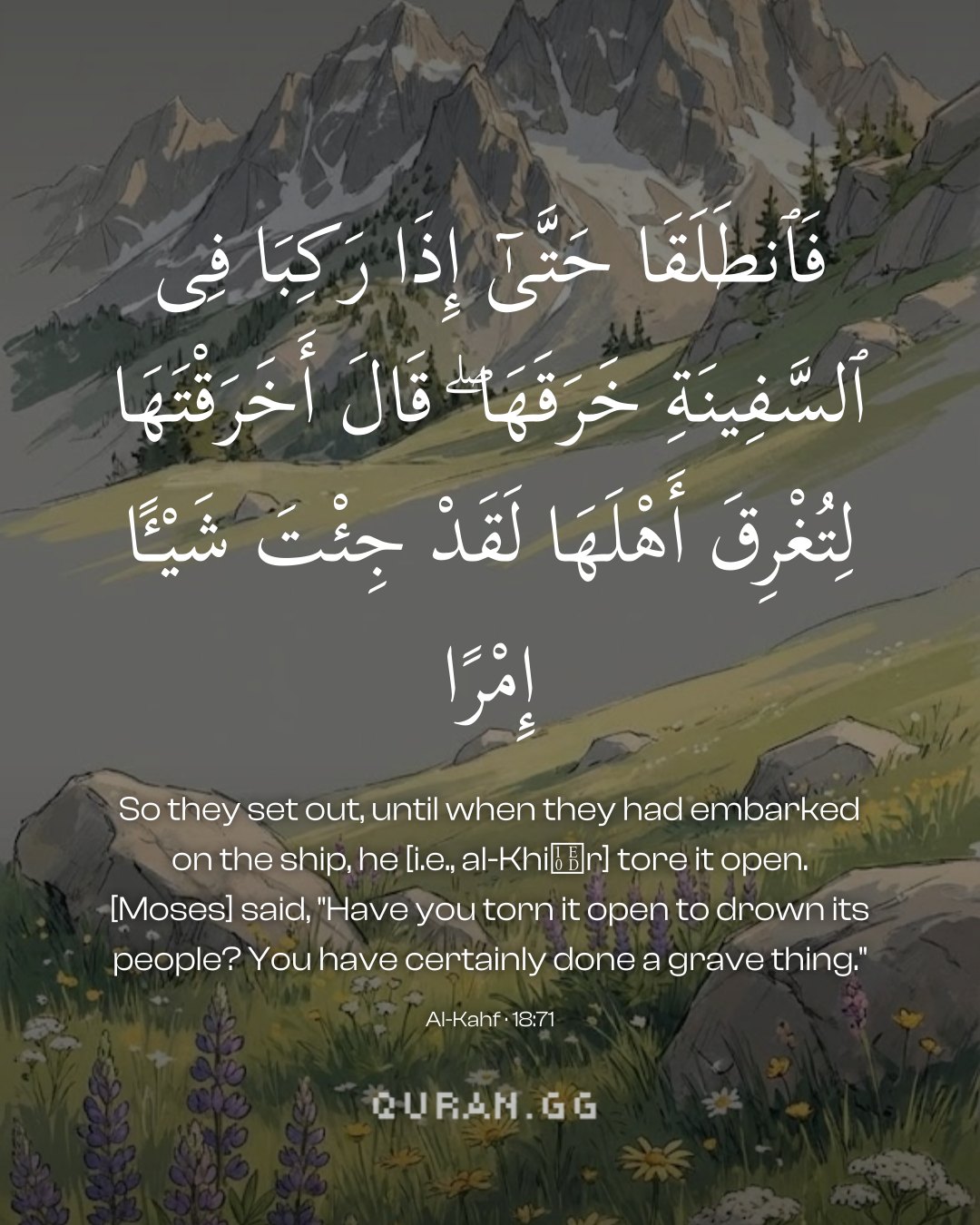
فَٱنطَلَقَا حَتَّىٰٓ إِذَا رَكِبَا فِى ٱلسَّفِينَةِ خَرَقَهَا ۖ قَالَ أَخَرَقْتَهَا لِتُغْرِقَ أَهْلَهَا لَقَدْ جِئْتَ شَيْـًٔا إِمْرًا ٧١

So they set out, until when they had embarked on the ship, he [i.e., al-Khiḍr] tore it open. [Moses] said, "Have you torn it open to drown its people? You have certainly done a grave thing."

Surah Al-Kahf 18:71 in Arabic with its translation: “So they set out, until when they had embarked on the ship, he [i.e., al-Khiḍr] tore it open. [Moses] said,…”

Make something with this ayah

Turn it into a video for Stories, Reels or TikTok, recited by the reciter you pick, or an image on a background you choose. Free, in your browser.

Download this image

Tafsir Ibn Kathir (abridged)

Damaging the Boat

Allah tells us that Musa and his companion Al-Khidr set out having come to an agreement and reached an understanding. Al-Khidr had made the condition that Musa should not ask him about anything he found distasteful until he himself initiated the discussion and offered an explanation. So they went on board the ship, as described in the Hadith quoted above -- the crew recognized Al-Khidr and let them ride on board free of charge, as an honor to Al-Khidr. When the boat took them out to sea and they were far from the shore, Al-Khidr got up and damaged the boat, pulling out one of its planks and then patching it up again. Musa, peace be upon him, could not restrain himself from denouncing him, so he said:

أَخَرَقْتَهَا لِتُغْرِقَ أَهْلَهَا

(Have you damaged it wherein its people will drown) The grammatical structure of the sentence in Arabic implies that this was the consequence, not the purpose, of his action.

لَقَدْ جِئْتَ شَيْئًا إِمْرًا

(Verily, you have committed a thing Imr.) About `Imr', Mujahid said: "An evil thing." Qatadah said, "An astounding thing." At this point, reminding him of the previously-agreed condition, Al-Khidr said:

أَلَمْ أَقُلْ إِنَّكَ لَن تَسْتَطِيعَ مَعِىَ صَبْراً

(Did I not tell you, that you would not be able to have patience with me) meaning, `this thing that I did deliberately is one of the things I told you not to denounce me for, because you do not know the full story, and there is a reason and purpose for it that you do not know about.'

قَالَ

(He said), meaning, Musa said:

لاَ تُؤَاخِذْنِى بِمَا نَسِيتُ وَلاَ تُرْهِقْنِى مِنْ أَمْرِى عُسْراً

(Call me not to account for what I forgot, and be not hard upon me for my affair (with you).) meaning, `do not be harsh with me.' Hence it says in the Hadith quoted above from the Messenger of Allah ﷺ:

«كَانَتِ الْأُولَى مِنْ مُوسَى نِسْيَانًا»

(In the first instance, Musa asked Al-Khidr because he had forgotten his promise.)

Ma'arif al-Qur'an

Commentary

It was said in verse 71: أَخَرَ‌قْتَهَا لِتُغْرِ‌قَ أَهْلَهَا (Did you break it that you drown its people?). About it, it appears in the Hadith of the Sahihs of al-Bukhari and Muslim that al-Khadir (علیہ السلام) had dislodged a plank of the

boat with an axe because of which there was a danger that water would fill up the boat and it would capsize. Therefore, Sayyidna Musa (علیہ السلام) had objected to it. But, according to historical reports, water did not fill into this boat. This may have happened either because al-Khadir had somehow repaired it himself soon after - as in a report carried by al-Baghawi according to which al-Khadir (علیہ السلام) had replaced the plank with glass. Or, water just did not enter the boat in the manner of a miracle. However, the context of the Qur’ an by itself is telling us that the boat did not capsize - something which supports these reports.

Tazkirul Quran

Moses was told about a further sign, i.e. that when he reached the required destination, the fish kept for eating would go down into the water in a peculiar manner. And at a certain place this was exactly what happened. But the fish was with the disciple and he could not for some reason inform Moses about this incident. After proceeding a little further, Moses came to know of this incident. He immediately returned to that place and found Khidr there, the person for whom he had undertaken such a long journey. God had bestowed on this servant, Khidr, special knowledge and powers, so that he could bring certain extraordinary influence to bear upon the affairs of this world. In view of this knowledge, he used to act against the customary norms. That is why, on Moses request to be allowed to accompany him, he said that he Moses would not be able to bear it.

Uthmani text of the Madinah mushaf (King Fahd Complex). Translation: Saheeh International. Tafsir via Quran.com.