The Story of Dhul-Qarnayn Allah says to His Prophet ,
وَيَسْـَلُونَكَ
(And they ask you) O Muhammad ,
عَن ذِى الْقَرْنَيْنِ
(about Dhul-Qarnayn.) i.e., about his story. We have already mentioned how the disbelievers of Makkah sent word to the People of the Book and asked them for some information with which they could test the Prophet . They (the People of the Book) said, `Ask him about a man who traveled extensively throughout the earth, and about some young men who nobody knows what they did, and about the Ruh (the soul),' then Surat Al-Kahf was revealed. Dhul-Qarnayn had great Power
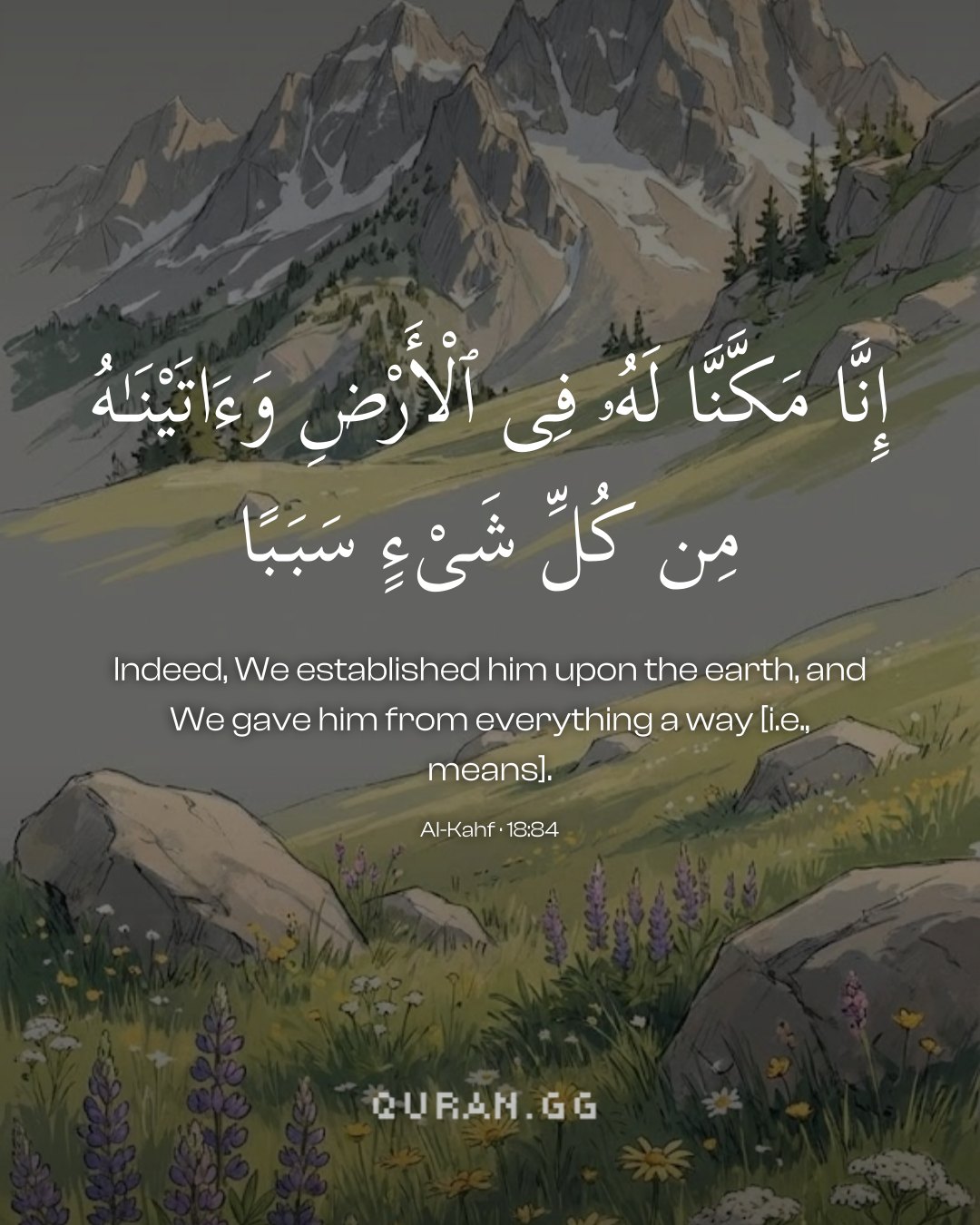
إِنَّا مَكَّنَّا لَهُ فِى الاٌّرْضِ
(Verily, We established him in the earth,) means, `We have given him great power, so that he had all that kings could have of might, armies, war equipment and siege machinery.' So he had dominion over the east and the west, all countries and their kings submitted to him, and all the nations, Arab and non-Arab, served him. Some of them said he was called Dhul-Qarnayn (the one with two horns) because he reached the two "Horns" of the sun, east and west, where it rises and where it sets.
Continue reading the tafsir of ayahs 83–84Ma'arif al-Qur'an
Mufti Muhammad Shafi
The word: سَبَب (sabab) used in: وَآتَيْنَاهُ مِن كُلِّ شَيْءٍ سَبَبًا (and provided for him a way to everything - 84) is employed in the Arabic lexicon to denote everything harnessed to achieve an objective. It includes material instruments and resources as well as knowledge, insight and experience etc. (al-Bahr al-Muhit). As for the expression: مِن كُلِّ شَيْءٍ (to everything), it means all things needed by a ruler to run the state system. The sense of the verse is that Allah Ta` ala had provided for the righteous king Dhul-Qarnain practically everything needed at that time in order that he could maintain his just rule, establish universal peace and extend his area of influence to other countries.
The literal meaning of ‘Dhu’l Qarnayn’ is ‘possessor of two horns’ i.e. the king whose conquests encompass the further reaches of the world to the east and west. Here, Dhu’l Qarnayn is perhaps a reference to the ancient Iranian King Cyrus, or Khusro, who reigned during the 5th century B.C. He had conquered a major part of the known world of ancient times and was at last killed in a war. He was a just king.
Uthmani text of the Madinah mushaf (King Fahd Complex). Translation: Saheeh International. Tafsir via Quran.com.