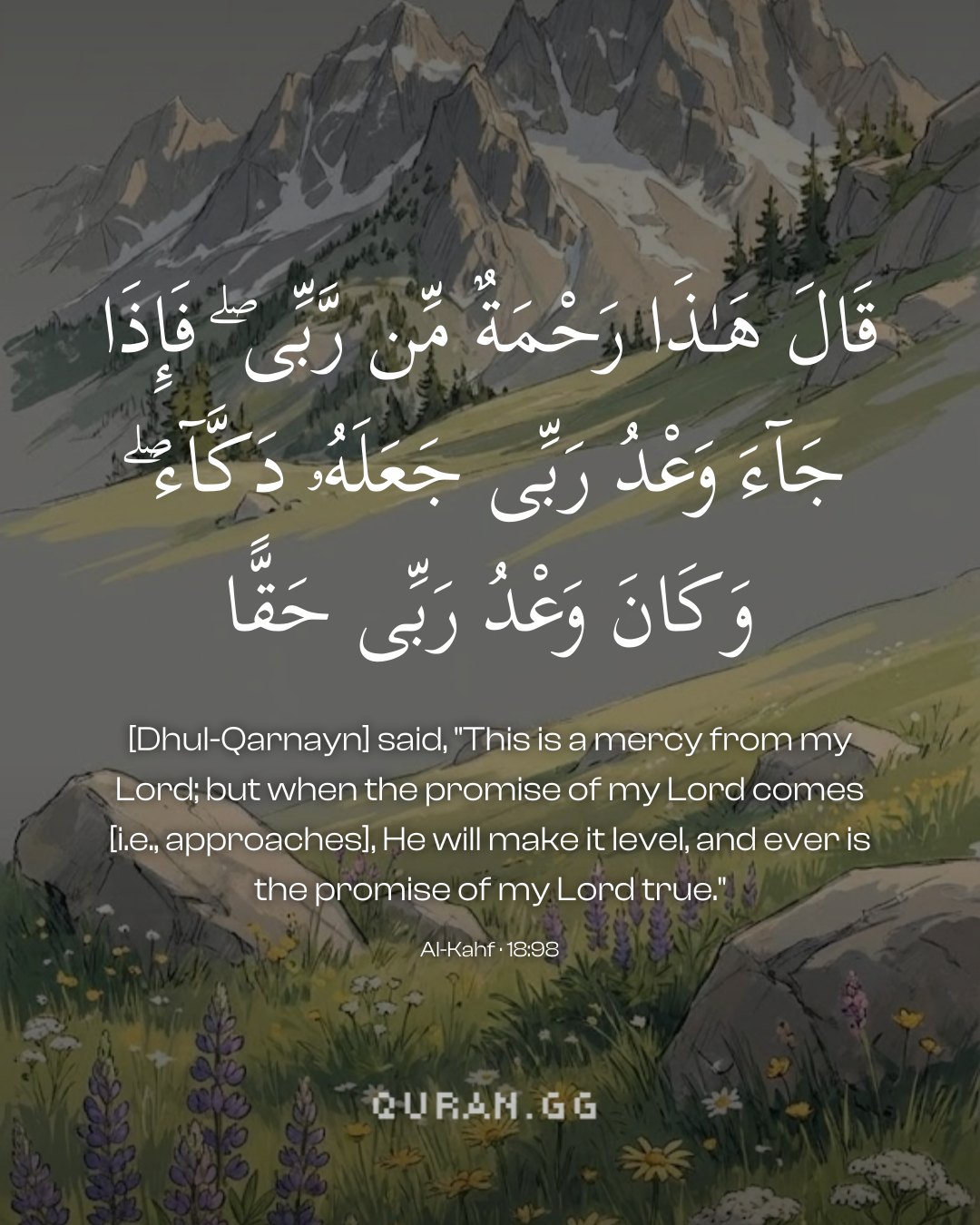
[Dhul-Qarnayn] said, "This is a mercy from my Lord; but when the promise of my Lord comes [i.e., approaches], He will make it level, and ever is the promise of my Lord true."
The Barrier restrains Them, but It will be breached when the Hour draws nigh
Allah tells us that Ya'juj and Ma'juj could not climb over the barrier or penetrate its lower portion. Varying forms of the verb are used here in the Arabic text to reflect the difficulty of the action referred to.
(So they (Ya'juj and Ma'juj) could not scale it or dig through it.) This indicates that they could not penetrate it or dig through it. Imam Ahmad recorded that Zaynab bint Jahsh, the wife of the Prophet said, "The Prophet woke from sleep, and he was red in the face. He said,
The Identity of Ya'juj Ma'juj and the Location of the Wall of Dhul-Qarnain
A lot of absurd and strange things disseminated through Isra'ili narratives and historical stories have found currency to the extent that some commentators have also reported them in terms of their historical status, though they themselves do not find them trustworthy. The truth of the matter is that the Qur'an has mentioned it briefly and the Holy Prophet ﷺ has informed his community also about the details as and where necessary. What has to be believed in as part of one's faith is limited to what has been covered in the Qur’ an, and Hadith. Beyond that, whatever historical and geographical information has been provided by commentators, Hadith experts and historians could be correct, or might as well prove incorrect. As for the variant sayings of historians from among those mentioned above, they are based on traces, analogies and conjectures. Whether they are true or false, it simply does not affect what the Qur'an says.
The high ranges of the Caucasus in what is now Russian territory running between the Caspian Sea and the Black Sea, serve as a natural dividing wall between Europe and Asia. In this mountainous region there were certain passes through which the savage Gog and Magog (Yajuj and Majuj) tribes from the south used to enter the northern part of Iran and plunder it. Here, till today, there are signs of an ancient wall. There is every probability that this was the very wall which was constructed by Dhu’l-Qarnayn for security purposes. To erect an ‘Iron Wall’ to ward off enemies is a feat which generally generates a sense of pride in people. But even after constructing such an invincible wall, Dhu’l- Qarnayn did not lose his modesty and humility. He had set his eyes not on his own creations but on God’s mighty powers, and a human being’s power is nothing as compared to God’s might.
Uthmani text of the Madinah mushaf (King Fahd Complex). Translation: Saheeh International. Tafsir via Quran.com.