قُلْ
(Say,) O Muhammad ,
لاَّ يَسْتَوِى الْخَبِيثُ وَالطَّيِّبُ وَلَوْ أَعْجَبَكَ
(Not equal are the bad things and the good things, even though they may please you) O human,
كَثْرَةُ الْخَبِيثِ
(the abundance of bad.) This Ayah means, the little permissible is better than the abundant evil.
فَاتَّقُواْ اللَّهَ يأُوْلِى الأَلْبَـبِ
(have Taqwa of Allah, O men of understanding...) who have sound minds, avoid and abandon the impermissible, and let the permissible be sufficient for you,
لَعَلَّكُمْ تُفْلِحُونَ
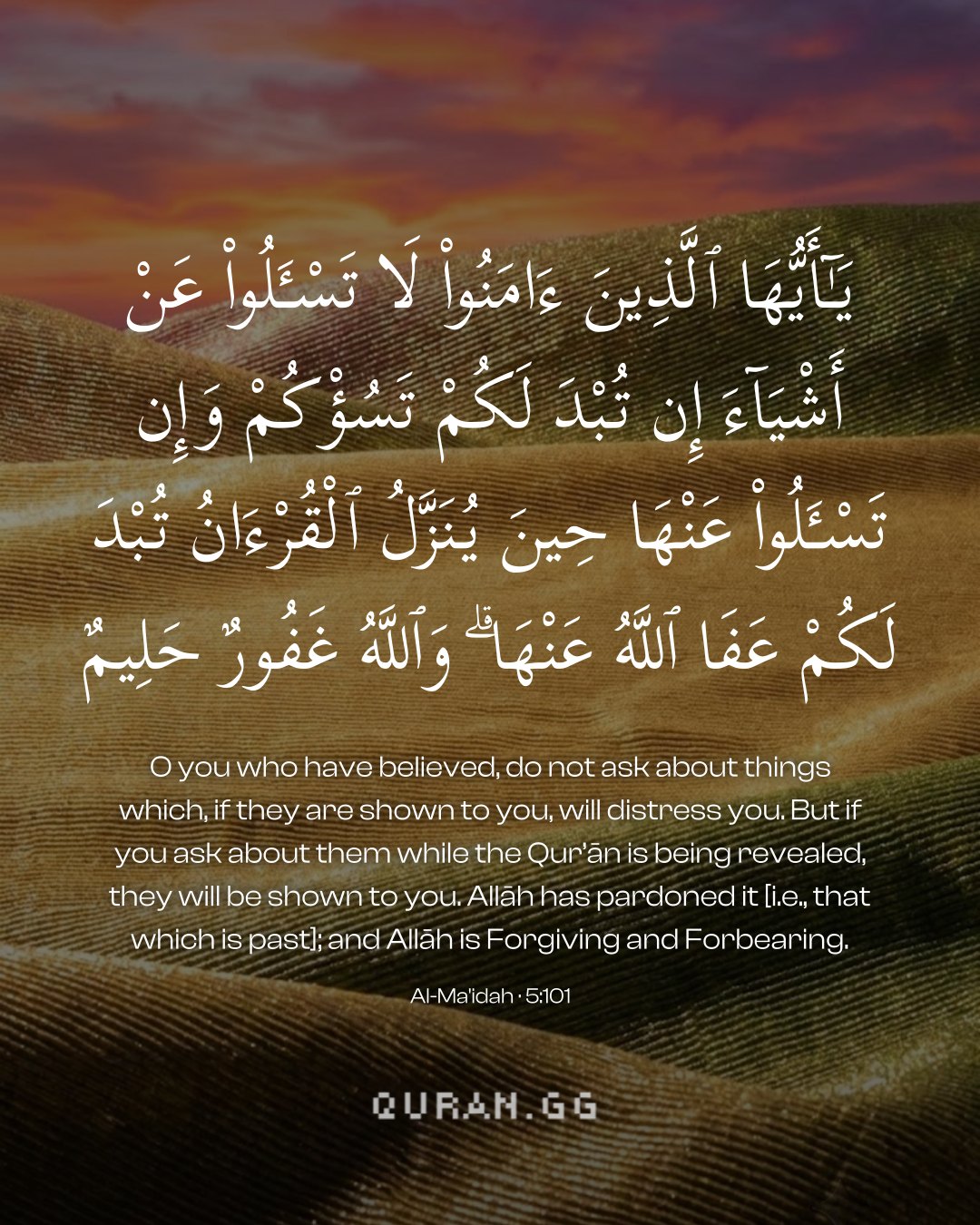
(in order that you may be successful.) in this life and the Hereafter. " So have Taqwa of Allah, O men of understanding in order that you may be successful.) (101. O you who believe! Ask not about things which, if made plain to you, may cause you trouble. But if you ask about them while the Qur'an is being revealed, they will be made plain to you. Allah has forgiven that, and Allah is Oft-Forgiving, Most Forbearing.) (102. Before you, a community asked such questions, then on that account they became disbelievers.) Allah says to His Messenger ,
Continue reading the tafsir of ayahs 100–102 Commentary
The Prohibition of Asking Unnecessary Questions
These verses warn people who keep investigating unnecessarily into Divine injunctions. So fond and bent are they in this exercise that they would go to the outer limit of asking questions even about in-junctions which have not been prescribed at all and for which there is really no genuine need that they be asked. In this verse, such people have been instructed not to ask questions lest they are subjected to some trial, or they have to face disgrace as a result of the disclosure of their secrets.
The Background of the Revelation
As narrated in Sahib Muslim, the background or the cause of the revelation of these verses is as follows. When the verse concerning the obligation of Hajj was revealed, Sayyidna Al-Aqra` ibn Habis ؓ asked: ` Have we been obligated with Hajj every year?' The Holy Prophet ﷺ did not answer that question. He asked again. The Holy Prophet still remained silent. When he asked a third time, the Holy Prophet ﷺ reprimanded him by saying: If, in answer to your question, I had said, ` Yes, the Hajj is obligatory every year' - so it would have become, and you would have been unable to do it. After that, he added: Things about which I give you no command, leave them as they are. Do not ask questions by digging and prying into them. Communities before you have been damned eternally through this very proliferation of questioning because they, questions after questions about what Allah and His Messenger did not make obligatory on them, and in consequence of their unnecessary enquiry, these optional things were made obligatory - and then, they got involved in the unfortunate practice of disobeying these. Your estab-lished routine should be: Do what I order you to do, with the best of your ability, and leave what I order you not to do (that is, do not dig and pry into things about which no injunctions are given).
There is No Nubuwwah (Prophethood) and Wahy (Revelation) after the Holy Prophet ﷺ
It has also been tacitly said in this verse: وَإِن تَسْأَلُوا عَنْهَا حِينَ يُنَزَّلُ الْقُرْآنُ تُبْدَ لَكُمْ : ` and if you ask about them while the Qur'an is being revealed, they will be disclosed to you (through revelation).' Here, by restricting it with the time duration of the revelation of the Qur'an, the indication given is that it will be after the completion of the revelation of the Qur'an, that the process of Prophethood (Nubuwwah) and Revelation (Wahy) will be discontinued.
Though, after the discontinuation of this process of Prophethood and Revelation, the consequences that new injunctions may come, things not obligatory may become obligatory or someone's secret may be disclosed through revelation are not likely to take effect - but, minting unnecessary questions, falling for investigations into them or asking about things for which there is no need, shall still remain prohibited, even after the discontinuation of the process of Prophethood. The reason is simple. This is a waste of time - your own and that of others. The Holy Prophet ﷺ has said:
مِن حُسنِ اِسلامِ المرَءِ تَرکُہ مَالَایَعنِیہِ
One of the qualities making someone a good Muslim is that one leaves what is unnecessary.
This tells us that many of our brother Muslims who keep investigating into unnecessary subjects, such as, the name of the mother of Sayyidna Musa (علیہ السلام) or the precise length and breadth of the Ark of Sayyidna Nuh (علیہ السلام) ، indulge in what has no effect on one's conduct in life. Therefore, asking such questions is blameworthy - especially when it is already known that people who tend to ask such questions are mostly unaware of the basics of their religion. The problem is that falling for what is wasteful invariably results in making one stay deprived of doing what is necessary. As for the large body of work left by Muslim jurists in which they have answered assumed religious problems and questions, it was not something unnecessary. Later events proved that they were needed by future generations. Therefore, they do not fall under the purview of wasteful or meaningless questions. It is also a part of Islamic teachings that one should not indulge in any activity, whether intellectual or practical, a task or a conversation, and waste precious time through it, unless there is some gain to be made from it in terms of the worldly or other-wordly life.
The Ka‘bah is the eternal centre for Islam and the Islamic community. By declaring it essential to turn towards the Ka‘bah to say one’s prayers (salat,), God has linked each and every Muslim with the centrality of the Ka‘bah. Then by means of Hajj (pilgrimage) it has been made the international meeting place of Islam. The symbolic rites to be performed in connection with the pilgrimage to the Ka‘bah are of great importance, not because of any inherent holiness in them, but because they are the signs of the trial of man. When a subject of God carries out His commandments on these symbolic rites, he reminds himself that though God is not apparently visible, He is actively present—He gives commands; He keeps a watch on His subjects; He is aware of all our actions. These thoughts develop fear of God in man and make him able to remain a true subject of God throughout the vicissitudes of his life. It is a human weakness to give the utmost importance to the drawing of crowds, and to accumulating an abundance of showy worldly goods, etc. In the eyes of God, however, importance attaches only to quality. Quantity has no value for Him. Those who rush towards ‘abundance’ and attach no value to truth think they are very clever, but in reality they are unwise. One who orders his life in fear of God and not on account of material considerations or worldly cares, is the one who is truly successful.
Uthmani text of the Madinah mushaf (King Fahd Complex). Translation: Saheeh International. Tafsir via Quran.com.