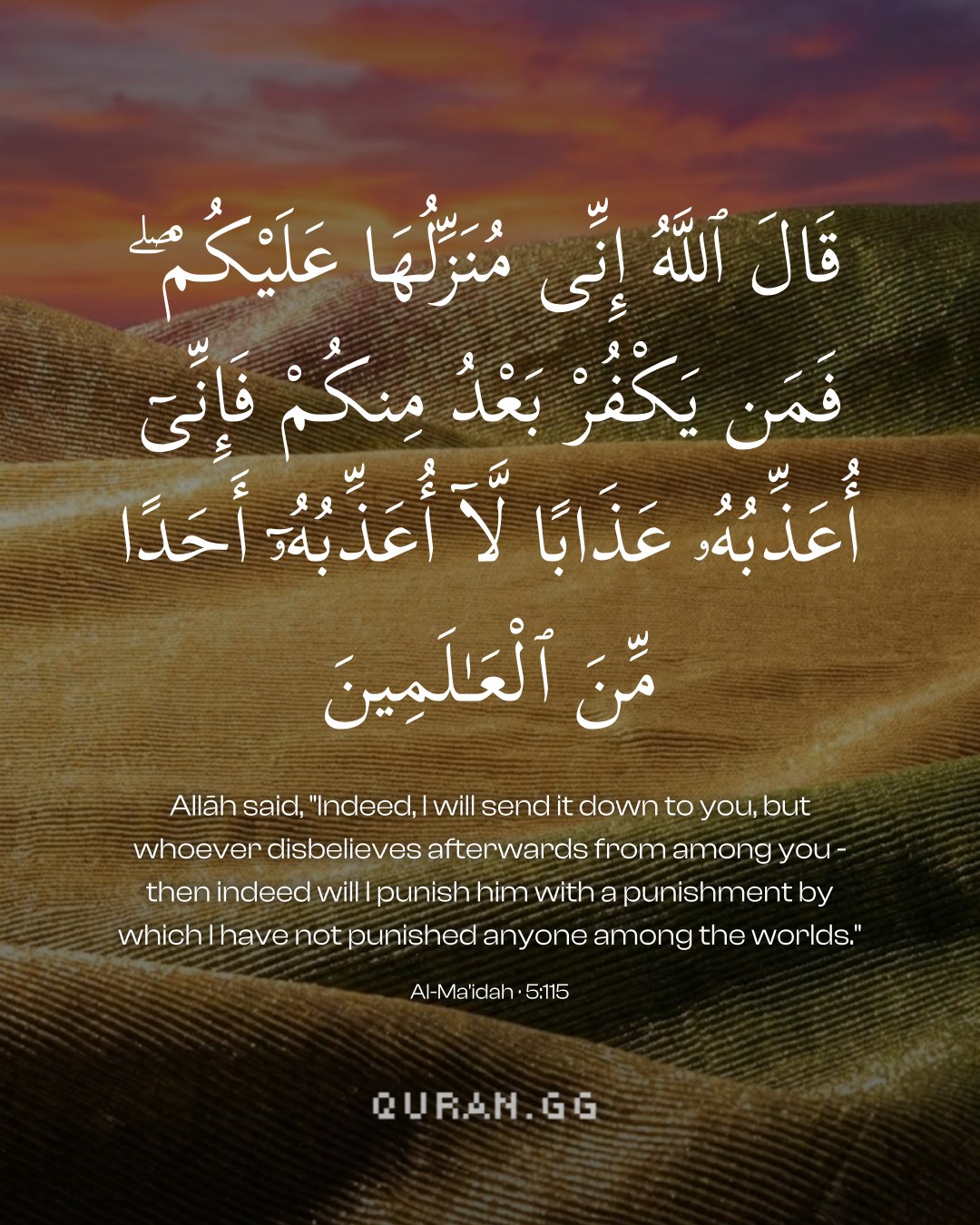
Allāh said, "Indeed, I will send it down to you, but whoever disbelieves afterwards from among you - then indeed will I punish him with a punishment by which I have not punished anyone among the worlds."
This is the story of the Ma'idah, the name of which this Surah bears, Surat Al-Ma'idah. This is also among the favors that Allah granted His servant and Messenger, `Isa, accepting his request to send the Ma'idah down, and doing so as clear proof and unequivocal evidence. Allah said,
إِذْ قَالَ الْحَوَارِيُّونَ
((Remember) when Al-Hawaryun said...) the disciples of `Isa said,
(O `Isa, son of Maryam! Can your Lord send down to us a Ma'idah from heaven) The Ma'idah is the table that has food on it. Some scholars said that the disciples requested this table because they were poor and deprived. So they asked `Isa to supplicate to Allah to send a table of food down to them that they could eat from every day and thus be more able to perform the acts of worship.
When the disciples of Sayyidna ` Isa (علیہ السلام) asked him to make ` Ma'idah' (food-spread) come down from the heavens, he replied by saying: قَالَ اتَّقُوا اللَّـهَ إِن كُنتُم مُّؤْمِنِين (Fear Allah if you are believers). This tells us that it does not behove a faith-bearing servant of Allah that he should test Him by making such requests. Rather than demand what is supernatural, he should seek things, like sustenance, through sources naturally appointed for him.
The Better the Blessing, the Worse the Curse of Ingratitude
From the words of the verse 115: فَإِنِّي أُعَذِّبُهُ عَذَابًا لَّا أُعَذِّبُهُ أَحَدًا مِّنَ الْعَالَمِينَ (I shall give him a punishment I shall not give to anyone in the worlds), we learn that in situations when the blessing of Allah is extra-ordinary and unique, the emphasis on the gratitude for it should be far above the ordinary.' As for the punishment of ingratitude, that too will be extra-ordinary and unique.
The fact is that crops flourishing in the fields, or the emergence of a tree, stout and green, from beneath the earth are all as miraculous events as the descent to us of a platter containing food from the midst of the clouds. But the miraculous nature of these events is not apparent to us because they appear from behind a veil. It is the test of man that he should be able to see the reality by tearing down that veil. He should be able to look upon the basic elements of foodstuffs emerging from the earth as if they were descending from heaven. If a person insists that he will accept the Divine Truth only on ‘seeing’ it, then he is saying, as it were, that he will receive God’s grace without undergoing His trial, and that is not possible according to the way of God.
Uthmani text of the Madinah mushaf (King Fahd Complex). Translation: Saheeh International. Tafsir via Quran.com.