`Isa Rejects Shirk and Affirms Tawhid
Allah will also speak to His servant and Messenger, `Isa son of Maryam, peace be upon him, saying to him on the Day of Resurrection in the presence of those who worshipped `Isa and his mother as gods besides Allah,
يعِيسَى ابْنَ مَرْيَمَ أَءَنتَ قُلتَ لِلنَّاسِ اتَّخِذُونِى وَأُمِّىَ إِلَـهَيْنِ مِن دُونِ اللَّهِ
(O `Isa, son of Maryam! Did you say unto men: `Worship me and my mother as two gods besides Allah') This is a threat and a warning to Christians, chastising them in public, as Qatadah and others said, and Qatadah mentioned this Ayah as evidence,
هَـذَا يَوْمُ يَنفَعُ الصَّـدِقِينَ صِدْقُهُمْ
Continue reading the tafsir of ayahs 116–118Ma'arif al-Qur'an
Mufti Muhammad Shafi
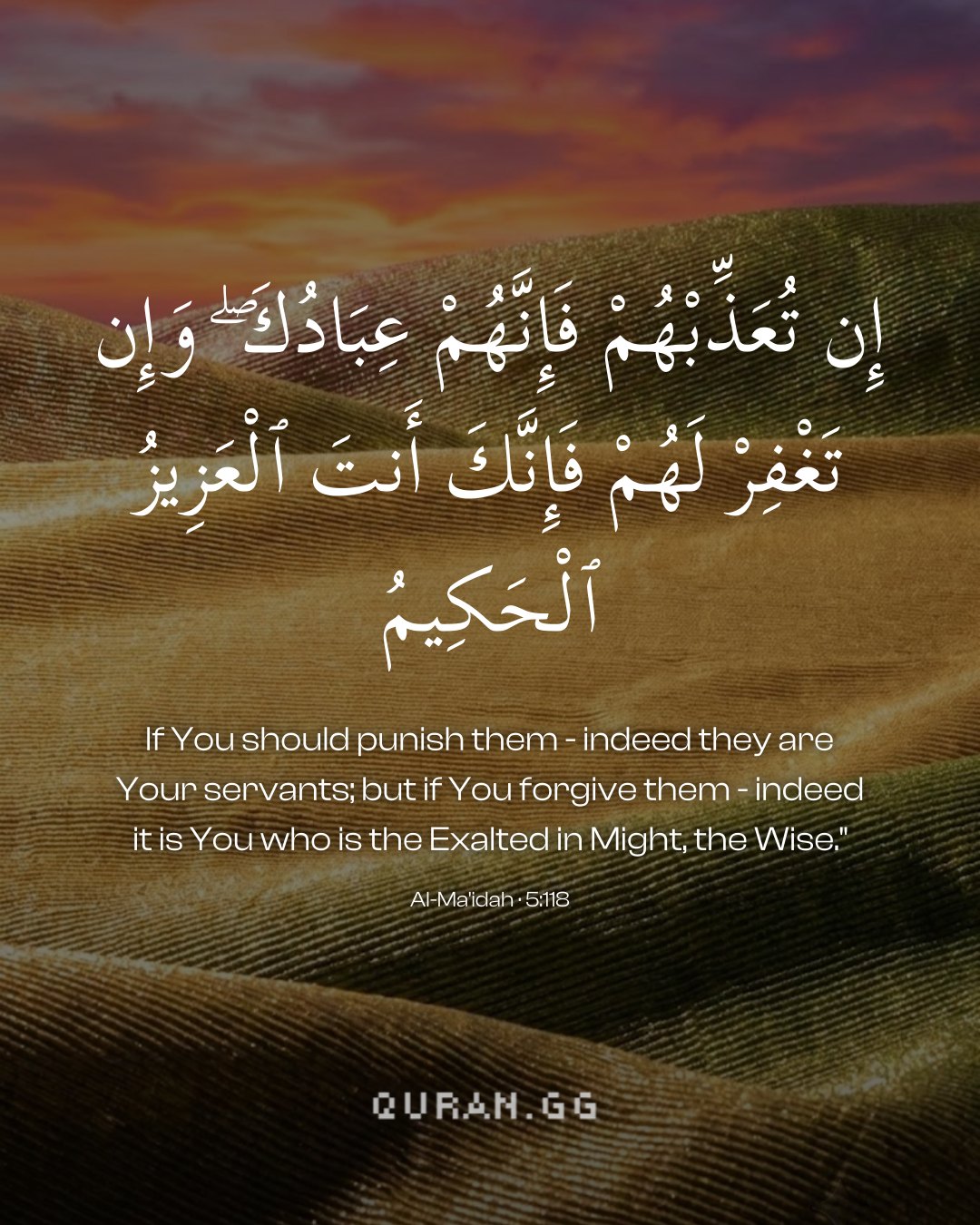
1. As for the statement beginning with the words: إِن تُعَذِّبْهُمْ فَإِنَّهُمْ عِبَادُكَ (If You punish them, they are Your slaves ... ) appearing in the last verse (118), it means that Allah does not bring undue hardship on His servants, therefore, if punishment does come to them, it will only be just, right and wise. And should He forgive them, then, this forgiveness too will not be a matter of not being able to do otherwise - because He is Mighty, fully-capable and overpowering, from whose reach and control no wrong-doer can escape. And since He is Wise too, therefore, it is also not possible that He would let a wrong-doer walk away just for no reason. Thus, the Divine verdict in the case of wrong-doers will be absolutely wise and masterly. Since this saying of Sayyidna ` Isa (علیہ السلام) will take place in the Mahshar (the day of Resurrection) - where no intercession on behalf of the disbelievers, or appeal of mercy for them, will be entertained - therefore, Sayyidna ` Isa (علیہ السلام) has not referred to the Divine attributes of Ghafurur-Rahim (the Most-Forgiving, the Very-Merciful) in place of "Al-` Aziz Al-Hakim" (the Mighty, the Wise) of the text. This stands in contrast with what Sayyidna Ibrahim (علیہ السلام) had said to his Lord during his life in this world: رَبِّ إِنَّهُنَّ أَضْلَلْنَ كَثِيرًا مِّنَ النَّاسِ ۖ فَمَن تَبِعَنِي فَإِنَّهُ مِنِّي ۖ وَمَنْ عَصَانِي فَإِنَّكَ غَفُورٌ رَّحِيمٌ ﴿36﴾ (That is, 0 my Lord, these [ idols ] have made many of the people go astray. Henceforth, whoever has followed me is one of mine. And whoever has disobeyed me, so then, You are the Most-Forgiving, the Very-Merciful - 14:36). It means that the likelihood still exists that Allah may, in His mercy, give them the Taufiq later on to repent and return to the path of truth and thereby forgive their sins. (Shabbir Ahmad Usmani - Notes)
Ibn Kathir reports a narration from Sayyidna Abu Dharr ؓ that once the Holy Prophet ﷺ spent a whole night reciting one single verse. And that verse was: إِن تُعَذِّبْهُمْ فَإِنَّهُمْ عِبَادُكَ (If You punish them, then, they are Your slaves - 118). When morning came, I said: Ya Rasul Allah, you kept reciting just this verse. You made your Ruku` with it and you made your Sujud with it, right upto this break of dawn. He said: I prayed to my Rabb to bless me with the station of intercession (Shafa’ ah), which He granted. Inshallah, it is going to be for one who has never associated anyone with Allah Ta` ala.
According to another narration, after reciting the verse cited above, he raised his hands facing the heaven and said: اَللَّھُمَّ اُمَّتِی (Allahumma Ummati that is, ` 0 Allah, mercy - mercy on my people.' And then he wept. Thereupon, Allah Ta` ala sent angel Jibra'il (علیہ السلام) to ask why would he weep. He told the angel what he had said. Then, Allah Ta` ala asked angel Jibra'il to go back and tell Muhammad that He will please him soon in his concern for his people and will not let him be unhappy.
When the Day of Judgement arrives, man will come to know without being told what is right and what is wrong. People will witness with their own eyes that all powers are with the one and only God. He has no partner in being our Creator and Lord. No one but Him has any powers and there is no one except Him who deserves to be worshipped and obeyed. Under these circumstances, when God asks His prophets with what message they were sent to the world, then it will amount to asking about something which would have already become known to the people. The answer to this question will be so clear at that time that, without anybody’s saying anything, the whole atmosphere of the Judgement Day will have been shouting it out. This question and answer will serve only to increase the abasement of the people being judged by God. It will be for the purpose of clarifying in the presence of the prophets that the religion concocted by them in the name of prophets was not at all connected with their teachings.
Uthmani text of the Madinah mushaf (King Fahd Complex). Translation: Saheeh International. Tafsir via Quran.com.