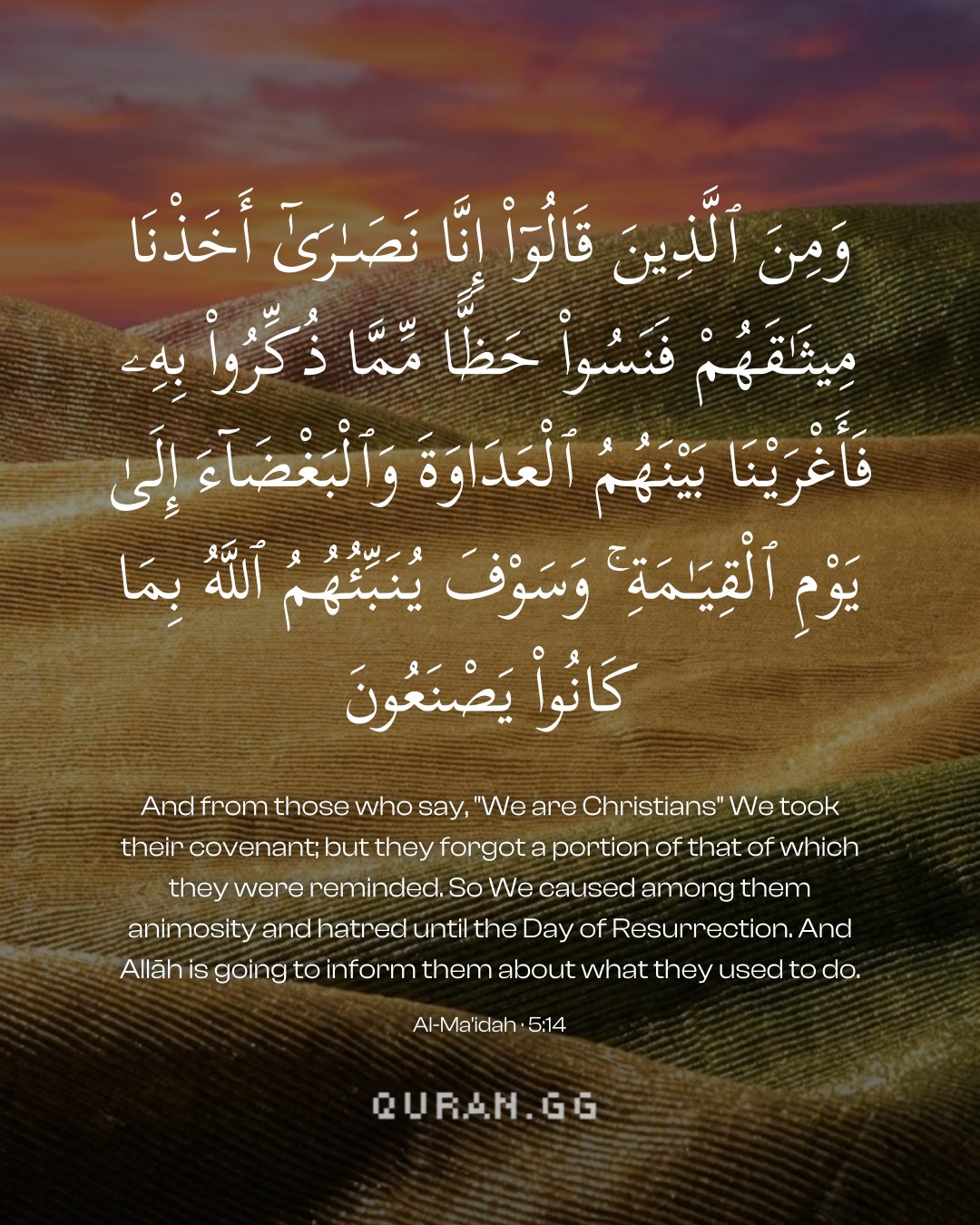
And from those who say, "We are Christians" We took their covenant; but they forgot a portion of that of which they were reminded. So We caused among them animosity and hatred until the Day of Resurrection. And Allāh is going to inform them about what they used to do.
Cursing the People of the Book for Breaking the Covenant
Allah commanded His believing servants to fullfil the promises and pledges that He took from them and which they gave His servant and Messenger, Muhammad ﷺ. Allah also commanded them to stand for the truth and give correct testimony. He also reminded them of the obvious and subtle favors of the truth and guidance that He granted them. Next, Allah informed them of the pledges and promises that He took from the People of the Book, who were before them, the Jews and Christians. When they broke these promises and covenants, Allah cursed them as a consequence and expelled them from His grace and mercy. He also sealed their hearts from receiving guidance and the religion of truth, beneficial knowledge and righteous actions. Allah said,
From the first verse, 5:13, which dealt with the breach of trust by Jews and their punishment for it, we now move to the next verse, 5:14, which refers to Christians: وَمِنَ الَّذِينَ قَالُوا إِنَّا نَصَارَىٰ. In this verse, the punishment described for Christians is mutual dissension. Being for their breach of trust, this wi11 continue right upto the Last Day.
Looking at the contemporary scene, one may have doubts about Christians who seem to be united. The answer is that the present statement covers genuine Christians, observing and abiding. As for those who have moved away from their own religion turning into non-conformist, secular or atheistic individuals or groups, they are, for all practical purposes, out of the list of Christians - even though, they may count them as Christians among the nationalities of a country. If, among such people, that religious dissension and mutual hostility does not exist, it would not be contrary to this verse - because the conflict was based on religion, once the religion is not there, conflict too would not be there. As said earlier, this verse describes people who profess and practice the religion of Christianity - and their division is well-known.
Given below is a brief reference from Taysir in the marginal notes of commentator, al-Baydawi which reports that there were three sects among Christians originally:
1. Fisturyah (Nestorians) who took Sayyidna ` Isa (علیہ السلام) (Jesus) as the son of God.
2. Ya'qubiyah (Jacobites) who believed in Sayyidna ` Isa (علیہ السلام) (Jesus) himself as one with God.
3. Malka'iyah (Malkites) who believed in Sayyidna ` Isa (علیہ السلام) (Jesus) as one of the Trinity.
And it goes without saying that in the presence of such major divisions in matters of belief, mutual malice is inevitable.
Tazkirul Quran
Maulana Wahiduddin Khan
When The People of the Book (i.e. those communities blessed with Divine Scriptures) go astray, they disregard the clear-cut, eternal parts of the Scriptures and hasten to embrace those parts which are of purely local or topical interest. This leads to conflict and results in degradation in the Hereafter. Whenever such groups leave the right path, infirmities become apparent. They start adopting a religion of their own imagining, casting aside their time-honoured authentic religion. Dissatisfied with the clear commandments given by God and His prophets on religious laws, spirituality and politics, they delve into them to find new points of contention. This opens up the door to differences and sectarianism. Sometimes, to justify worldly desires, sometimes to perfect the ‘imperfect’ religion of God, sometimes just to move with the times, dissatisfied elements introduce new elements into religion which are not really part of it. In this way, different new editions of religion take shape—some spiritual, some political, and so on. Around each one of them, like-minded persons start gathering and finally they form a sect. Succeeding generations start protecting this new version, treating it as if it were the heritage of their forefathers. A stage comes when it will clearly be perpetuated until Doomsday, because man tends to treat the past as sacred, and once something is sanctified by time and tradition, it takes on an aura of being eternal. Sectarianism in the name of religion on the one hand becomes sacred and eternal and on the other comes to be regarded as God’s command and gives licence for harbouring hatred and indulging in violence against others.
Uthmani text of the Madinah mushaf (King Fahd Complex). Translation: Saheeh International. Tafsir via Quran.com.