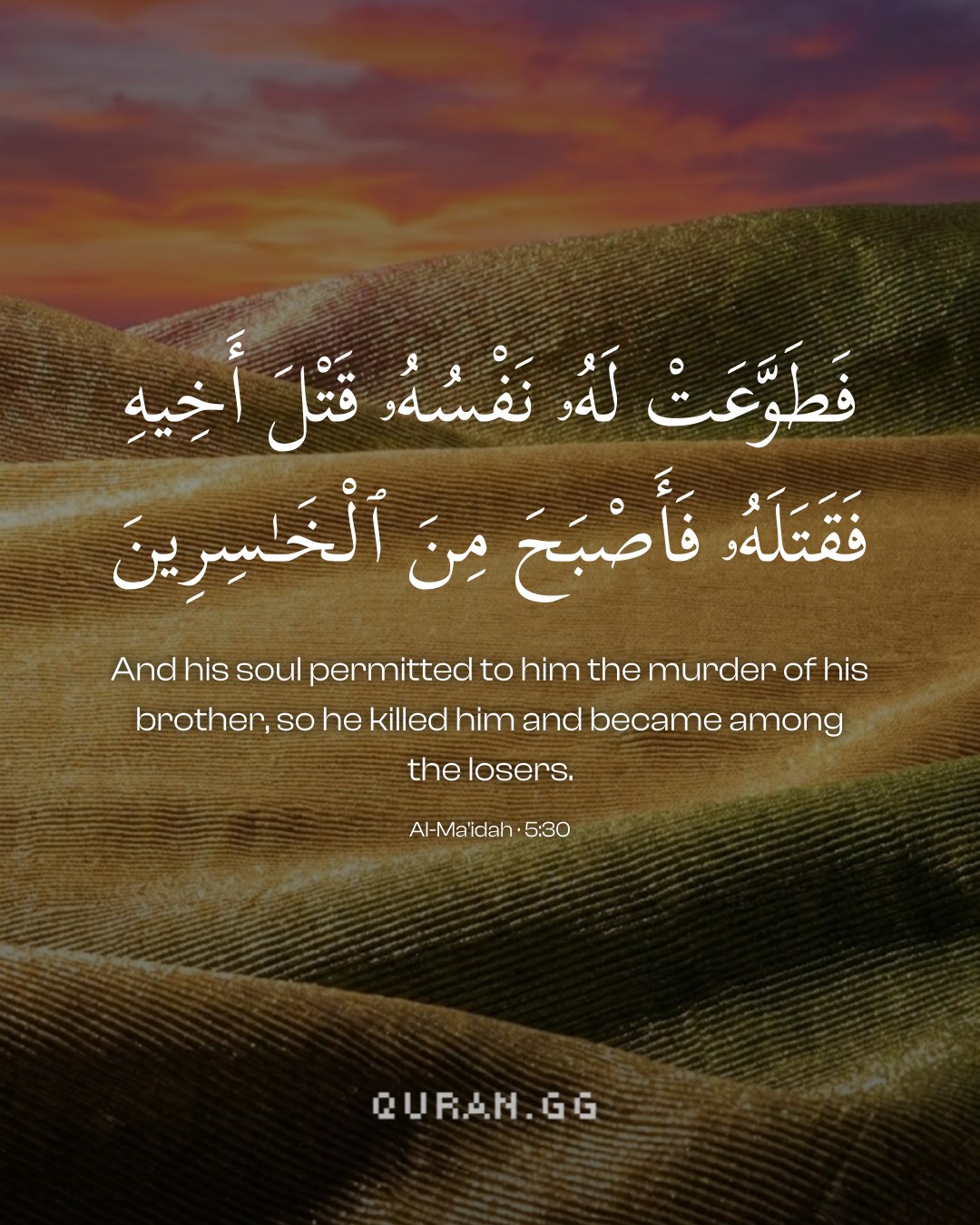
Allah describes the evil end and consequence of transgression, envy and injustice in the story of the two sons of Adam, Habil and Qabil. One of them fought against the other and killed him out of envy and transgression, because of the bounty that Allah gave his brother and because the sacrifice that he sincerely offered to Allah was accepted. The murdered brother earned forgiveness for his sins and was admitted into Paradise, while the murderer failed and earned a losing deal in both the lives. Allah said,
(And recite to them the story of the two sons of Adam in truth;) meaning, tell these envious, unjust people, the brothers of swine and apes from the Jews and their likes among mankind, the story of the two sons of Adam, Habil and Qabil, as many scholars among the Salaf and later generations said. Allah's statement,
In these verses, Allah Ta` a1a has instructed the Holy Prophet ﷺ that he should relate the story of the two sons of Adam truthfully to the people of the Book, or to the whole Ummah.
People who are blessed with insight into the Holy Qur'an know that it is no book of folklore, fiction or history where the purpose is to relate an event from the beginning to the end. But, events of the past and accounts of earlier peoples carry many lessons and wise counsels within their fold. That is the real essence of history. Then, in them, there are such conditions and circumstances as form the basis of different religious injunctions. In view of these very beneficial considerations, the Qur'an employs a methodology of its own throughout the text. It would, when the occasion warrants, narrate an event. Most of-ten, it would not narrate the whole event in one sequence and at one place. In fact, preference is given to narrating a particular segment from it which bears some element of purpose and is relevant at the given place.
The real reward for the deeds performed for the sake of God will be given in the Hereafter. However, sometimes even in this world certain occurrences show whether human actions have gained God’s approval. This happened in the case of Adam’s sons, Abel and Cain (Habil and Qabil). Abel’s offerings from his flocks of sheep and goats were accepted by God and he was duly blessed, but Cain’s offerings of his agricultural produce were not, and he remained unblessed. Cain then became so jealous of his younger brother that he threatened to kill him. Abel said that Cain’s offering had been rejected because Cain had no heartfelt fear of God and should, therefore, reform himself instead of threatening him. But, jealousy and enmity blur the truth and one can think only of how to eliminate one’s supposed enemy. Abel told Cain that he might raise his hand to murder him, but that he would not retaliate, because God had prohibited any fighting between one Muslim and another. Even if a Muslim wanted to assassinate his brother, the brother should not consider it legitimate to kill his attacker. This obviated the mutual clash which was otherwise inevitable, as well as the resulting endless chain of action and reaction in Muslim society. If two Muslims are bent on each other’s destruction, the guilt is divided between the two. But if one Muslim carries out his intention, while the other remains immersed in prayer, the attacker will not only shoulder the burden of his own sin, but also that of any sin which his victim might have commmitted had he not remained patient and prayerful.
Uthmani text of the Madinah mushaf (King Fahd Complex). Translation: Saheeh International. Tafsir via Quran.com.