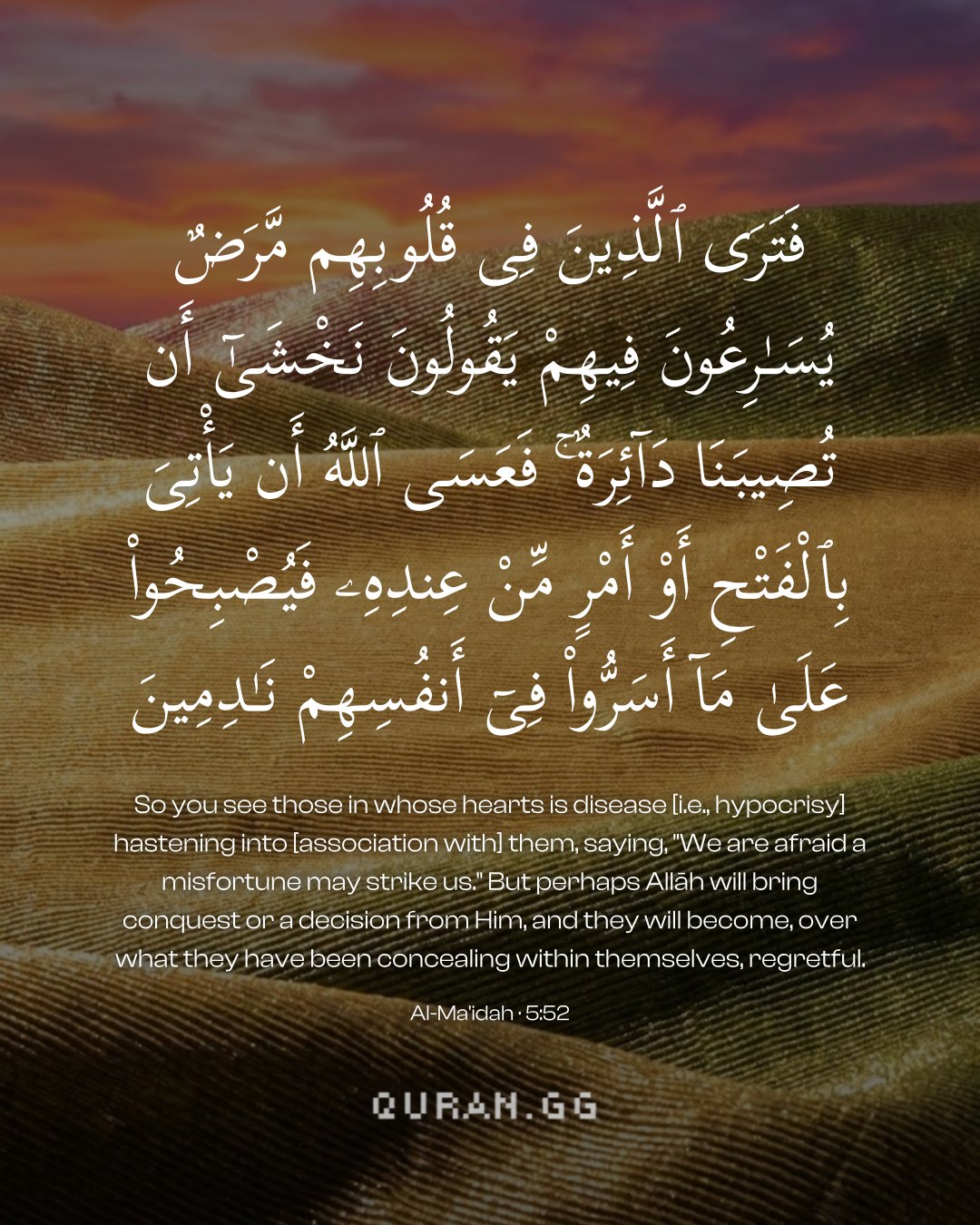
So you see those in whose hearts is disease [i.e., hypocrisy] hastening into [association with] them, saying, "We are afraid a misfortune may strike us." But perhaps Allāh will bring conquest or a decision from Him, and they will become, over what they have been concealing within themselves, regretful.
The Prohibition of Taking the Jews, Christians and Enemies of Islamas Friends
Allah forbids His believing servants from having Jews and Christians as friends, because they are the enemies of Islam and its people, may Allah curse them. Allah then states that they are friends of each other and He gives a warning threat to those who do this,
وَمَن يَتَوَلَّهُمْ مِّنكُمْ فَإِنَّهُ مِنْهُمْ
(And if any among you befriends them, then surely he is one of them.) Ibn Abi Hatim recorded that `Umar ordered Abu Musa Al-Ash`ari to send him on one sheet of balance the count of what he took in and what he spent. Abu Musa then had a Christian scribe, and he was able to comply with `Umar's demand. `Umar liked what he saw and exclaimed, "This scribe is proficient. Would you read in the Masjid a letter that came to us from Ash-Sham" Abu Musa said, `He cannot." `Umar said, "Is he not pure" Abu Musa said, "No, but he is Christian." Abu Musa said, "So `Umar admonished me and poked my thigh (with his finger), saying, `Drive him out (from Al-Madinah).' He then recited,
Now, you see those who have disease in their hearts race to-wards them saying, "We apprehend that some misfortune may overtake us."
It means that after hearing the religiously binding injunction of the abandonment of close friendships, people who have the disease of hypocricy in their hearts started racing towards their disbelieving friends saying that cutting off relationships with these people is dangerous for them.
So, it is likely that Allah may bring victory or a command from His own side, whereupon they become regretful over what they concealed in their hearts.
It means that these people are under the impression that the disbelievers and the Jews will overcome Muslims. But, Allah has decided that it will not happen. Rather, close is the conquest of Makkah. Or, even before the conquest of Makkah, Allah may, by exposing the hypocrisy of the hypocrites, put them to disgrace. Then, at that time, these people will regret thoughts they had concealed.
Tazkirul Quran
Maulana Wahiduddin KhanOn ayahs 51–52
In Arabia, in the early days of Islam, the Jews and Christians held a monopoly of the major economic resources of the country, and made efforts day and night to uproot the Muslims, who were as yet a newly emerging force. The people, deeply impressed by the centuries of history which reinforced the greatness of the Jews and the Christians, saw them as having such power that they could never be overthrown. The weaker members of the Muslim community did not, therefore, want to take part in Islamic efforts in such a way as to displease them, for if this struggle ended in defeat for the Muslims, they would have to face the vengeful retaliation of these powerful enemies. In order to protect themselves from future danger, they lived in a state of dual loyalty, which itself was not without its hazards. They lost sight of the fact that worshipping the Truth solely in unimportant matters would not stand them in good stead if, once faced with danger, they lent their support to upholders of falsehood: their fate would inevitably be no different from the fate of those they had co-operated with whenever they felt imperiled.
Uthmani text of the Madinah mushaf (King Fahd Complex). Translation: Saheeh International. Tafsir via Quran.com.