Threatening to Replace the Believers With Another People if They Revert from Islam
Allah emphasizes His mighty ability and states that whoever reverts from supporting His religion and establishing His Law, then Allah will replace them with whomever is better, mightier and more righteous in Allah's religion and Law. Allah said in other Ayat,
الْفُقَرَآءُ وَإِن تَتَوَلَّوْاْ يَسْتَبْدِلْ قَوْماً غَيْرَكُمْ ثُمَّ لاَ يَكُونُواْ
(And if you turn away, He will exchange you for some other people and they will not be your likes.) and,
أَلَمْ تَرَ أَنَّ اللَّهَ خَلَقَ السَّمَـوَتِ وَالأَرْضَ بِالْحقِّ إِن يَشَأْ يُذْهِبْكُمْ وَيَأْتِ بِخَلْقٍ جَدِيدٍ - وَمَا ذَلِكَ عَلَى اللَّهِ بِعَزِيزٍ
Continue reading the tafsir of ayahs 54–56Ma'arif al-Qur'an
Mufti Muhammad Shafi
Marks of True Muslims
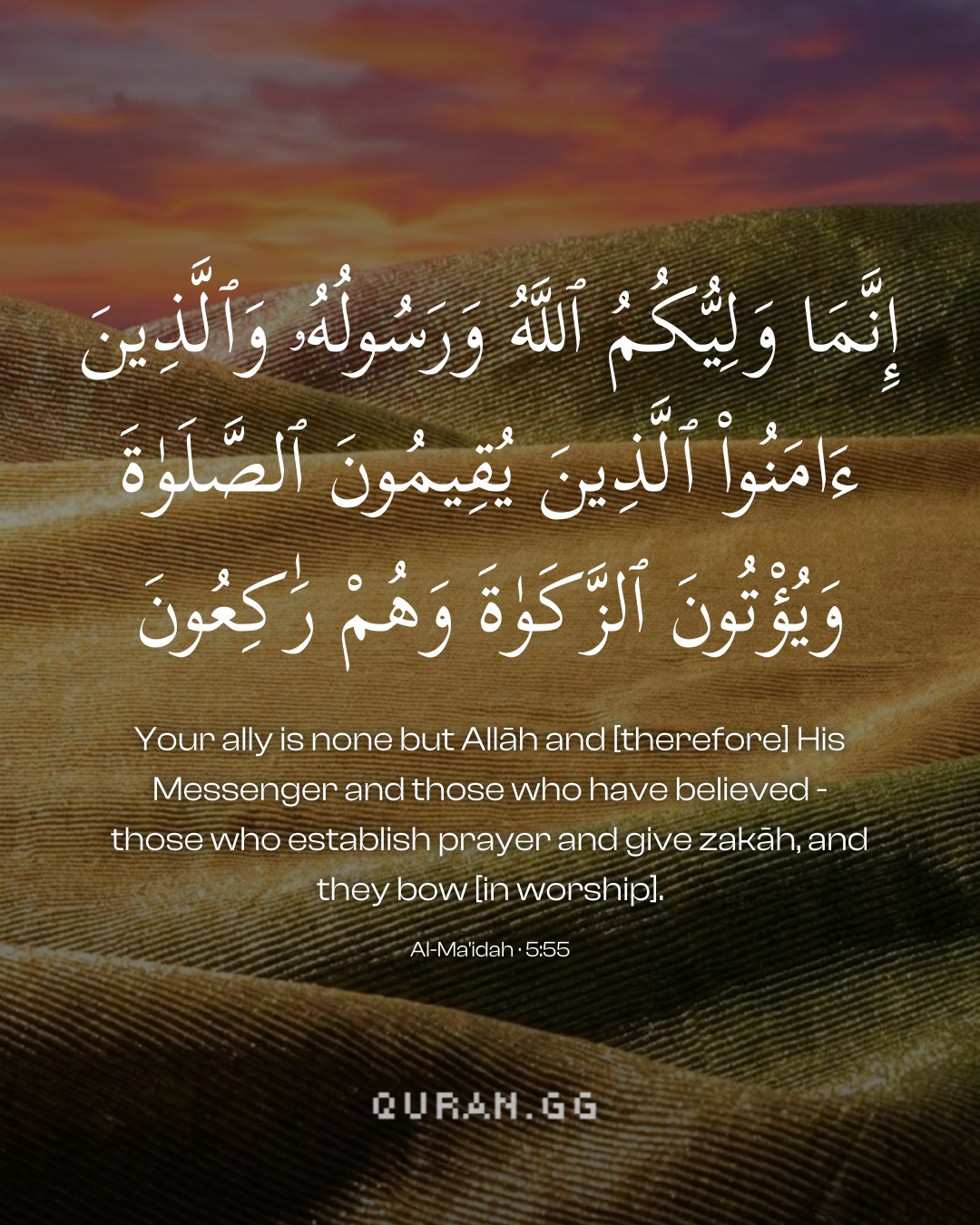
In the previous four verses discussed so far, Muslims have been forbidden to maintain intimate friendship with disbelievers. A positive approach has been taken in the fifth verse (55) where those with whom Muslims can have intimate friendship and special camaraderie have been identified. Mentioned first is Allah and then, His blessed Prophet, for Allah is - and He alone can be - the real friend, guardian and guide of a true Muslim, all the time and under all conditions. Other than the relationship with Him, every relationship and every friendship is perishable. As for the bond of fidelity to the Holy Prophet ﷺ is concerned, that too is, in reality, connected with Allah - and not separated. In the last sentence of the verse, the sincere most friends and fellows of Muslims have been identified as those who are true Muslims - not simply Muslims in name. They have three qualities which mark them out. These are:
الَّذِينَ آمَنُوا الَّذِينَ يُقِيمُونَ الصَّلَاةَ وَيُؤْتُونَ الزَّكَاةَ وَهُمْ رَاكِعُونَ
Those who establish Salah and pay Zakah and bow before Allah.
It means that they: (1) Fulfill the obligation of Salah punctually observing all etiquettes ('Adab) and conditions (Shara'it) which must be observed in it; (2) Pay Zakah out of their wealth; and (3) they are humble and modest and never become proud and arrogant over their good deeds.
The word, رکوع Ruku` in the concluding statement of this verse (55) : وَهُمْ رَاكِعُونَ translated as ` those who bow before Allah' could be taken in more than one sense. Therefore, some of the leading commentators have said that Ruku` refers to the functional Ruku` (bowing position) at this place - which is a basic element (Rukn`: pillar) of Salah. And the sentence: وَهُمْ رَاكِعُونَ (and those who bow before Allah) has been placed after: يُقِيمُونَ الصَّلَاةَ ' (those who establish Salah) because the purpose is to distinguish the Salah of Muslims from the prayer offered by others. As for the essential prayer which Muslims call Salah is something the Jews and Christians also do, but it has no Ruku` in it. Ruku' is a distinctive element of the Islamic prayer known as Sarah. (Mazhari)
But, the majority of commentators says that Ruku` at this place does not mean the technical Ruku' of Sa1ah. Rather, it means to bow, to be modest and humble in the lexical sense. Abu Hayyan in Tafsir al-Bahr al-Muhit and Al-Zamakhshari in Tafsir al-Kashshaf have gone by this meaning. The same view has been adopted in Tafsir Mazhari and Tafsir Bay-an al-Qur'an. Thus, the meaning of this sentence comes to be that these people do not feel proud of their good deeds; their natural disposition is, rather, modesty and humility.
It appears in some narrations that this sentence has been revealed about Sayyidna Ali ؓ ، in the background of a particular event. It is said that Sayyidna Ali ؓ was busy making Salah on a certain day. When he bowed in Ruku`, someone needy turned up and asked for something. He, within that state of Ruku`, took out a ring from one of his fingers and tossed it towards him. He could have taken care of the need of this person after having finished his Salah, but he did not wish to make even that much of a delay in removing the need of a poor faqir. This act of ` racing towards good deeds' was pleasing in the sight of Almighty Allah and it was through this sentence that it was appreciated.
The Sanad or authority of this narration is a debated issue among Varna and Muhaddithin, but, should this narration be taken as correct or sound, it would essentially mean that deserving of the close friendship of Muslims are common Muslims who fulfill the obligations of Salah and Zakah particularly and regularly - and among them, Sayyidna ` Ali ؓ is specially more deserving of this friendship - as has been said by the Holy Prophet ﷺ in another authentic Hadith: مَن کُنت موَلاہُ فَعَلِیُّ مَولاہُ (To whomever I am a friend, then, ` Ali too is a friend of his) (narrated by Ahmad, as in Mazhari). In yet another hadith, the Holy Prophet ﷺ has been reported to have said: اللَّھُمَّ وَالِ مَن وَالَاہُ وَ عَادِ مَن عَادَاہُ (0 Allah, befriend whoever befriends him and take as enemy whoever shows enmity to him).
Perhaps, Sayyidna ` Ali ؓ has been blessed with this honour because the Fitnah to appear in the future was unveiled before him and he knew that there will be people who will nurse enmity with him and will not hesitate in even rising in rebellion against him - as it did happen during the uprising of the Khawarij.
Anyway, the revelation of the present verse - even if it is related to this event - is worded in a general sense which includes all Companions ؓ of the Prophet ﷺ ، and all Muslims. This is not particular to any one individual under a specific command. Therefore, when someone asked Sayyidna Imam Baqar ؓ : "Do the words: الَّذِينَ آمَنُوا (those who believe) in this verse mean Sayyidna Ali ؓ ?” He said: "He too, as included under ` believers', is within the purview of this verse."
People of Allah shall prevail ultimately
The next verse (56) gives the good news that such people will over-come the world as come forward in obedience to the Qur'anic injunctions given in this verse and stay away from forging close friendship with others by limiting themselves to taking Allah, His Messenger and those who have faith in them as their genuine friends. The words of the verse are:
Uthmani text of the Madinah mushaf (King Fahd Complex). Translation: Saheeh International. Tafsir via Quran.com.