(Do you criticize us for no other reason than that we believe in Allah, and in what has been sent down to us and in that which has been sent down before (us)) Do you have any criticism or cause of blame for us, other than this This, by no means, is cause of blame or criticism. Allah said in other Ayat,
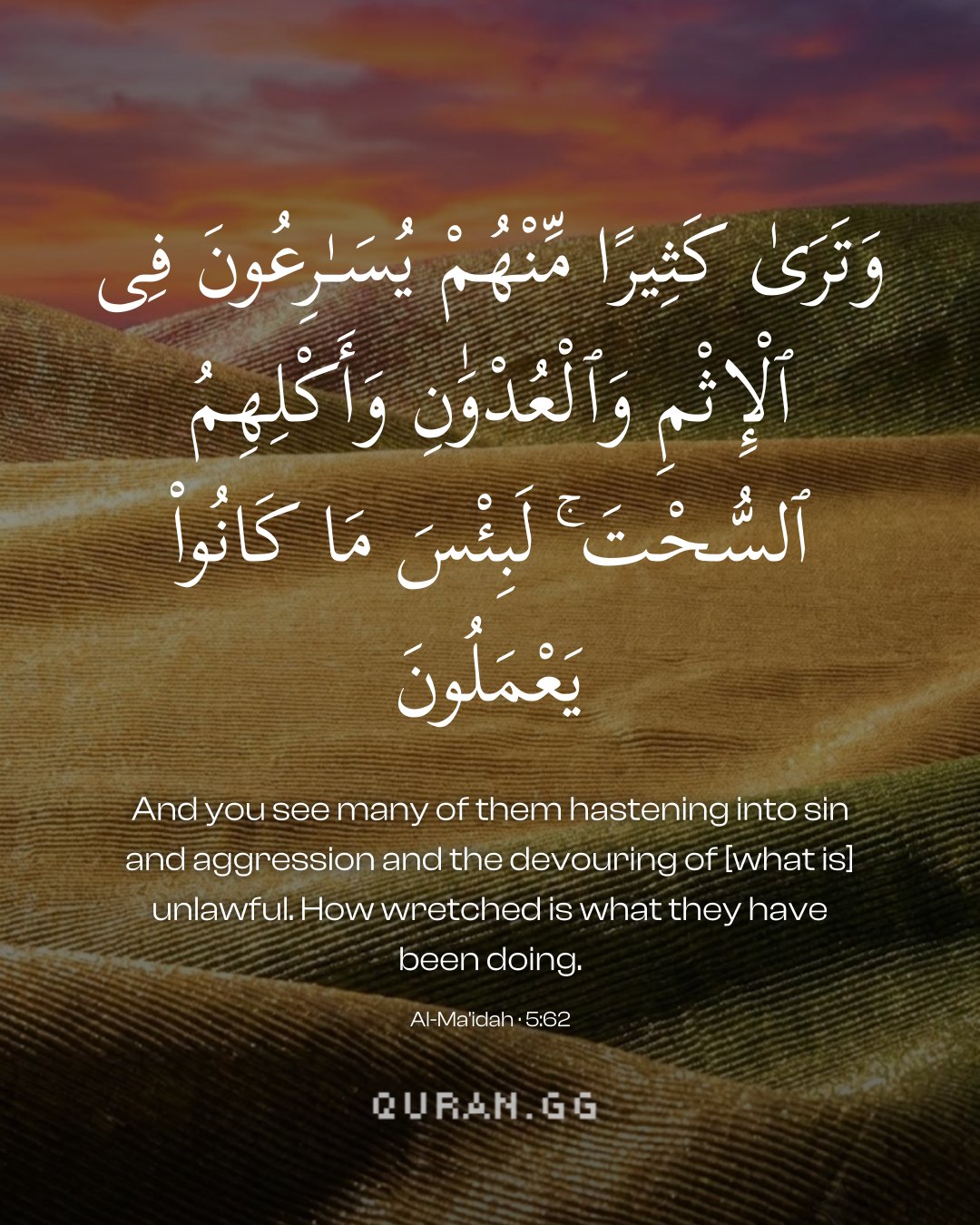
In the first verse (62) cited above, mentioned there is the moral depravation and self-destructive attitude of many Jews so that people who know that may take a lesson and stay away from such deeds, as well as from causes that lead to them.
Though, this was generally the condition of Jews, but they also had some good people among them. It is to exclude them that the Qur'an has used the word: کَثِیرًا ` kathiran' (many). As for aggression and eating of the unlawful, these are though included under the sense of ` sin', yet they have been particularly mentioned, distinctly, in order to lay emphasis on the ruin these two kinds of sins bring on one and all. (Al-Bahr Al-Muhit)
According to Ruh al-Ma'ani, by using the expression ` racing towards sin' about these people, the Holy Qur'an has given the hint that they are chronic subjects of these evil traits and the evil deeds they do have become fixed habits with them, so ingrained that they (automatically) move in that direction, even without intention.
This tells us that a good or bad deed when done many times repeatedly becomes a part and parcel of the inmost being of a person, almost a skill or drive or a fixed habit, after which, there remains no exertion or hesitation in doing what one does. This was the limit reached by Jews in pursuing their evil traits. To highlight it, it was said: يُسَارِعُونَ فِي الْإِثْمِ (They race towards sin). The same thing applies to prophets and men of Allah in the case of their good traits. About them too, the Holy Qur'an has used the same expression when it says: يُسَارِعُونَ فِي الخیراتِ (They race towards good deeds - 3:114).
Tazkirul Quran
Maulana Wahiduddin KhanOn ayahs 61–62
There were certain of the Jews of Madinah who were impressed by Islam. Moreover, considering the increasing domination of Islam, they did not want to incur its open enmity. Although in their hearts these people were steadfast in the religion of their forefathers, they used to make a show of being believers by their utterances. Such people forget that their dealings are not actually with any human being but with God, and God is the Being who knows what is inside one’s heart. When He deals with anyone, it will be based on reality and not on any words which that person chose to utter to protect his own interests. There were two types of prominent Jews—one the rabbis and the other the holy men. The latter were ahbar, i.e. scholars and interpreters. Both types remained busy day and night in the work of religion, for their leadership was propped up solely by religious work and they received substantial amounts in the name of religion. But, the real secret of their leadership and public acclaim was their presentation of a popular version of religion rather than the true religion favoured by God. They spoke and acted ostensibly for the sake of religion, but in reality their words and deeds were worldly-wise. Worse, they gave to the people, in the name of religion, whatever they wanted for themselves, knowing full well that in actuality those things were unconnected with religion.
Uthmani text of the Madinah mushaf (King Fahd Complex). Translation: Saheeh International. Tafsir via Quran.com.