There is no Salvation Except through Faith in the Qur'an
Allah says: O Muhammad, say,
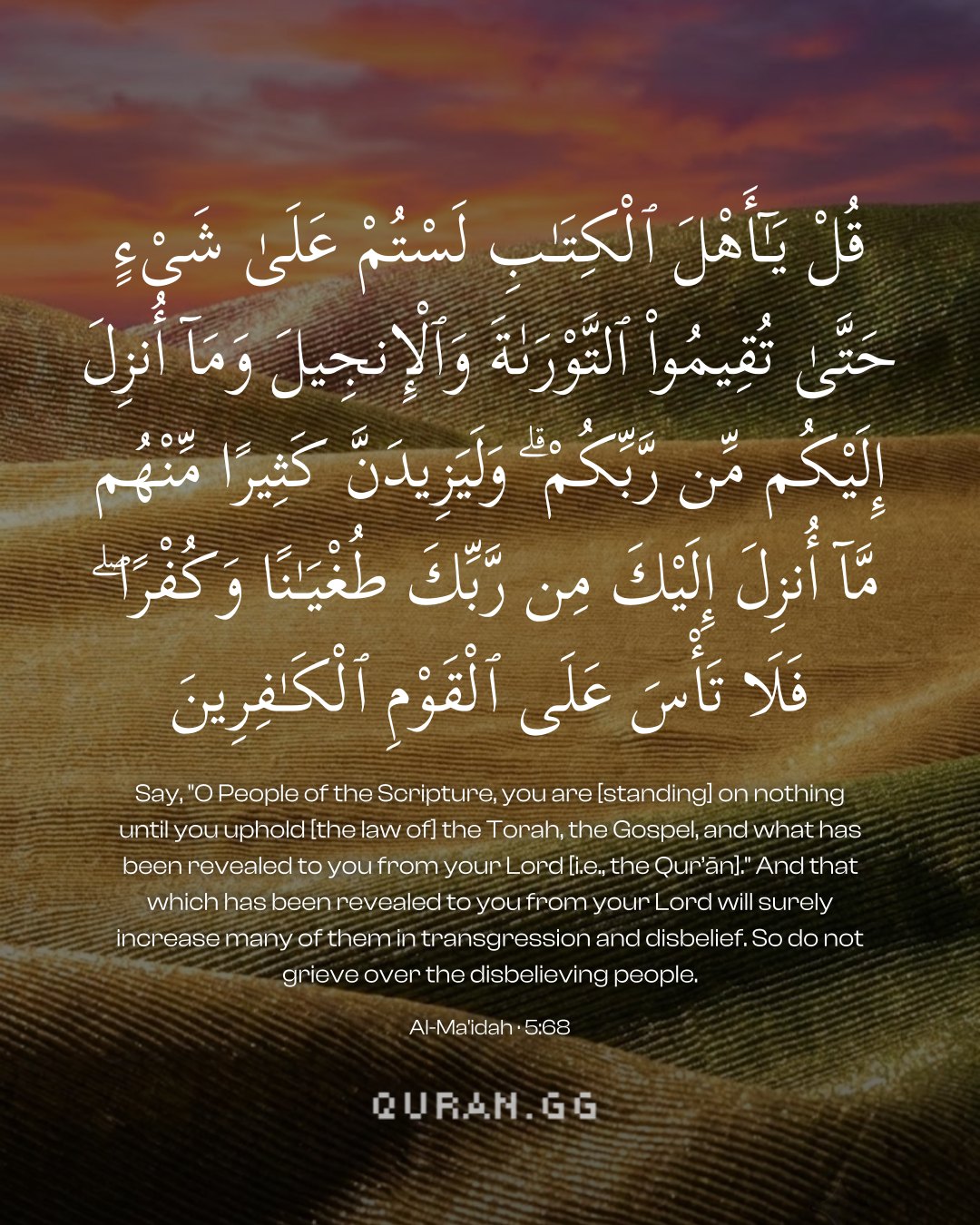
يَـأَهْلَ الْكِتَـبِ لَسْتُمْ عَلَى شَىْءٍ
(O People of the Scripture! You have nothing...) meaning no real religion until you adhere to and implement the Tawrah and the Injil. That is, until you believe in all the Books that you have that Allah revealed to the Prophets. These Books command following Muhammad and believing in his prophecy, all the while adhering to his Law. Before, we explained Allah's statement,
وَلَيَزِيدَنَّ كَثِيراً مِّنْهُم مَّآ أُنزِلَ إِلَيْكَ مِن رَّبِّكَ طُغْيَـناً وَكُفْراً
(Verily, the revelation that has come to you from your Lord makes many of them increase in rebellion and disbelief.)
فَلاَ تَأْسَ عَلَى الْقَوْمِ الْكَـفِرِينَ
(So do not grieve for the people who disbelieve), Do not be sad or taken aback by their disbelief. Allah said next,
إِنَّ الَّذِينَ ءَامَنُواْ
(Surely, those who believe) referring to Muslims,
وَالَّذِينَ هَادُواْ
(those who are the Jews) who were entrusted with the Tawrah,
وَالصَّـبِئُونَ
(and the Sabians. ..) a sect from the Christians and Magians who did not follow any particular religion, as Mujahid stated. As for the Christians, they are known and were entrusted with the Injil. The meaning here is that if each of these groups believed in Allah and the Hereafter, which is the Day of Judgement and Reckoning, and performed good actions, which to be so, must conform to Muhammad's ﷺ Law, after Muhammad ﷺ was sent to all mankind and the Jinns. If any of these groups held these beliefs, then they shall have no fear of what will come or sadness regarding what they lost, nor will grief ever affect them. We discussed a similar Ayah before in Surat Al-Baqarah 2:62.
Ma'arif al-Qur'an
Mufti Muhammad Shafi
Sequence
Earlier, the people of the Book were persuaded to embrace Islam. Mentioned now is the futility of their current approach which they claimed to be the God's truth while it was unworkable in the sight of Allah, insufficient for salvation and dependant on Islam as the only source of salvation. Then, as an antidote to their insistence on remaining disbelievers after being warned, there are words of comfort for the Holy Prophet ﷺ . The mention of Tabligh of Din had appeared in between as based on particular need and congruity.
Commentary
Follow the Divine Shari` ah: Instruction for the people of the Book
In the first verse (68), the people of the Book, that is, the Jews and Christians were instructed to follow the Divine Shari` ah by making it clear that they would be reduced to nothing if they chose not to abide by the injunctions of the Shari` ah. In other words, if they do not ad-here to the Shari` ah of Islam, all their achievements shall stand wasted. To them Allah had given the privilege of being the progeny of prophets. Then, they had the intellectual excellence of the Torah and the Injil as well. Added to this was the presence of many men of Allah among them who went through strenuous spiritual exertions in their search for truth. But, for all this to be valid and weighty the one binding condition was that they should follow the Divine Shari` ah. Without it, no genealogical superiority will work, nor would their intellectual excellence or their spiritual strivings become the means of their salvation.
This statement provides for Muslims too the crucial guidance that there is no way of Dervishes or path of spiritual realization (Suluk Tariqat) or repeated strivings to achieve spiritual goals (Mujahadah and Riyadat) or extra-sensory spiritual illumination (Kashf) or having visitations of inspiration (Ilham) which can become the source of spiritual achievement or salvation in the sight of Allah unless there is full adherence to the Shari'ah.
To prove one's obedience to the Divine Shari` ah, the instruction given in this verse is to follow three things. These are the Torah and Injil which had been revealed earlier for the Jews and Christians while the third one is: وَمَا أُنزِلَ إِلَيْكُم مِّن رَّبِّكُمْ , that is, what has been revealed to you from your Lord.
According to the consensus of the majority of commentators, the Sahabah and the Tabi` in, it means the Holy Qur'an which was sent for the universal community of inviters to faith - including the Jews and Christians - through the (midmost) medium of the Holy Prophet ﷺ . Therefore, the verse comes to mean unless you act in accordance with the injunctions brought by the Torah, the Injil and the Qur'an - correctly, fully and totally - no lineal or intellectual excellence of yours shall be valid or acceptable with Allah.'
At this point one may wonder why, in this verse, rather than mentioning Qur'an by its brief name, as was done with the Torah and the Injil., a long sentence : (and what has been revealed to you from your Lord) has been used. What is the wisdom behind it? It is possible that it may be carrying a hint to what was said by the Holy Prophet ﷺ in which he disclosed that the way he was given the Qur'an which is a treasure of knowledge and wisdom, also given to him were other sources of knowledge and insight, which could be called, in a certain aspect, the explication of the Holy Qur'an as well. The words of the Hadith are:
الا انّی اوتیت القرآن و مثلہ معہ الا یوشک رجل شبعان علی اریکتہ یقول علیکم بھذا القرآن فما وجدتم فیہ من حلال فأحلوہ وما وجدتم فیہ من حرام فحرّموہ وان ما حرم رسول اللہ (ﷺ) کما حرم اللہ۔ (ابوداؤد ، ابن ماجہ، دارمی وغیرہا)
Remember! I have been given the Qur'an and, with it, (many fields of knowledge) like it - lest, in times to come, some sated man reclining on his couch were to say: For you this Qur'an is sufficient - what you find Halal in it, take that as Halal; and what you find Harm in it, take that as Haram - although, what the Messenger of Allah has declared to be Harm is like what Allah has declared to be Harm. (Abu Dawud, Ibn Majah, Darimi others)
Three Kinds of Ahkam
The Qur'an itself is a testimony of this subject. It says: وَمَا يَنطِقُ عَنِ الْهَوَىٰ ﴿3﴾ إِنْ هُوَ إِلَّا وَحْيٌ يُوحَىٰ ﴿4﴾ which means that the Holy Prophet ﷺ does not say anything on his own - whatever he says is all revealed to him from Almighty Allah; and under conditions when he says something based on his Ijtihad (fully deliberated judgment) and Qiyas (analogical de-duction) - following which he receives no guidance contrary to it - then, consequently, that Qiyas and Ijtihad too hold the same legal force as that of an injunction revealed through Wahy.
In a nutshell, we can say that, out of the injunctions (Ahkam) given to the Ummah by the Holy Prophet ﷺ first come those which have been mentioned clearly in the Holy Qur'an. Then, there are those which have not been mentioned in the Qur'an clearly, instead of which, they were revealed to the Holy Prophet ﷺ through a separate Wahy (Wahy Ghayr Matlu: Revelation not recited). Thirdly, the command which he gave as based on his Ijtihad and Qiyas - following which no command was revealed by Almighty Allah - then, that too takes the legal force of a revealed injunction. It is obligatory to follow all these three kinds of injunctions. They are included within the purview of وَمَا أُنزِلَ إِلَيْكُم مِّن رَّبِّكُمْ (What has been revealed to you from your Lord).
It is also possible that the use of the longer sentence: وَمَا أُنزِلَ إِلَيْكُم مِّن رَّبِّكُمْ (and what has been revealed to you from your Lord) in place of the likely brief name of Qur'an in this verse may have been preferred so as to indicate that the following of all injunctions given in the Qur'an or given by the Holy Prophet ﷺ is equally mandatory.
Another point worth noting in this verse is that the Jews and Christians have been asked to follow the injunctions of all three Books, that is, the Torah, the Injil and the Qur'an - although, some of them abrogate others. The Injil abrogates some injunctions of the Torah and the Qur'an abrogates many injunctions of the Torah and the Injil. How then, could the sum of three be followed in action?
The answer is clear. Since every incoming Book changed some injunctions of the outgoing Book, it becomes obvious that following the replaced modality, in itself, amounts to acting in accordance with both Books. Following and acting in accordance with abrogated injunctions is against the requirement of both Books.
Allah consoles His Prophet ﷺ
To console the Holy Prophet ﷺ it was said at the end that there will be many among the people of the Book who would fail to benefit by the Divine magnanimity shown to them. They may even react adversely by increasing the tempo of their disbelief and hostility. Let this be no cause of grief to him, nor should he have any sympathetic concern for them.
Uthmani text of the Madinah mushaf (King Fahd Complex). Translation: Saheeh International. Tafsir via Quran.com.