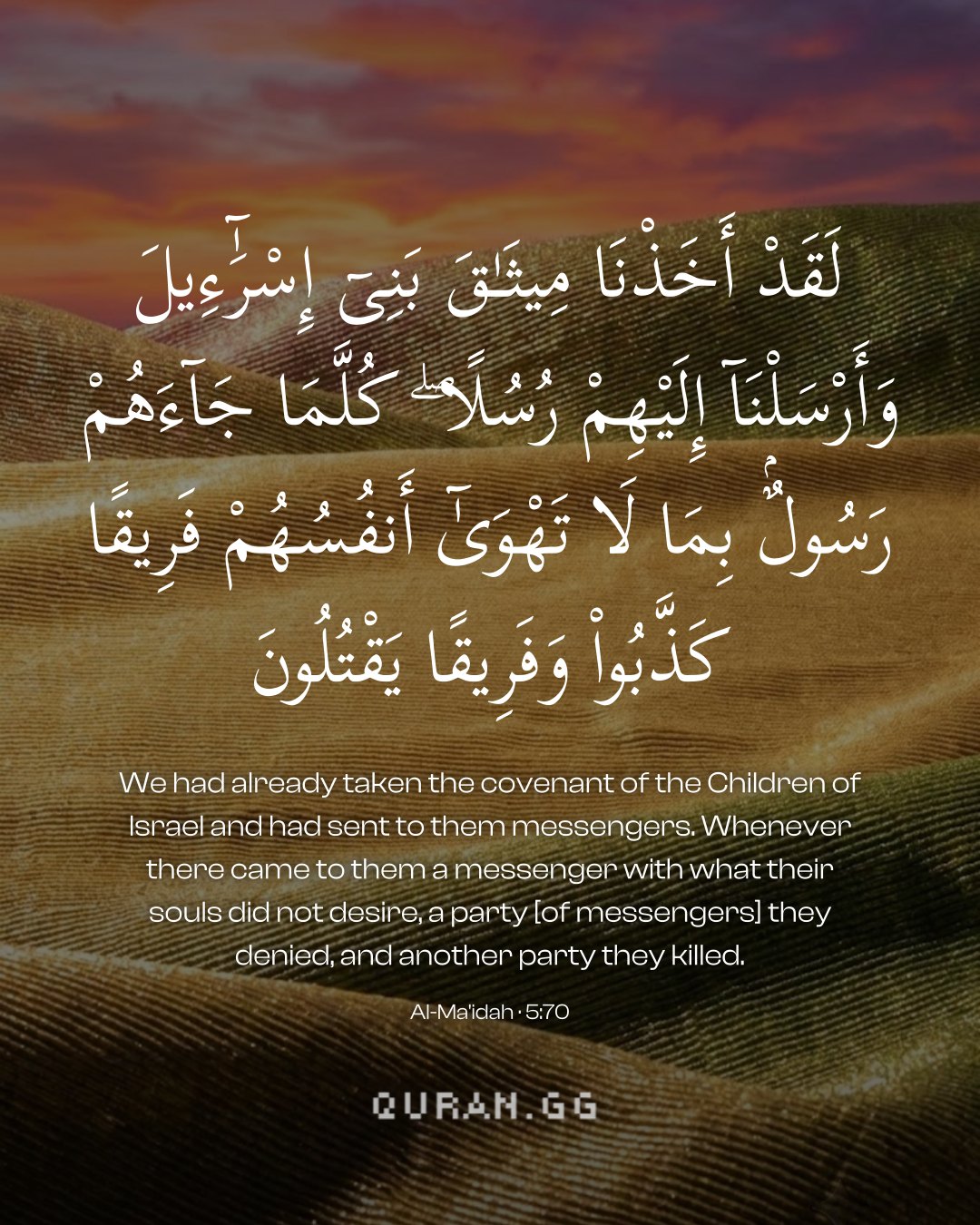
We had already taken the covenant of the Children of Israel and had sent to them messengers. Whenever there came to them a messenger with what their souls did not desire, a party [of messengers] they denied, and another party they killed.
(Whenever there came to them a Messenger with what they themselves desired not - a group of them they called liars, and others among them they killed. They thought there will be no Fitnah (trial or punishment) so they became blind and deaf.) thinking that they would suffer no repercussions for of the evil that they committed. Consequently, they were blinded from the truth and became deaf, incapable of hearing the truth. For these reasons they were unable to be guided by it. Allah forgave that, then,
(many of them, and Allah is the All-Seer of what they do.) He has perfect knowledge of what they do and whomever among them deserves the guidance and whomever deserves misguidance.
Ma'arif al-Qur'an
Mufti Muhammad ShafiOn ayahs 70–72
Commentary
This is an account of how the Bani Isra'il kept breaking the pledge taken from them. As said in verse 70, whenever their Messenger brought a command which did not suit their fancy, they would break their pledge and go about betraying Allah to the limit that they would falsify His Messengers, even kill some of them. They were commanded ` to believe in Allah and act righteously.' But, this was what they did in response. As for the other part of the command - ` Belief in the Last Day' their behaviour was equally reckless. After having committed acts so oppressive, they became totally carefree as if they would not have to pay for what they had done and as if the consequences of their injustice and rebellion will never come out in the open. Under this false impression, they became totally blind and deaf to Divine signs and words. They went on doing what should have not been done. So much so that they killed some prophets and put some others behind bars. Finally, Almighty Allah imposed on them the mastery of Nebuchadnezzar (King of Babylonia, 605-562 B.C., who took them as slaves to Babylon - Old Testament, book of Daniel). When, after a long time, they were sent back to Jerusalem from Babylon through help from some Persian kings who secured their release from disgrace under Nebuchadnezzar, they repented and turned to making amends. Allah relented and accepted their repentance. But, with the passage of some time, they went back to their old practices which made them so blind and deaf once again that they dared killing Sayyi.dna Zakariyah (علیہ السلام) (Zechariah) and Sayyidna Yahya (John) and were all set to kill Sayyidna ` Isa (علیہ السلام) (Jesus ). (Tafsir Usmani - Notes)
Tazkirul Quran
Maulana Wahiduddin KhanOn ayahs 69–70
The members of the Jewish community, thriving on stories of the excellence of their community and the supposed holiness of their elders, had not subjected themselves and their personal affairs to the will of God. Moreover, as a result of wishful thinking, they were convinced of their salvation before God. But their wishful thinking had no value in His eyes, for they were not ruled by His religion. What actually carries weight with God is being punctilious about carrying out His commandments and founding one’s life on His religion. When people who indulge in wishful thinking and false hopes are confronted by the message that, before God, it is intentions and deeds that carry weight and not wishes and false hopes, they react strongly against it. In this call they see the demolition of their castles in the air and this imagined state of affairs becomes a trial for them. It follows that they become strong opponents of such a call. Their self-centredness, hidden in the garb of showy devotion to God, comes out into the open. While they should have taken Divine nourishment from this call for Truth, they are instead spurred on by it to disbelief and arrogance. The generations succeeding the early followers of the prophets of ancient times gradually assumed the shape of a regular group or community. They no longer followed the examples set by the prophets; instead they perpetuated legends eulogizing their past glories and supremacy. Every group began to regard itself as the best of all, believing that their salvation was certain and that their status before God was the highest of all. But the fact is that such groupist religions have no value in the eyes of God. Every individual’s case will be separately presented before God and the decision about his future will be wholly based on his own deeds and not on any other basis. Upholding the Book of God means having full faith in God; being overwhelmed by the fear of the Hereafter; and leading a life of a righteous character among one’s fellow human beings. This is the true religion and everybody is required to adopt it in his way of living. The community blessed with the Book of God has great merit in the world so long as its members adopt God’s true religion. On deviating from this they become completely undeserving before God—even less meritorious than open deniers and polytheists.