Sequence of Verses
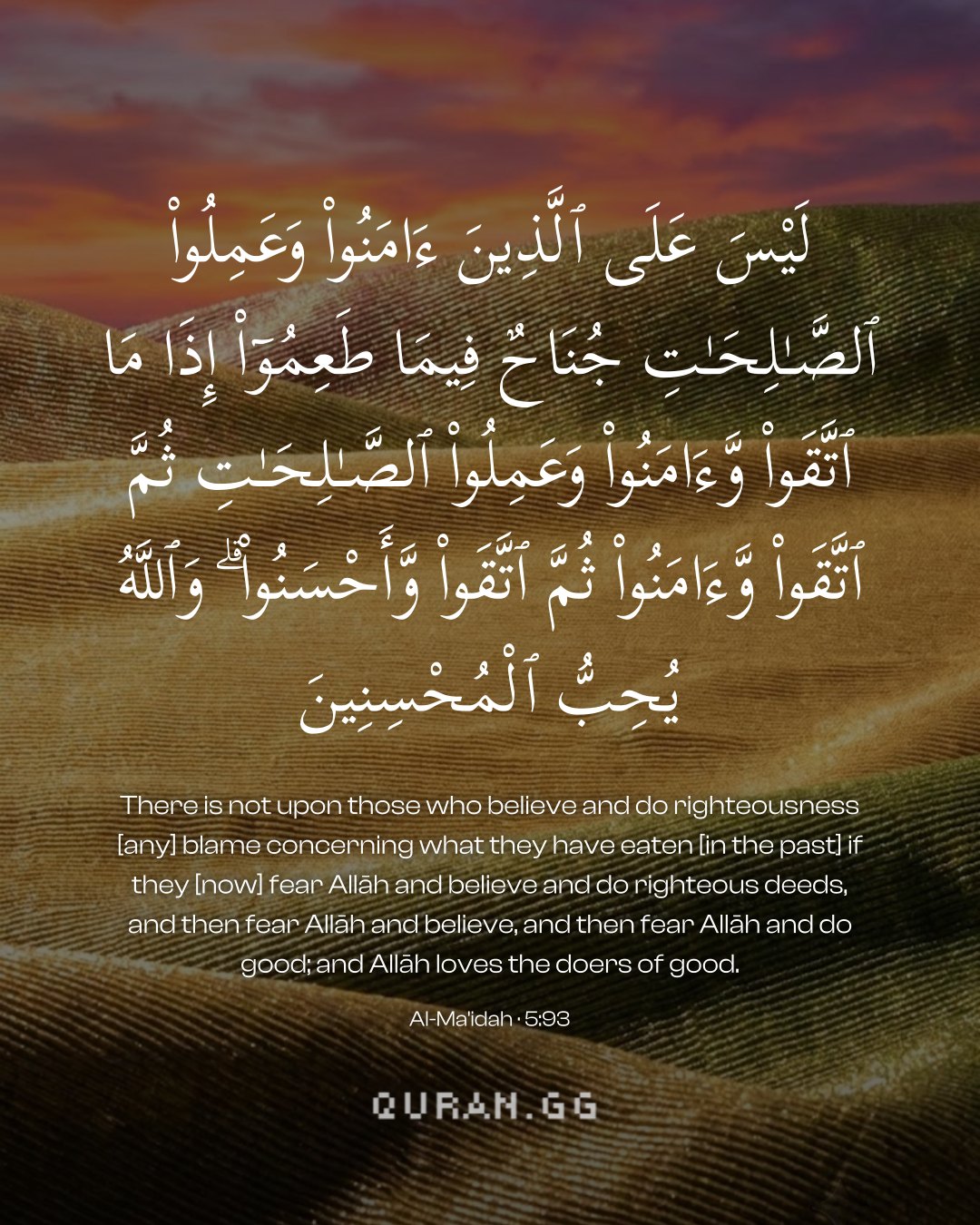
A report from Sayyidna Abu Hurairah ؓ appearing in the Musnad of Ahmad, quoted in Al-Lubab, says: When the Verse forbidding drinking and gambling had been revealed, some people asked the Holy Prophet ﷺ that there were many people who drank wine and lived off earnings from gambling and then died before these were forbidden. What would happen to them, now that we know about these being حَرَام haram? Thereupon, the verse : لَيْسَ عَلَى الَّذِينَ آمَنُوا (On those who believe and do good deeds, there is no sin ...) was revealed.
In a verse appearing earlier (87): يَا أَيُّهَا الَّذِينَ آمَنُوا لَا تُحَرِّمُوا طَيِّبَاتِ ( O those who believe, do not make unlawful good things ...), the making of good things unlawful was prohibited. Now, in the verse (94) : يَا أَيُّهَا الَّذِينَ آمَنُوا لَيَبْلُوَنَّكُمُ اللَّـهُ بِشَيْءٍ ( those who believe, Allah shall certainly test you with some ... ), it is said that it is Allah Who has that absolute power to declare particular things unlawful in particular circumstances. (Bayan al Qur'an)
Commentary
Scholars have said that there are several degrees of Taqwa (abstaining from what is likely to harm the purity of one's faith). Similarly, the degrees of faith and belief are also different in terms of personal strength and weakness. The touchstone of experience and the inviolable authority of the Shari’ ah both prove that the more one progresses in the remembrance of Allah (Dhikr), concern for life here and hereafter (Fikr), good deeds (Al-Amalus-Salih) and Jihad in the way of Allah (Al-Jihad fi Sabilillah), the more filled his heart is with the fear of Allah and the awe of His greatness and majesty, with his faith and belief becoming firm and fortified more than ever. Thus, there are degrees of one's ascent onto the pathways of Allah (referred to as Sayrilallah by spiritual masters). The considered repetition in verse 93 of the basis of Taqwa (fear of Allah) and 'Iman (faith) is a pointer in this direction. Finally, at the end of the verse, what stands identified is the seeker's last station - Ihsan (righteousness at its best) - and the re-ward for it too, which is, the love of Allah. (Tafsir Usmani)
Rulings:
1. The game صَید (Sayd) which is حرام haram (unlawful) in the حرَم Haram (the precincts of the Sacred Mosque) and in اِحرَام Ihram (the state of consecration for Hajj or ` Umrah) is general in sense. It may be eatable, that is, a Halal (lawful) animal, or one uneatable, that is, a حَرَام haram (unlawful) animal (as generalized in the verse).
2. Sayd صَید ، that is, game, is the name of animals which are wild and who habitually do not live close to human beings. Thus, as for those which are naturally domesticated, such as, sheep, goats, cows and camels, slaughtering and eating them in Ihram is correct.
However, animals that have been exempted by a specific rule can be trapped and killed. It is Halal, for example, the hunting of sea (or water) game as permitted by Allah Ta` a1a: أُحِلَّ لَكُمْ صَيْدُ الْبَحْرِ (lawful for you is the game of the sea). This applies to some land animals, crawlers and birds as well, such as, the wolf, the biting dog, the crow, the kite, the snake and the scorpion. Similarly, permissible is the killing of an attacking beast. Their exemption has been mentioned in Hadith. This tells us that the letter Alif-Lam in' اَلصَیدُ ' (Al-Sayd - 5:95) is that of Ahd.1
1. The Lam of ` Ahd indicates that the word is used in a restricted sense and not in a general sense. Here it means that all types of games are not prohibited, but the prohibition is restricted to some of them. (Muhammad Taqi Usmani)
3. It is permissible for a Muhrim (person in Ihram) to eat from Halal game which has been hunted in a state other than that of lhram and in a place other than that of the sacred precincts of the حَرَم Haram - subject to the condition that this person (in Ihram) has not been an assistant or adviser or guide in the hunting and killing of that game. This is exactly what the Hadith says. In addition to that, there is an indication towards this rule in the words: لَا تَقتُلُوا (la taqtulu: do not kill) in this verse (95) - because what is said here is "la taqtulu" (do not kill) and not لَاتَاکُلُوا ` la ta'kulu' (do not eat).
4. The way it is obligatory (Wajib) to pay compensation (Jaza' ) against killing land game in the sacred precincts of the Haram (Sacred Mosque) intentionally, similarly, it is also obligatory (Wajib) if done by mistake or forgetfulness. (As deduced in Ruh al Maini)
5. The compensation (Jaza' ) which becomes obligatory (Wajib) the first time shall remain equally obligatory (Wajib) in such killing a second or a third time as well.
6. The substance of the compensation (Jaza' ) is that, after having determined the (facts of) time and place of the killing of this animal, one should get an estimate of the cost of this animal from two just person, which is better, but, it is also permissible that he can have only one just person do it. Then, there are other details: If the killed animal is inedible (that is, حَرَام haram), then, this obligatory cost will not be more than the cost of a she-goat.
And if the animal was edible (that is, Halal), then, whatever the estimate (of cost), the whole of it will be obligatory (Wajib). Now, beyond these two situations, he has three options: (1) Whether he buys an animal at this price keeping in view the (standard) conditions which govern a sacrificial animal, and after slaughtering it properly within the sacred precincts of the حَرَم Haram (the Sacred Mosque and its environs), distributes it to persons poor and needy; or, (2) gives grains equivalent to the price of the animal, in accordance with the conditions of Sadaqatul-Fitr, at the rate of 1/2 Sa` per poor and needy person; or, (3) keeps as many fasts as would be the number of poor and needy persons to whom the amount of grains could reach at the rate of 1/2 Sa` per person. As for the distribution of the grains and the keeping of fasts, there is no restriction that these be done with-in the sacred precincts of the Haram. And in case the obligatory (Wajib) amount is a price less than 1/2 Sa`, then, one has the choice of either giving it to a poor and needy person, or keep a fast. Similarly, if one is left with less than 1/2 SW even after giving at the rate of 1/2 Sa` per poor and needy person, still then, one has the choice of either giving the remainder to one poor and needy person, or keep a fast. The weight of 1/2 Sa` is the equivalent of 1.75 Seers or 1.62 kg approximately (usually rounded as a matter of precaution).
7. If in lieu of giving the share of the number of poor and needy persons arrived at in the said estimate, one were to feed them two meals of the day, to their fill and satisfaction, that too will be permissible.
8. If an animal matching the cost arrived at in the estimate was selected for slaughter - but, some amount was left over - then, in this remainder, on'e has the choice of either buying another animal, or giving grain against it, or fasting in terms of the distributability of the grains. As compensation (Jaza' ) is obligatory in killing, similarly, in the case of such an animal becoming wounded, an estimate would have to be taken to determine how low the price of the animal has become as a result of its being wounded. Once again, in this amount of the cost, the same three options will be permissible.
9. The animal the hunting of which is حَرَام haram (unlawful) for a Muhrim (one in the consecrated state of Ihram), its slaughtering is حَرَام haram too. If the Muhrim were to slaughter it, its legal status will be that of carrion, dead animal. (In ` la-taqtulu,: [ do not kill ] there is a hint towards slaughter being like killing).
10. If the place where the animal was killed was a forest, then, the estimate will be made in terms of the habitation close to it.
11. Pointing to, guiding along or assisting in hunting is حَرَام haram (unlawful) as hunting itself.
Uthmani text of the Madinah mushaf (King Fahd Complex). Translation: Saheeh International. Tafsir via Quran.com.