؟ (If I told you all that the enemy was going to attack you in the morning, or in the evening, would you all believe me) They replied, "Yes." Then he said,
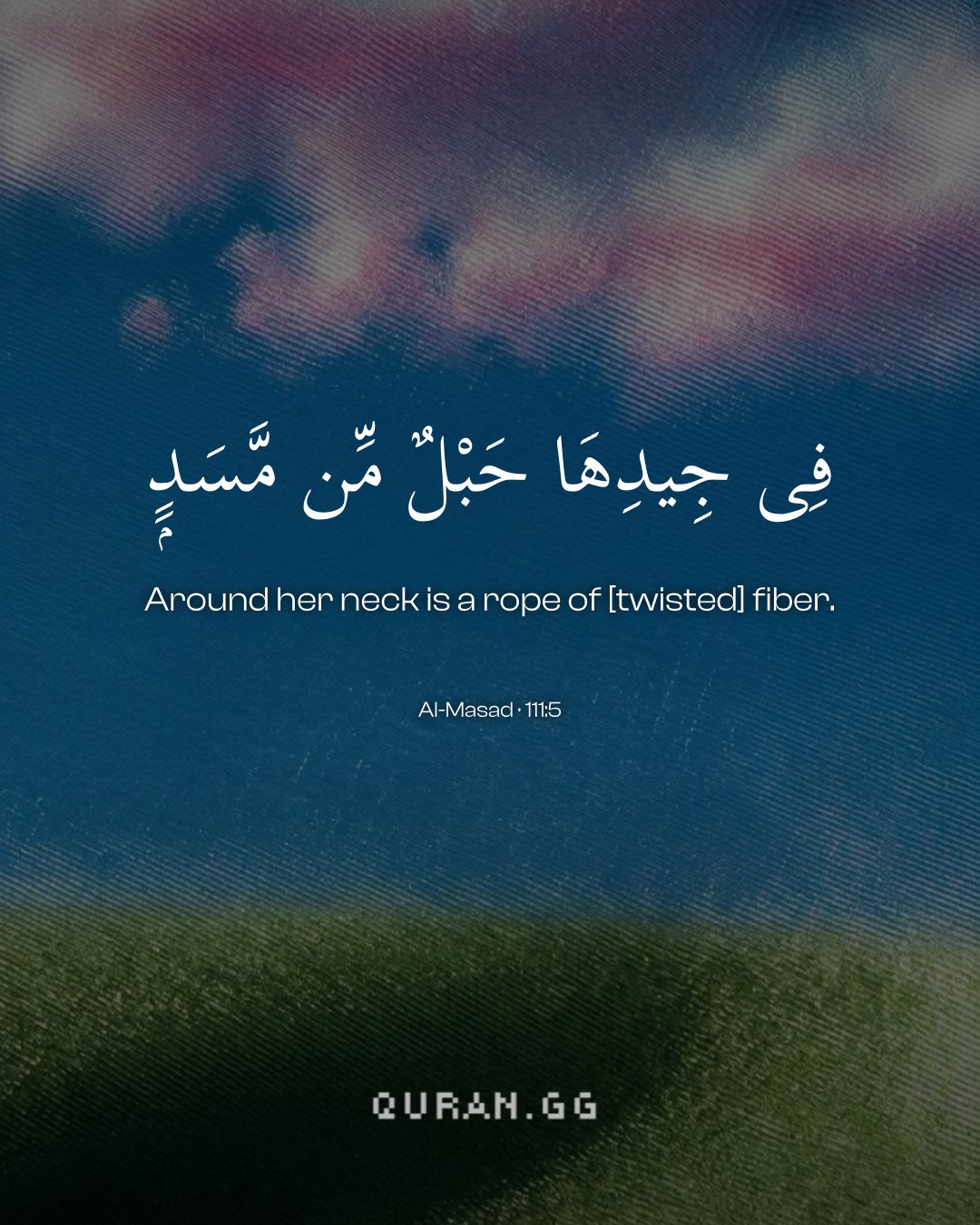
Verse [ 111:5] فِي جِيدِهَا حَبْلٌ مِّن مَّسَدٍ (In her neck there is a rope of twisted palm-fibre.) The masd with the letter-s-bearing sukun [ quiescence or rest ] is an infinitive which means 'to twist rope or cord, or to twist it strongly and tightly'. If the word is read as masad with the letters m-s bearing fatha [= a-a ], the word refers to fibres. It is also a rope made of 'twisted fibres of palm tree' or 'tightly braided fibres of coconut tree' or 'cord that has been woven strongly' or 'coil or cable formed by winding iron strands together'. [ al-Qamus ]. Some scholars have preferred to translate it specifically as 'a rope made of twisted fibres of palm tree' and no other string or twine. This is in conformity with the general usage of the Arabs. Basically, it refers to any string or twine or rope or cord or coil or cable formed by intertwining strands of any material. In keeping with this general sense of the word, Sayyidna Ibn ` Abbas ؓ ، ` Urwah Ibn Zubair ؓ and others said that in this context the phrase حَبْلٌ مِّن مَّسَدٍ "rope of masad" refers to 'rope formed by twisting iron strands'. This will be her condition in Hell where an iron-collar will be in her neck. Sayyidna Mujahid (رح) interprets min masad as min hadid, that is, 'of iron'. [ Mazhari ].
Sha'bi, Muqatil and other commentators have taken the phrase min masad to refer to 'a rope made of twisted fibres of palm tree' and said that Abu Lahab and his wife were extremely wealthy and were looked upon as leaders of their nation but, on account of his wife's mean disposition and miserliness, she used to collect firewood from the jungle, bind them together with a rope, place the bundle on her head and put its rope round her neck, so that it might not fall from her head. This practice of hers one day led to her destruction. She had a bundle of wood on her head and the rope in her neck. She felt tired and sat down. Then fell, was choked and died. According to this second interpretation, the verse describes her mean disposition and the disastrous consequences of her sadistic behavior. [ Mazhari ]. However, such a conduct in Abu Lahab's family, especially of his wife, was hardly conceivable; therefore, most commentators have preferred the first interpretation. Allah knows best!
Al-Hamdulillah
The Commentary on
Surah Al-Lahab
Ends here
Tazkirul Quran
Maulana Wahiduddin Khan
This chapter, containing five verses, was revealed at Makkah. This is the only passage in the Quran where an opponent of the Prophet is denounced by name. Abu Lahab, whose real name was Abdul Uzza, was a first cousin of the Prophet’s father. He was the only member of the Prophet’s clan who bitterly opposed him. Abu Lahab made it his business to torment the Prophet, and his wife took pleasure in strewing thorn bushes in the path the Prophet was expected to take. Consumed with grief on seeing many of the Quraysh leaders of the unbelievers killed at Badr, Abu Lahab died a week after Badr. Though this chapter refers, in the first instance, to a particular incident, it carries the general message that cruelty and haughtiness ultimately recoil upon oneself. Abu Lahab, the name of an actual person, has come to denote a particular kind of character. ‘Abu Lahab’ who was an uncle of the Prophet Muhammad has come to be a symbol of such an opponent of the call for Truth as will stoop in his hostility to meanness. Just as the Prophet had to face this character, similarly others of his followers (ummah) may have to face just such a character. However, if the dayee has become active for the sake of God in the real sense, then God’s help will be given to him. The inimical efforts of people like Abu Lahab will, by God’s grace, become ineffective and, in spite of all their means and resources, the antagonists will perish. They will themselves burn in the fire of their own jealousy and enmity. Their aim may have been to ensure that the call of God came to a miserable end, but the opponents themselves will be the ones to suffer that everlasting fate.
Uthmani text of the Madinah mushaf (King Fahd Complex). Translation: Saheeh International. Tafsir via Quran.com.