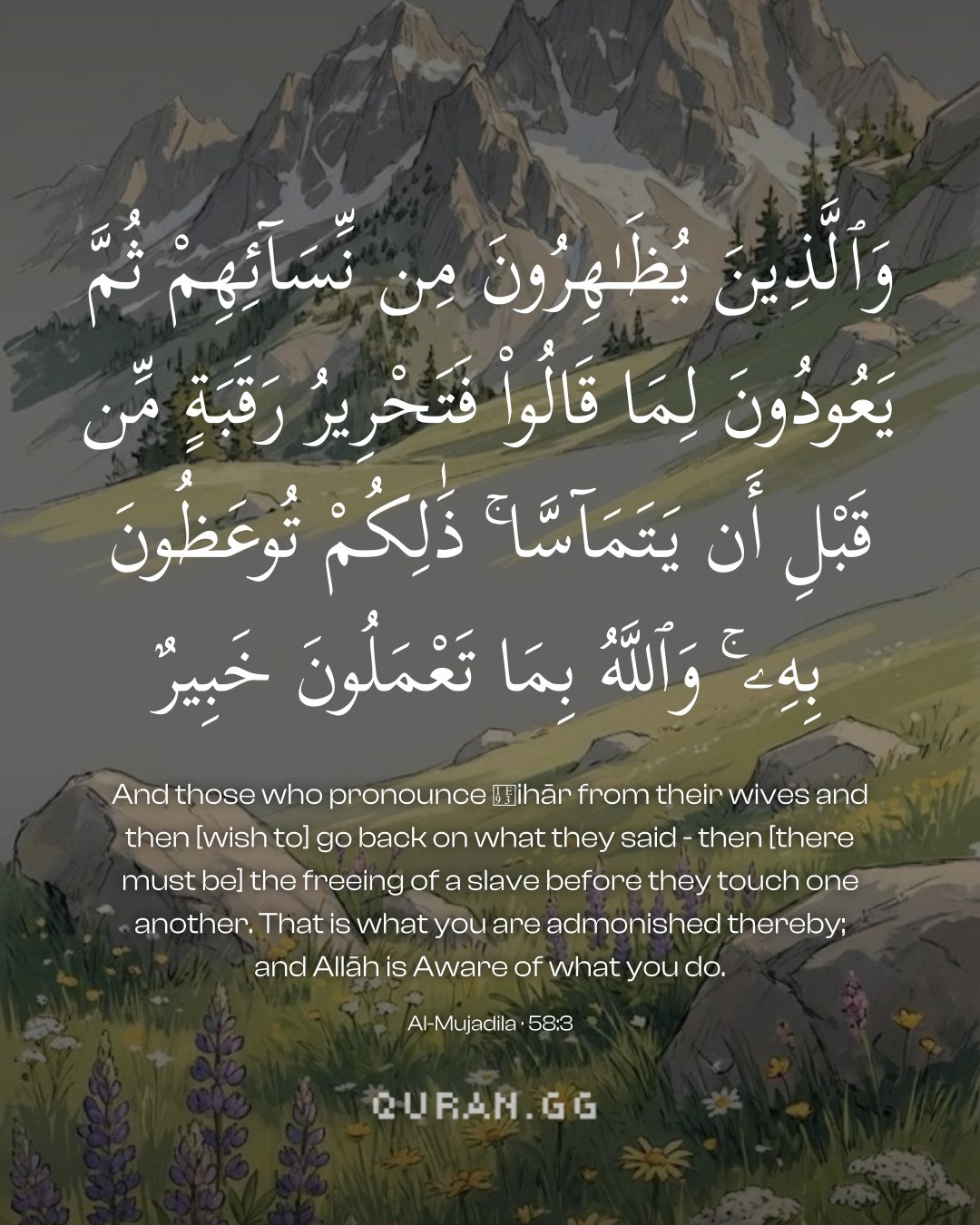
Az-Zihar and the Atonement for It Imam
Ahmad recorded that Khuwaylah bint Tha`labah said, "By Allah! Allah sent down the beginning of Surat Al-Mujadilah in connection with me and `Aws bin As-Samit. He was my husband and had grown old and difficult. One day, he came to me and I argued with him about something and he said, out of anger, `You are like my mother's back to me.' He went out and sat with some of his people. Then he came back and wanted to have sexual intercourse with me. I said, `No, by the One in Whose Hand is the soul of Khuwaylah! You will not have your way with me after you said what you said, until Allah and His Messenger issue judgement about our case.' He wanted to have his way regardless of my choice and I pushed him away from me; he was an old man.' I next went to one of my neighbors and borrowed a garment from her and went to the Messenger of Allah ﷺ. I told him what happened and kept complaining to him of the ill treatment I received from `Aws. He said,
Continue reading the tafsir of ayahs 2–4Ma'arif al-Qur'an
Mufti Muhammad Shafi
The Expiation for Zihar
وَالَّذِينَ يُظَاهِرُونَ مِن نِّسَائِهِمْ ثُمَّ يَعُودُونَ لِمَا قَالُوا (And those who declare zihar against their wives, then retract what they said, ...58:3). The preposition lam in the phrase يَعُودُونَ لِمَا قَالُوا "...retract what they said..." is used in the sense of ` an [ from ]. Sayyidna Ibn ` Abbas ؓ interprets 'retract' in the sense of 'regret': 'they regret what they said and wish to be intimate or cohabit with their wives'. [ Mazhari ]
The verse shows that the penalty has been imposed on the husband for the purpose of making the wife lawful - without it she cannot become lawful to him. zihar per se is not the cause of the expiation. In fact, zihar is a heinous sin for which repentance and seeking pardon and forgiveness is absolutely necessary. The concluding part of verse [ 2] وَإِنَّ اللَّـهَ لَعَفُوٌّ غَفُورٌ "...Allah is surely Most-forgiving, Very-Merciful." points to this fact. In other words, Allah in His great mercy has made allowance for man's weaknesses and He is always ready to forgive his lapses, provided he comes to Allah with a penitent heart and makes amends. However, if a person did commit zihar and does not wish to take back his wife and enjoy intimacy with her, expiation is not obligatory on him. However, destroying a wife's conjugal rights is unlawful. If she demands, it is obligatory for him to pay the expiation and take her back, should he wish to do so; or if she demands, he must divorce her and set her free from the bond of marriage. If he does not divorce her and set her free, then she has the right to apply to a Qadi or an Islamic court to compel him to either pay the expiation and take her back or to divorce her and set her free so that she could contract a second marriage. Islamic works on jurisprudence set down details of the laws pertaining to zihar.
The penalty for zihar is obligatory, which is given in this and the next verse. There are three options: [ 1] فَتَحْرِيرُ رَقَبَةٍ (...obligated on them is to free the neck [ of a slave ]...) [ 2] If a person cannot afford to do that, he must keep fast for two consecutive months; and [ 3] if he is so weak or ill that he cannot fast, then he must feed sixty poor people. The expiation will be fulfilled if one poor person is given two meals for sixty days. Alternatively, it is possible to give two meals to sixty poor persons on a single day. In each case, the poor should be fed to their fill. Another possible alternative is to give to a poor person about 1.6 kg wheat or 2.12 kg dates or barley for sixty days or the equivalent price of these food items may be given. The details of the law appertaining to zihar and its expiation are available in the texts of Islamic jurisprudence.
It is recorded in Traditions that when Sayyidah Khaulah ؓ complained to Allah's Messenger ﷺ about her husband and pleaded her case to Allah, verses relating to zihar and its expiation were revealed. So, Allah's Messenger ﷺ called for the husband. When he came, the Holy Prophet ﷺ noticed that he was a weak-sighted old man. He recited to him the verses resolving his case, and commanded him to emancipate a slave, he said that he does not have the means to do that. The Holy Prophet ﷺ then asked him to fast two successive months, to which he replied: "By Him Who has sent you as the true Messenger, if I do not have two or three meals a day, I lose my sight completely." The Holy Prophet ﷺ said 'Then feed sixty poor people'. He said 'I do not have the ability for that either, unless you help me'. The Holy Prophet ﷺ gave him some food grain, and also other people gathered more food grain for him, which amounted to the measure of sadaqatul-fitr for sixty poor men, and in this way the expiation was made. [ Ibn Kathir ]
Saying to one’s wife, ‘To me you are like my mother’s back’. This was an old pagan custom which was known as zihar, by which one’s wife could be wrongfully divorced.
Uthmani text of the Madinah mushaf (King Fahd Complex). Translation: Saheeh International. Tafsir via Quran.com.