Surah Al-Mulk Ayah 3 (67:3) — Meaning & Tafsir | Quran.GG

Surah Al-Mulk, Ayah 3

67:3 · Meaning and tafsir

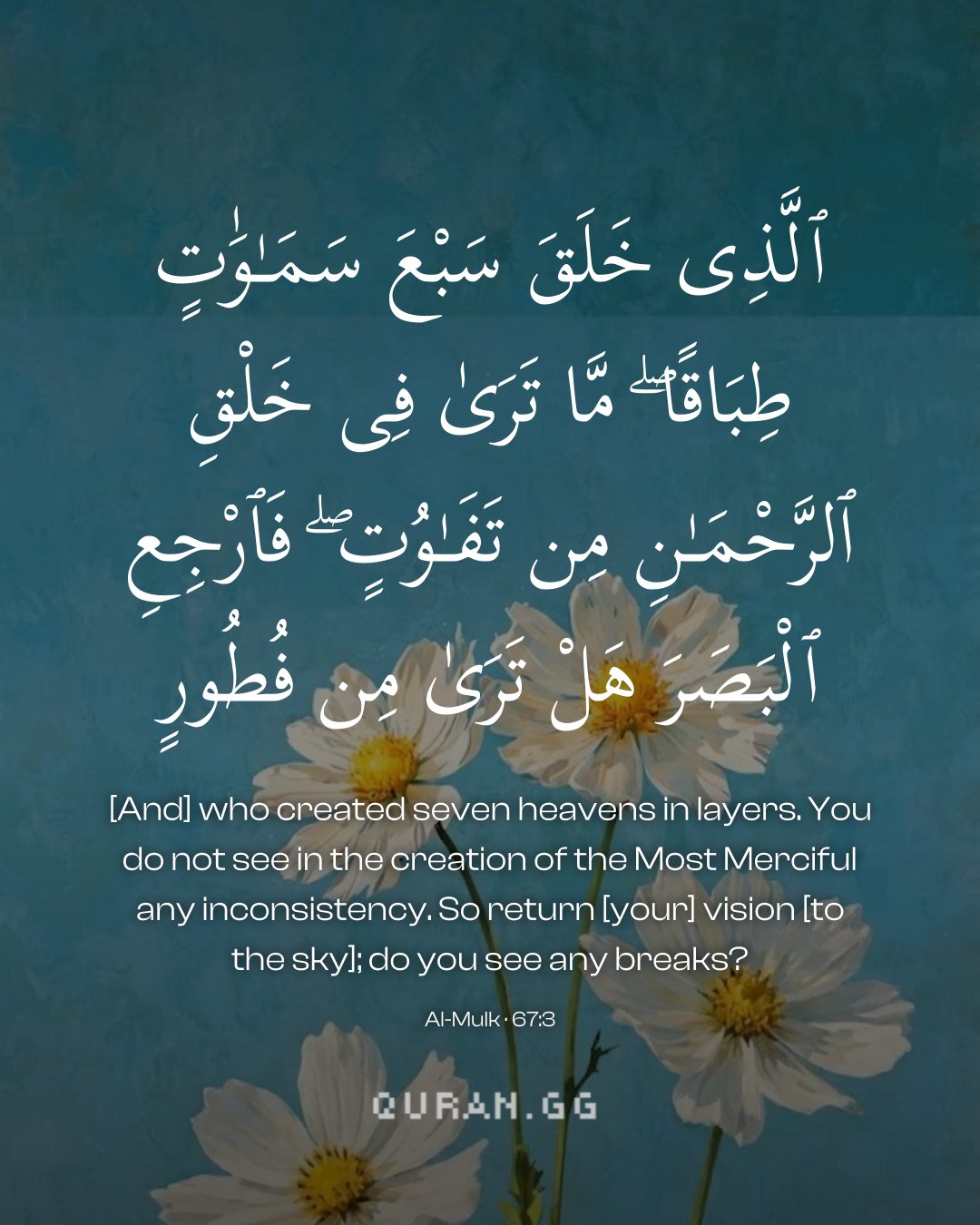
ٱلَّذِى خَلَقَ سَبْعَ سَمَـٰوَٰتٍ طِبَاقًا ۖ مَّا تَرَىٰ فِى خَلْقِ ٱلرَّحْمَـٰنِ مِن تَفَـٰوُتٍ ۖ فَٱرْجِعِ ٱلْبَصَرَ هَلْ تَرَىٰ مِن فُطُورٍ ٣

[And] who created seven heavens in layers. You do not see in the creation of the Most Merciful any inconsistency. So return [your] vision [to the sky]; do you see any breaks?

Surah Al-Mulk 67:3 in Arabic with its translation: “[And] who created seven heavens in layers. You do not see in the creation of the Most Merciful any…”

Make something with this ayah

Turn it into a video for Stories, Reels or TikTok, recited by the reciter you pick, or an image on a background you choose. Free, in your browser.

Download this image

Tafsir Ibn Kathir (abridged)

Which was revealed in Makkah

The Virtues of Surat Al-Mulk

Imam Ahmad recorded from Abu Hurayrah that Allah's Messenger ﷺ said,

«إِنَّ سُورَةً فِي الْقُرْآنِ ثَلَاثِينَ آيَةً شَفَعَتْ لِصَاحِبِهَا حَتْى غُفِرَ لَهُ:

تَبَارَكَ الَّذِى بِيَدِهِ الْمُلْكُ»

(Verily, there is a chapter in the Qur'an which contains thirty Ayat that will intercede on behalf of its reciter until he is forgiven. (It is): (Blessed be He in Whose Hand is the dominion.)) This Hadith was collected by At-Tirmidhi and the four Sunan Compilers. At-Tirmidhi said concerning it, "This is a Hasan Hadith." At-Tabarani and Al-Hafiz Ad-Diya' Al-Maqdisi both recorded from Anas that the Messenger of Allah ﷺ said,

Continue reading the tafsir of ayahs 1–5

Ma'arif al-Qur'an

ارْ‌جِعِ الْبَصَرَ‌ هَلْ تَرَ‌ىٰ مِن فُطُورٍ‌ (So, cast your eye again. Do you see any rifts?...67:3). Apparently, this verse shows that it is possible to see the nearest sky with the naked eyes. Sky, in this context, does not necessarily refer to the bluish atmosphere seen over the earth. In fact, the sky may be very much higher than this, and the bluish colour may be that of the upper atmosphere, as claimed by the scientists. This, on the other hand, does not necessarily imply that the sky cannot be seen at all. It is possible that the bluish atmosphere, on account of being transparent, may not block the vision of the actual sky. However, if it is proved by any evidence that the sky cannot be seen with eyes, then the 'casting ones eyes' in this verse would refer to 'intellectual observation'. [ Bayan-ul-Qur’ an ]

Uthmani text of the Madinah mushaf (King Fahd Complex). Translation: Saheeh International. Tafsir via Quran.com.