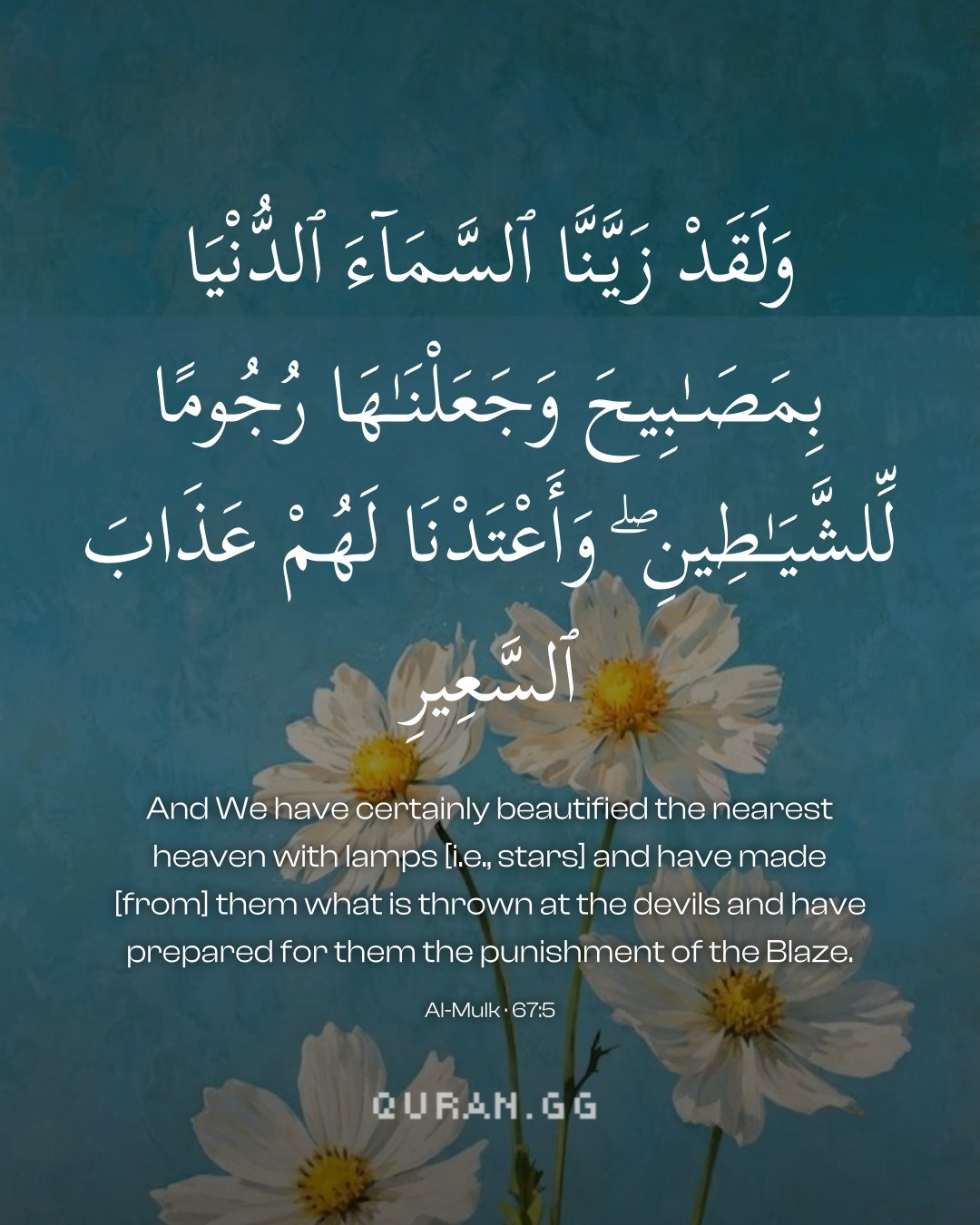
And We have certainly beautified the nearest heaven with lamps [i.e., stars] and have made [from] them what is thrown at the devils and have prepared for them the punishment of the Blaze.
(Verily, there is a chapter in the Qur'an which contains thirty Ayat that will intercede on behalf of its reciter until he is forgiven. (It is): (Blessed be He in Whose Hand is the dominion.)) This Hadith was collected by At-Tirmidhi and the four Sunan Compilers. At-Tirmidhi said concerning it, "This is a Hasan Hadith." At-Tabarani and Al-Hafiz Ad-Diya' Al-Maqdisi both recorded from Anas that the Messenger of Allah ﷺ said,
وَلَقَدْ زَيَّنَّا السَّمَاءَ الدُّنْيَا بِمَصَابِيحَ وَجَعَلْنَاهَا رُجُومًا لِّلشَّيَاطِينِ (And We have decorated the nearest sky with lamps, and have made them devices to stone the devils, and We have prepared for them the punishment of Hell....67:5). The word 'masabih' (translated above as 'lamps' ) stands for 'stars'. The fact that the sky is decorated with stars does not necessarily imply that they should be studded with them inside or under the sky. The decoration is available also to the situation when the stars are far below the sky in space as modern research has proved it by observation. This is not contradictory to the classical interpretation.
The statement '[ We ] have made them [ stars ] devices to stone the devils' probably implies that some fiery matters originating from the stars are used to shoot at them, and the stars themselves remain intact in their position. Since this illuminated matter seems to the common people as 'falling stars'. [ Qurtubi ]. This further shows that devils who attempt to eavesdrop on celestial conversations for information are driven away before they can reach the stars. [ Qurtubi ]. Thus far evidence and proofs of Allah's consummate knowledge and power were adduced with reference to the various types of creation. In the verses that follow the subject of punishment for unbelievers and of re-ward for believers and the obedient is taken up, thus:
وَلِلَّذِينَ كَفَرُوا بِرَبِّهِمْ عَذَابُ جَهَنَّمَ (And for those who disbelieve, there is the punishment of Jahannam ...67:6). The subject runs through seven verses. Thereafter, the subject of Divine knowledge and power is revisited.
Tazkirul Quran
Maulana Wahiduddin KhanOn ayahs 4–10
A study of the present world reveals a certain contradiction. The whole universe (except for human beings) is running quite perfectly and in the most well-organised manner. It has no defect in it anywhere. On the contrary, one finds many defects in human life. This is because the nature of man’s creation is different. Man in this world is living under testing conditions. A test essentially demands freedom of action. This freedom of action has given the opportunity to human beings to create disturbance and imbalance in the world. The transgression rampant in the human world is the price of human freedom. If such conditions did not exist, how could divine approval be given to those worthy persons who did not transgress, in spite of having opportunities to transgress and who abstained from arrogance in spite of having the power to be arrogant?
Uthmani text of the Madinah mushaf (King Fahd Complex). Translation: Saheeh International. Tafsir via Quran.com.