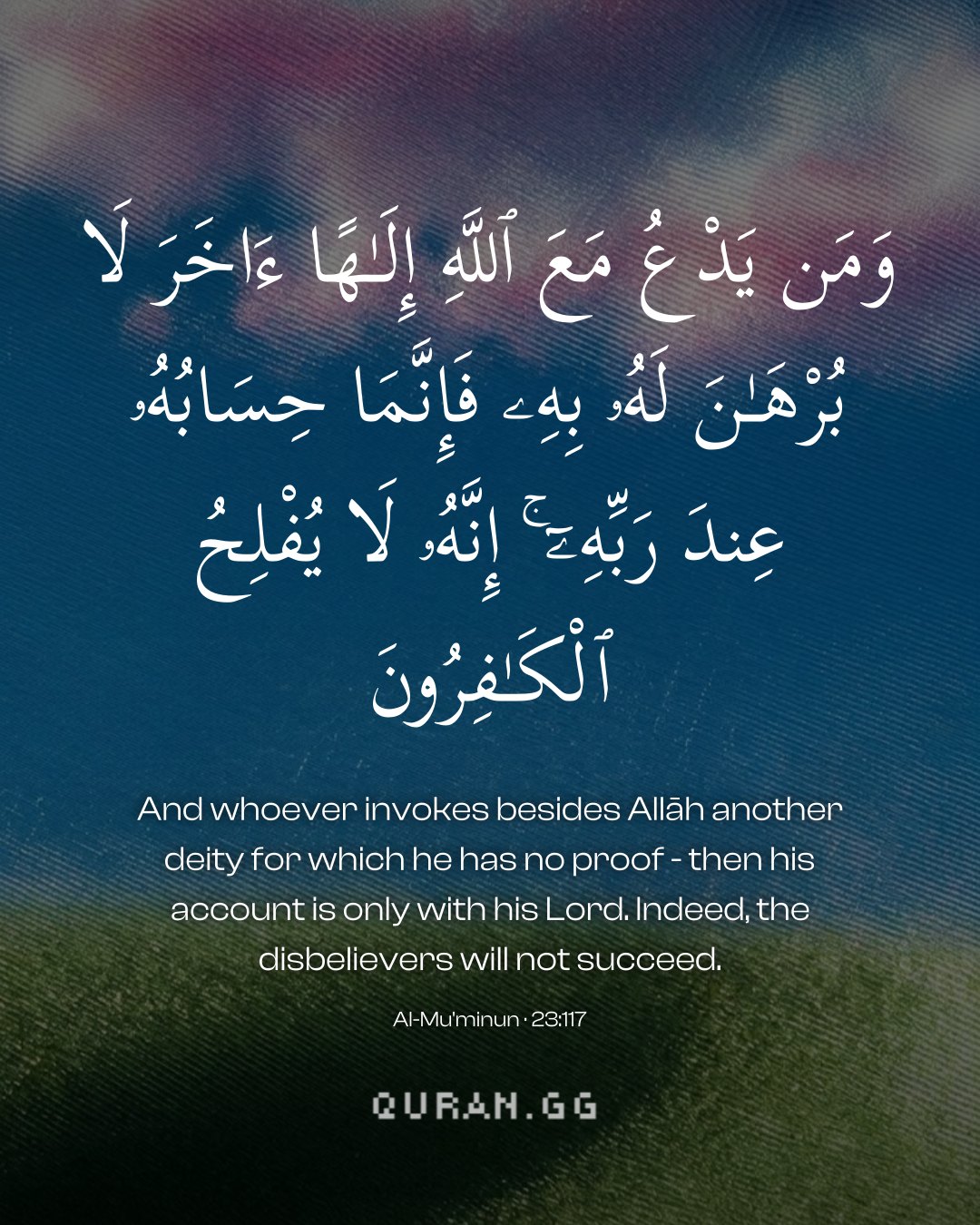
Shirk is the Worst form of Wrong, its Practitioner shall never succeed. Allah threatens those who associate anything else withHim and worship anything with Him. He informs that those whoassociate others with Allah:
لاَ بُرْهَانَ لَهُ
(of whom he has no proof), meaning no evidence for what he says. Then Allah says:
وَمَن يَدْعُ مَعَ اللَّهِ إِلَـهَا ءَاخَرَ لاَ بُرْهَانَ لَهُ بِهِ
(And whoever invokes, besides Allah, any other god, of whom he has no proof;) this is a conditional sentence, whose fulfilling clause is:
فَإِنَّمَا حِسَابُهُ عِندَ رَبِّهِ
(then his reckoning is only with his Lord.) meaning, Allah will call him to account for that. Then Allah tells us:
إِنَّهُ لاَ يُفْلِحُ الْكَـفِرُونَ
(Surely, disbelievers will not be successful.) meaning, they will not be successful with Him on the Day of Resurrection; they will not prosper or be saved.
وَقُل رَّبِّ اغْفِرْ وَارْحَمْ وَأنتَ خَيْرُ الرَحِمِينَ
(And say: "My Lord! Forgive and have mercy, for You are the best of those who show mercy!") Here Allah is teaching us to recite this supplication, for forgiveness, in a general sense, means wiping away sins and concealing them from people, and mercy means guiding a person and helping him to say and do good things.
Commentary
The last few verses of this Surah Al-Mu'minun from verse 115 to verse 118 have special merit. Baghawi and Thalabi have related from Sayyidna Ibn Masud ؓ that he came across a person who was very ill. He recited the above verses into the sick man's ears and he was cured immediately. The Holy Prophet ﷺ asked him what he had whispered in the sick man's ears to which Sayyidna 'Abdullah Ibn Masud ؓ replied that he had recited these verses (115 to 118) in his ears. Thereupon the Holy Prophet ﷺ said, "I swear by Him Who has power over my life that if a person with genuine faith were to recite these verses on a mountain, the mountain itself may move from its place". (Qurtubi and Mazhari)
That joy which is everlasting is the real joy. Fleeting moments of joy have no meaning. In the life of this world, man is forgetful of this fact. But in the Hereafter, it will become abundantly clear to him. Truth manifests itself to a man in this world, but he does not want to disturb his status quo, so he does not accept it. He is not prepared to forego the already available present gain for the sake of any promised future gain. The comforts and the considerations of this world appear valuable to him and he is unable to understand why he should ignore them all and attach himself to a ‘non-thing,’ or abstract promise.
Uthmani text of the Madinah mushaf (King Fahd Complex). Translation: Saheeh International. Tafsir via Quran.com.