The Sign of Allah in the progressive creation of Man from Clay then from Nutfah and thereafter
Allah tells us how He initially created man from an extract of Tin. This was Adam, peace be upon him, whom Allah created from sounding clay of altered black smooth mud. Ibn Jarir said, "Adam was called Tin because he was created from it." Qatadah said, "Adam was created from Tin." This is the more apparent meaning and is closer to the context, for Adam, upon him be peace, was created from a sticky Tin, which is a sounding clay of altered black smooth mud, and that is created from dust, as Allah says:
وَمِنْ ءَايَـتِهِ أَنْ خَلَقَكُمْ مِّن تُرَابٍ ثُمَّ إِذَآ أَنتُمْ بَشَرٌ تَنتَشِرُونَ
(And among His signs is this that He created you (Adam) from dust, and then -- behold you are human beings scattered!) 30:20 Imam Ahmad recorded from Abu Musa that the Prophet said:
Continue reading the tafsir of ayahs 12–16Ma'arif al-Qur'an
Mufti Muhammad Shafi
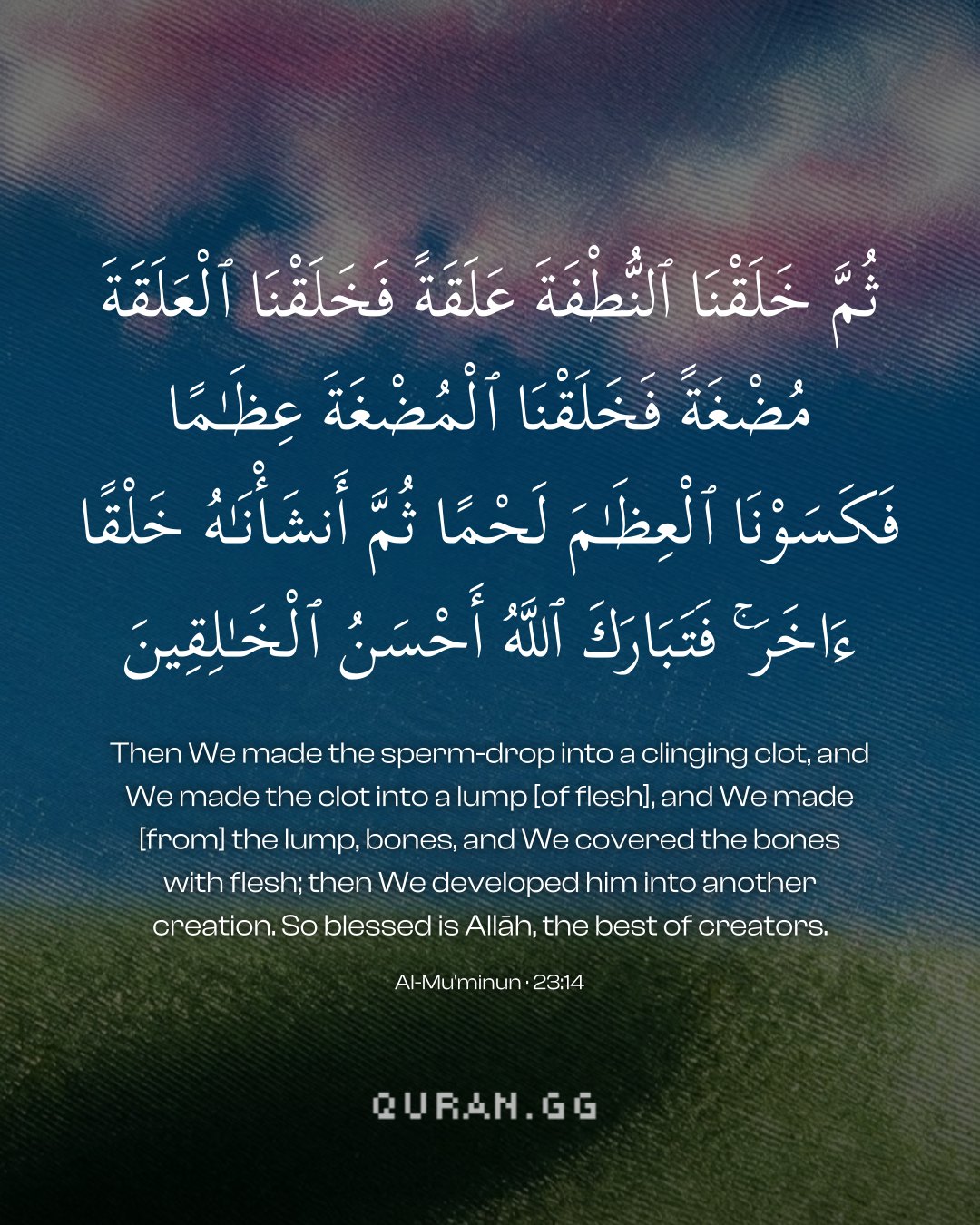
(an extract of clay) which changes into the seed ثُمَّ جَعَلْنَاهُ نُطْفَةً (then We made him a sperm-drop). Now it is well known that the production of food from the earth, its absorption in the human body of that special element which changes into the seed is a long drawn out process. Similarly the third stage of the transformation from the sperm-drop نُّطْفَةَ to clot مُضْغَةَ takes a long time to materialize and has been described by the Qur'an in the words ثُمَّ خَلَقْنَا النُّطْفَةَ عَلَقَةً (then We made the sperm-drop into a clot - 23:14 ). The next three stages, i.e. from عَلَقَةً (clot) to مُضْغَةَ (foetus-lump), from to bones, and thirdly clothing flesh on bones occurring in short periods is not too remote a possibility, and in describing these three changes the particle فَ has been used which, as has been explained earlier, is indicative of uninterrupted succession. The final change in the condition of the unborn child comes when life and soul are breathed into it. And since, according to human reckoning, putting life and soul into a lifeless mass must necessarily take a long time, therefore, here again the word ثُم has been used to describe this final stage of transformation.
The final stage in human creation, i.e. putting life and soul into it
The Qur'an describes this change with the words ثُمَّ أَنشَأْنَاهُ خَلْقًا آخَرَ (We developed it into another creature - 23:14). This distinction is due to the fact that whereas the first six stages in the creation of man are related to the world of elements and substances, the final stage relates to the transfer of soul from the world of spirits into his body and is, therefore, described as - خَلْقًا آخَرَ i.e. a special or distinct creation.
Biological spirit and Real Spirit
"We developed it into another creature" in this verse is interpreted by Ibn ` Abbas, Mujahid, Sha'bi, ` Ikrimah, Dahhak and Abul-` Aliyah ؓ to mean blowing spirit into the body. Tafsir Mazhari mentions that most probably it refers to the biological spirit. According to its explanation spirits are of two kinds. Biological spirit is a subtle substance embedded in every part of the body of a human being or an animal. This is the spirit recognized by medical scientists and the philosophers. This biological spirit is created after the organs are created. That is why its creation is mentioned in this verse with the word ثُمَّ (thereafter). The other kind of spirit is the 'Real spirit'. It belongs to the spiritual universe. This real spirit was created long before the creation of human beings, and it is these spirits which were assembled by Allah when He asked them, "Am I not your Lord?" and they answered, "Why not?" This Real Spirit having been created long before, is connected by Allah Ta’ ala with biological spirit in a manner not known to anyone. Life of man depends on this connection and when biological spirit of a person is disconnected from Real Spirit, he dies. Therefore, it is also possible that it is this connection which is referred to in this verse by the words another creation.
فَتَبَارَكَ اللَّـهُ أَحْسَنُ الْخَالِقِينَ (So, glorious is Allah, the best of the creators-23:14). The word خَلق and تَخلِیق mean "to create something from nothing", which is a very special and exclusive attribute of Allah. Thus, Allah alone is the creator and none else. Neither an angel nor man can create anything. However sometime these two words are used in the sense of manufacturing which is no more than the reshaping and assembly by man of substances created by Allah. The man who does this is also called the creator of an article. The Qur'an says تَخْلُقُونَ إِفْكًا (you invent a lie 29:17), and again it says about Sayyidna ` Isa أَنِّي أَخْلُقُ لَكُم مِّنَ الطِّينِ كَهَيْئَةِ الطَّيْرِ (I create for you from clay something in the shape of a bird - 3:49). In all these places the word خَلق (creating) has been used in the metaphorical sense to mean "manufacture".
Here the word خَالِقِینَ (creators) has been used in the plural and the meaning is that though ordinary human beings who manufacture things may also be called خَالِق or creators in the metaphorical sense, yet Allah is the best among all those creators.
The vivid Quranic description of the various developmental stages of the formation and birth of human beings, is surprisingly identical with modern scientific findings. This provides a clear proof of the fact that the Quran is the Book of God. Had it not been so, such similarity between the findings of modern research and the statements of the Quran, made fourteen hundred years ago, would not have been possible. Cf. 39:6 and the corresponding note.
Uthmani text of the Madinah mushaf (King Fahd Complex). Translation: Saheeh International. Tafsir via Quran.com.