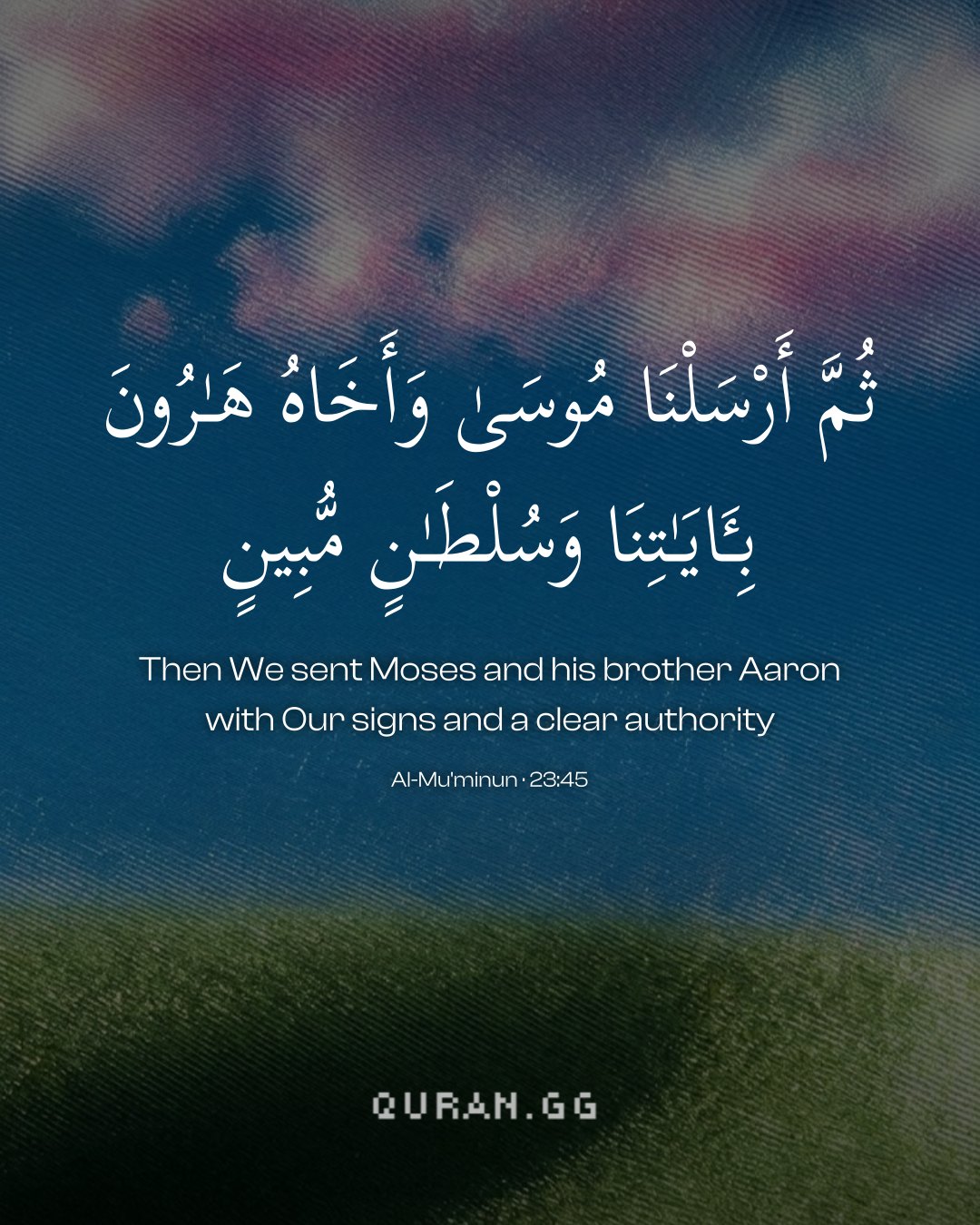
Allah tells us that He sent Musa, peace be upon him, and his brother Harun to Fir`awn and his chiefs with decisive evidence and definitive proof, but Fir`awn and his people were too arrogant to follow them and obey their commands because they were human beings, just as previous nations had denied the Message of the human Messengers. They were of a similar mentality, so Allah destroyed Fir`awn and his chiefs, drowning them all in one day. He revealed the Book to Musa, i.e., the Tawrah, in which were rulings, commands and prohibitions, after He had destroyed Fir`awn and the Egyptians and seized them with a punishment of the All-Mighty, All-Capable to carry out what He wills. After Allah revealed the Tawrah, Allah did not destroy any nation with an overwhelming calamity; instead, He commanded the believers to fight the disbelievers, as He says:
(And indeed We gave Musa -- after We had destroyed the generations of old -- the Scripture as an enlightenment for mankind, and a guidance and a mercy, that they might remember.) 28:43
Ma'arif al-Qur'an
Mufti Muhammad ShafiOn ayahs 42–50
Commentary
وَآوَيْنَاهُمَا إِلَىٰ رَبْوَةٍ ذَاتِ قَرَارٍ وَمَعِينٍ (and We gave them shelter on a height, a place of rest and running springs). According to Bayan-ul-Qur’ an, this verse refers to the event that a tyrant was resolute to kill Sayyidna ` Isa and his mother (علیہما السلام) right from his childhood. They escaped from him and, with Allah's grace, found a place on a height where they enjoyed a peaceful life until Sayyidna ` Isa (علیہ السلام) attained maturity and was entrusted with prophethood. (This commentary is taken from Khulasa-e-tafsir of Ma` ariful-Qur’ an).
Tazkirul Quran
Maulana Wahiduddin KhanOn ayahs 44–46
After the advent of each prophet, the succeeding generations of his community were always led astray. In order to reform them, prophets were sent to them again and again. In Adam’s generation Noah appeared. In Noah’s generation (the ‘Ad), Hud appeared as a prophet. In Hud’s generation (the Thamud), Salih appeared. But on each occasion those who had accepted the prophet of the past without question, were the very same people who were not at all prepared to accept the prophet of their own times. The reason for this is that the prophet of the past, as a result of a wealth of traditions surrounding him, ultimately becomes a symbol of national pride, or national identity. He assumes the status of a national hero. By accepting him, one’s superiority complex is satisfied. Obviously, who will refuse to accept such a prophet? But, the case of the prophet during his lifetime is just the opposite. He has neither any halo of history around him nor any traditions of greatness to enhance his persona. Accepting him amounts to accepting an invisible reality. This is why those who accepted the prophet of the past have always refused to accept the prophet of their own times. ‘So away with the people who will not believe!’ Those referred to in this injunction are people who could recognize God’s emissary only when, as a result of historical process, he had become their national hero.
Uthmani text of the Madinah mushaf (King Fahd Complex). Translation: Saheeh International. Tafsir via Quran.com.