The Record of the Wicked and some of what happens to Them
Allah says truly,
إِنَّ كِتَـبَ الْفُجَّارِ لَفِى سِجِّينٍ
(Nay! Truly, the Record of the wicked is in Sijjin.) meaning, that their final destination and their abode will be in Sijjin, which is derived from the word prison (Sijn), and here it means straitened circumstances. Thus, Allah expresses the greatness of this matter, saying;
وَمَآ أَدْرَاكَ مَا سِجِّينٌ
(And what will make you know what Sijjin is) meaning, it is a great matter, an eternal prison, and a painful torment. Some have said that it is beneath the seventh earth. It has been mentioned previously in the lengthy Hadith of Al-Bara' bin `Azib that the Prophet said,
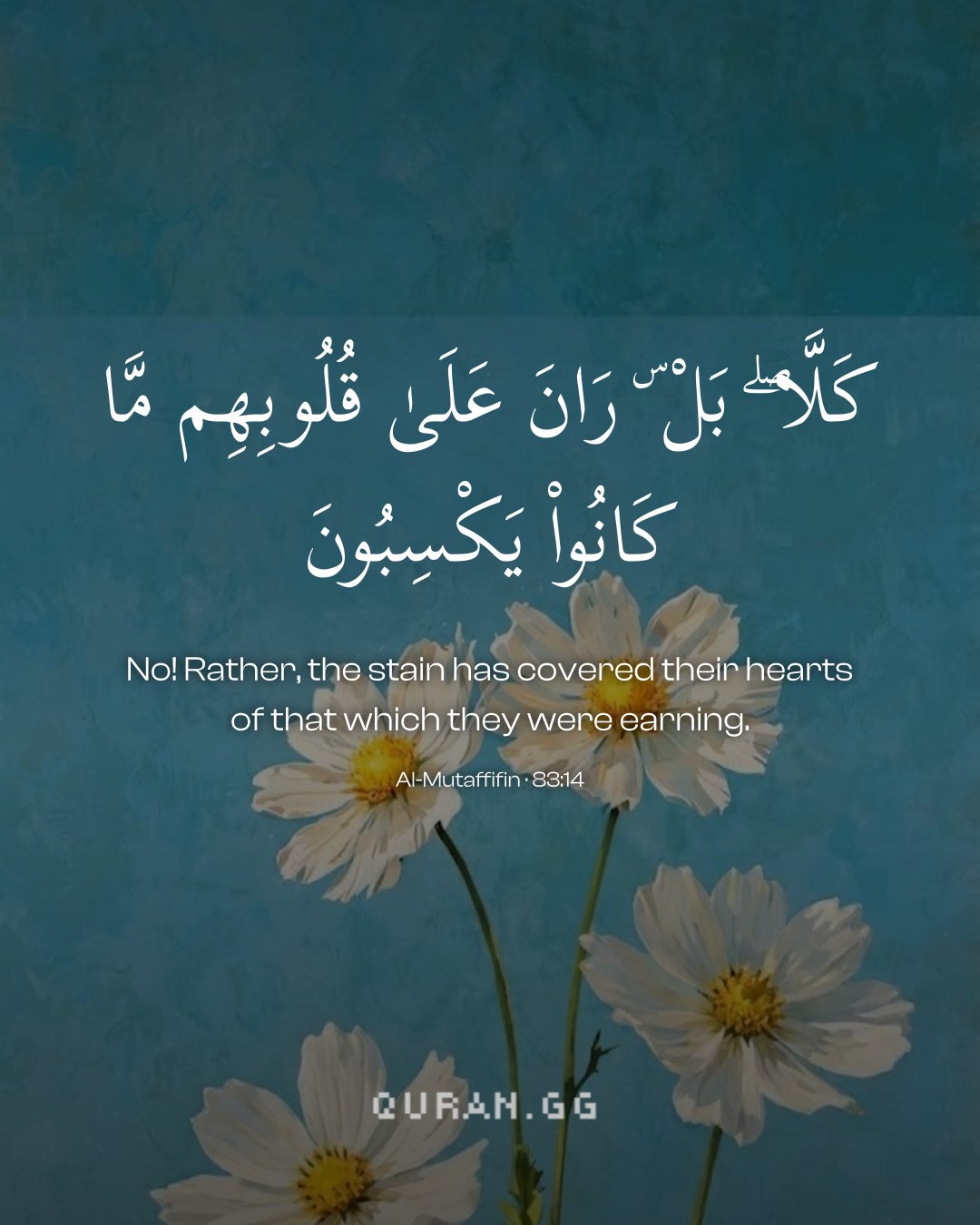
sins has destroyed their innate capacity to distinguish right from wrong. Sayyidna Abu Hurairah ؓ narrates that the Holy Prophet ﷺ said: "Surely, when the servant commits a sin, a black dot appears on his heart. If he repents from it, his heart is polished clean. However, if he increases in the sin, the blackness continues to increase. That is the statement of Allah: كَلَّا ۖ بَلْ ۜ رَانَ عَلَىٰ قُلُوبِهِم 'No! But that which they used to commit has covered their hearts with rust. [ 83:14] '." [ Baghawi, Ahmad, Tirmidhi, Nasai, Ibn Majah, Ibn Hibban and al-Hakim have recorded it, and Tirmidhi has rated it as sahih, as quoted by Mazhari ]. The particle kalla كَلَّا ، in Arabic grammar, is called harf-ur-ra’ d` 'particle of disapproval, particle of repelling or averting'. In the preceding verses, mention was made of the attitude of the unbelievers towards the Qur'anic verses, in that when they are recited to them, they say, " (These are) tales of the ancients." [ 13]. The present verse uses kalla كَلَّا to repel the false idea of the ignoramus [ that Qur'an is the tale of the ancients ]. In fact, [ the heavy ] load of their sins have eclipsed the light and innate capacity to separate the right and the wrong. This capacity is innate and inborn in man. The verse purports to say that their rejection is not based on any logical or intellectual evidence, but their hearts have become blind, as a result they are unable to see the good and the bad.
Tazkirul Quran
Maulana Wahiduddin KhanOn ayahs 4–16
Every human being wants to have his dues paid in full. But it is only right and proper that, if he is a man of character, he should also take care to give to others their full and rightful dues. He should want for others whatever he wants for himself. Those who take full measure for themselves and give less to others, will reach the Hereafter in such an ill state of grace that they will be doomed to eternal perdition. One who tries to ensure full measure for himself knows that everyone should receive his just deserts. In this context, if he gives less while giving to others, he lessens his realization of or sensitivity to the rights of others. If a man repeats this sort of misdeed again and again, a time will finally come when he will completely lose his sensitivity to others’ rights. His heart will be completely corroded by his sinful actions. In the present world many people are not at all keen to respect the rights of others or to give them their full dues. They are interested solely in recovering in full what is due to them from others. Such people will remain in a state of deprivation in the Hereafter. Wise are those who are eager to discharge others’ rights and dues fully, because they are the ones who will be entitled to the great bounties of God in the Hereafter.
Uthmani text of the Madinah mushaf (King Fahd Complex). Translation: Saheeh International. Tafsir via Quran.com.