Which was revealed in Makkah
بِسْمِ اللَّهِ الرَّحْمَـنِ الرَّحِيمِ
(In the Name of Allah, the Most Gracious, the Most Merciful.
The Command to stand at Night (in Prayer)
Allah commands His Messenger to cease being wrapped up, and this means to be covered during the night. He commands him to get up and stand in prayer to His Lord. This is as Allah says,
تَتَجَافَى جُنُوبُهُمْ عَنِ الْمَضَاجِعِ يَدْعُونَ رَبَّهُمْ خَوْفاً وَطَمَعاً وَمِمَّا رَزَقْنَـهُمْ يُنفِقُونَ
(Their sides forsake their beds, to invoke their Lord in fear and hope, and they spend out of what We have bestowed on them.) (32:16) Thus, the Prophet did as Allah ordered him, by standing for prayer at night. This was obligatory upon him alone, as Allah said,
Continue reading the tafsir of ayahs 1–9 Injunctions Pertaining to salat-ut-Tahajjud and its Abrogation
Reading into the titles muzzammil and muddaththir a consensus of scholarly opinion assigns the revelation of this Surah to the earliest period when the five daily prayers had not become obligatory. They were prescribed on the night of Holy Prophet's ﷺ Ascent to heavens. [ mi` raj ].
Imam Baghawl (رح) ، says, on the basis of Ahadith reported by Sayyidah ` A'ishah Siddigah ؓ and others, that 'night-prayer' was compulsory for the Holy Prophet ﷺ and the entire Muslim community until the five prayers were not prescribed.
This verse not only prescribes the night-prayer but it also prescribes to stand up in prayer from at least one quarter of the night, because the verse under comment basically commanded to stand up all night to pray except a little portion of it.
Imam Baghawi (رح) says, on the basis of narration of Ahadith, that the Holy Prophet ﷺ and the noble Companions ؓ in compliance with this command, spent the major portion of the night in tahajjud, so much so that their feet would swell and this exertion caused hardship and difficulty to them. This situation continued for a year. After that, towards the end of the Surah, the following injunction was revealed:
فَاقْرَءُوا مَا تَيَسَّرَ مِنْهُ
'...Therefore, recite as much of it as is easy_[ 73:20] '
It repealed the obligation of staying up for a long time, and granted them concession and permission to stay up for prayer as much as they could easily manage. This is transmitted by Abu Dawud and Nasa'i on the authority of Sayyidah ` A'ishah ؓ ، Sayyidna Ibn ` Abbas ؓ says that when the five prescribed prayers became obligatory on the night of mi` raj, the obligatory nature of tahajjud was abrogated. It was, however, retained as sunnah, because the Holy Prophet ﷺ performed it most regularly. Most of the blessed Companions ؓ were regular with their tahajjud as well. [ Mazhari ] Let us now analyze the wordings of the verses.
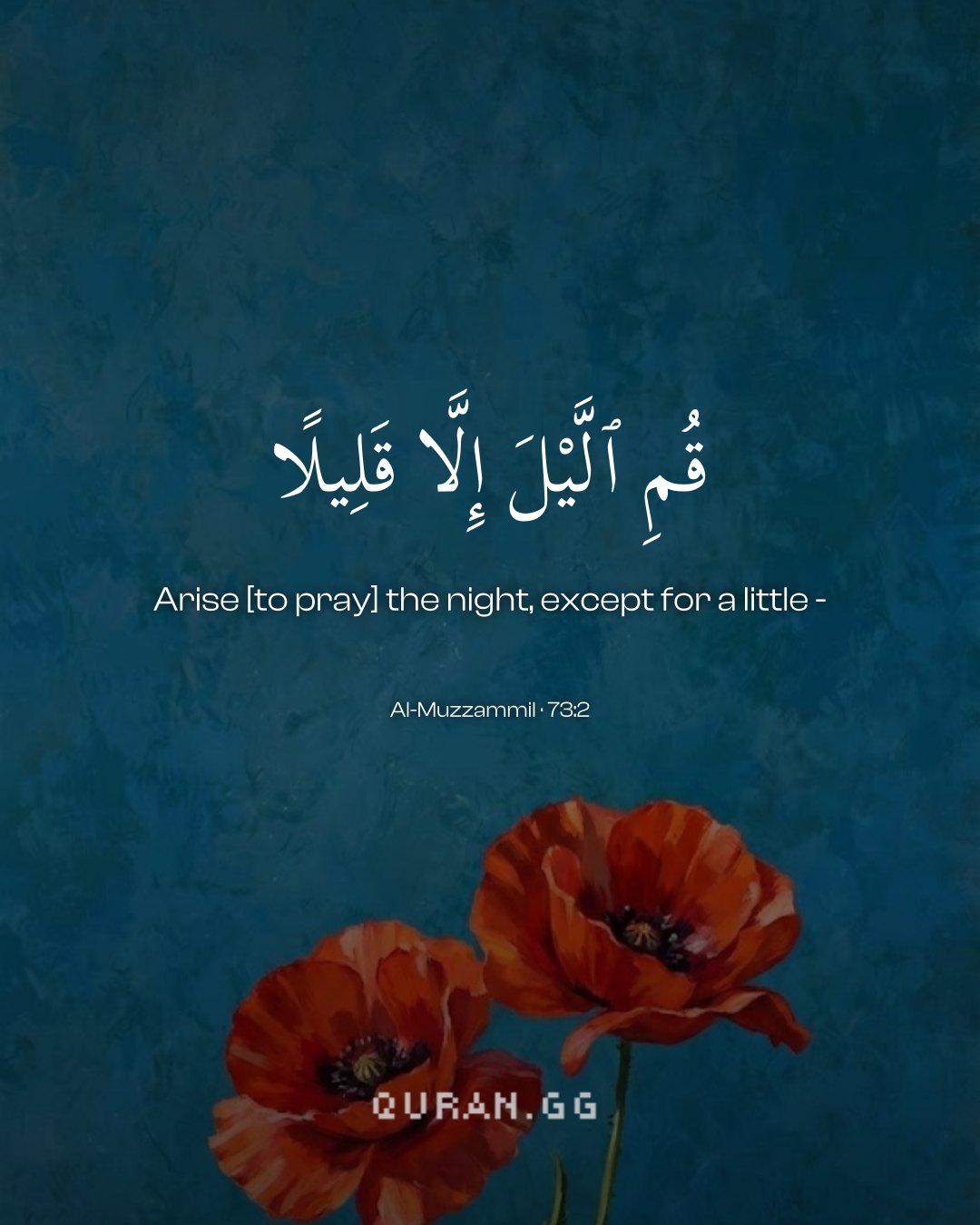
قُمِ اللَّيْلَ إِلَّا قَلِيلًا 'stand at night (for prayer) except a little_[ 73:2] '. The word al-lail with the definite article 'al' connotes 'the entire night', signifying that he should stay up the whole night for prayer except a little portion of it. As the word 'little' is indefinite, the verse further clarifies:
نِّصْفَهُ أَوِ انقُصْ مِنْهُ قَلِيلًا 'half of it, or make it a little less, [ 3] or أَوْ زِدْ عَلَيْهِ make it a little more [ 73:4] '. This is explicative of the exception 'except a little'. A question may be raised here that 'a little' cannot be 'half. The answer is that the earlier portion of the night is spent in the prayer at maghrib and ` isha'. 'Half then refers to the half of the rest of the night. Its total in relation to the whole night amounts to 'a little'. The verse permits to reduce it a little less than half and it also permits to add to it a little more than half. Thus it was compulsory to stay up at least for a little over one fourth of a night for prayer.
Uthmani text of the Madinah mushaf (King Fahd Complex). Translation: Saheeh International. Tafsir via Quran.com.