Which was revealed in Makkah
بِسْمِ اللَّهِ الرَّحْمَـنِ الرَّحِيمِ
(In the Name of Allah, the Most Gracious, the Most Merciful.
The Command to stand at Night (in Prayer)
Allah commands His Messenger to cease being wrapped up, and this means to be covered during the night. He commands him to get up and stand in prayer to His Lord. This is as Allah says,
تَتَجَافَى جُنُوبُهُمْ عَنِ الْمَضَاجِعِ يَدْعُونَ رَبَّهُمْ خَوْفاً وَطَمَعاً وَمِمَّا رَزَقْنَـهُمْ يُنفِقُونَ
(Their sides forsake their beds, to invoke their Lord in fear and hope, and they spend out of what We have bestowed on them.) (32:16) Thus, the Prophet did as Allah ordered him, by standing for prayer at night. This was obligatory upon him alone, as Allah said,
Continue reading the tafsir of ayahs 1–9Ma'arif al-Qur'an
Mufti Muhammad Shafi
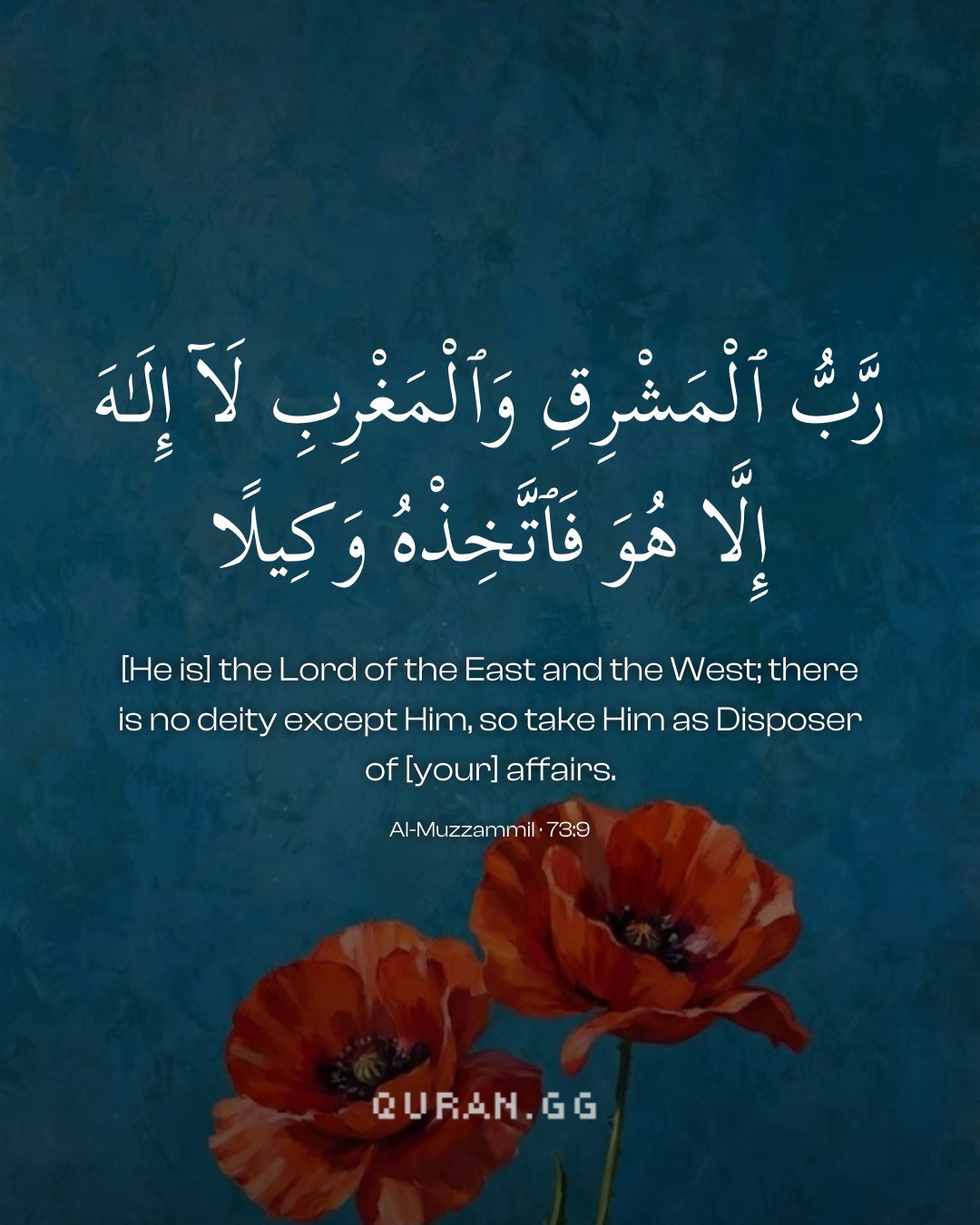
رَبُّ الْمَشْرِقِ وَالْمَغْرِبِ لَآ اِلٰهَ اِلَّا هُوَ فَاتَّخِذْهُ وَكِيْلًا (He is the Lord of the East and the West; there is no god but He; so take Him for [ your ] Guardian...73:9). The word wakil, lexicologically, refers to a 'person who has been given a task to do'. 'To take Allah as guardian' means that all matters and affairs should be entrusted to Allah. Technically, this is called tawakkul 'trust'.
The Holy Prophet ﷺ is given several injunctions in this Surah. This is the fifth injunction. Imam Ya` qub Karkhi says that from the beginning of the Surah up to this verse there is reference to the maqamat suluk 'journeying or a methodical travelling along the spiritual path through the various states and stations under the direction of a spiritual master or adept'. The references are as follows: [ 1] solitude at night to worship Allah; [ 2] preoccupation with Qur'an; [ 3] constant Remembrance of Allah; [ 4] severance of relationship with "everything-other-than-Allah, and [ 5] total trust in Allah. Preceding the last injunction about trust,
Allah's attribute is given, thus: رَبُّ الْمَشْرِقِ وَالْمَغْرِبِ 'He is the Lord of the East and the West__[ 73:9] '. In other words, Allah is the Cherisher and Sustainer of the entire universe. He is responsible to fulfill the needs of all from the beginning to the end. He alone can assist in all matters. Just as He has been singled out for worship, so should He be singled out for reliance, and full trust must be put in Him. Anyone who trusts and relies on Allah will never be deprived of his needs as the Qur'an puts it:
'...And whoever places his trust in Allah, He is sufficient for him. _[ 65:3] '
The Correct Concept of Tawakkul [ Trust ]
Trust in Allah does not imply for anyone to avoid the apparent means of acquiring livelihood, or giving up the normal ways of saving oneself from any affliction. The ways and means that Allah has created for a particular purpose should not be abandoned while placing total trust in Allah. On the contrary, in order to achieve our purpose it is necessary for us to utilize the God-given power and causes at our disposal to the fullest extent, but we should not repose blind faith in material causes and means. But having adopted actions of choice, the result should then be left with Allah whose will is the Ultimate Cause of everything.
The Holy Prophet himself has explained tawakkul in this way. Imam Baghawi, in his Sharh-us-Sunnah, and Baihagi, in his Shu` ab-ul-'Iman, have cited the following Hadith:
ان نفسا لن تموت حتی تستکمل رزقھا، الا فاتقواللہ واجملوا فی الطلب۔
"Jibra'il (علیہ السلام) has inspired me with the thought that no person will ever die until he receives, in full, his sustenance that Allah has decreed for him. Therefore, fear Allah and be moderate in your search."
In other words, we should not be over-absorbed in quest for our needs so deeply that the attention of the heart is totally focused on the material causes and means. Instead, after adopting the ways and means to fulfill our needs, we should repose our total trust in and reliance upon Allah in the sense that without His will, no cause can bring any effect.
Tirmidhi transmits a Hadith on the authority of Sayyidna Abu Dharr Al-Ghifari that the Holy Prophet said: "Zuhd (Renunciation of the world) does not mean to turn lawful things into unlawful or squander the wealth Allah has given you. Renunciation of the world means to have more faith in the things that are in Allah's hands than what are in your hands." [ Mazhari ]
Literally ‘weighty words’ refers to that order for giving warning which is mentioned in the next chapter, ‘Arise and give warning’ ( 74:2 ). This means inform people about the hazards of the Hereafter. Undoubtedly this is the most difficult task in the world. For this, the missionary has to stand by the pure and unadulterated Truth, even if he becomes a stranger to all his people. He has to tolerate being tormented by the people, so that the relationship between him and his addressees remains unaffected till the last moment. He has to be unilaterally governed by the principles of patience and avoidance of confrontation, so that his status as da‘i should not be damaged.
Uthmani text of the Madinah mushaf (King Fahd Complex). Translation: Saheeh International. Tafsir via Quran.com.