A Parable of the Removal of the Earnings of the Disbelievers
This is a parable that Allah made of the behavior of the Quraysh disbelievers with the great mercy, and tremendous favors He granted them. The mercy and favor of sending of Muhammad ﷺ to them. But they met him with denial, rejection and opposition. Therefore Allah says,
إِنَّا بَلَوْنَـهُمْ
(Verily, We have tried them) meaning, `We have tested them.'
كَمَا بَلَوْنَآ أَصْحَـبَ الْجَنَّةِ
(as We tried the People of the Garden,) This refers to a garden containing different types of fruits and vegetation.
إِذْ أَقْسَمُواْ لَيَصْرِمُنَّهَا مُصْبِحِينَ
(when they swore to pluck the fruits of the (garden) in the morning,) meaning, they vowed between themselves during the night that they would pluck the fruit of the garden in the morning so that poor and the beggars would not know what they were doing. In this way they would be able to keep its fruit for themselves and not give any of it in charity.
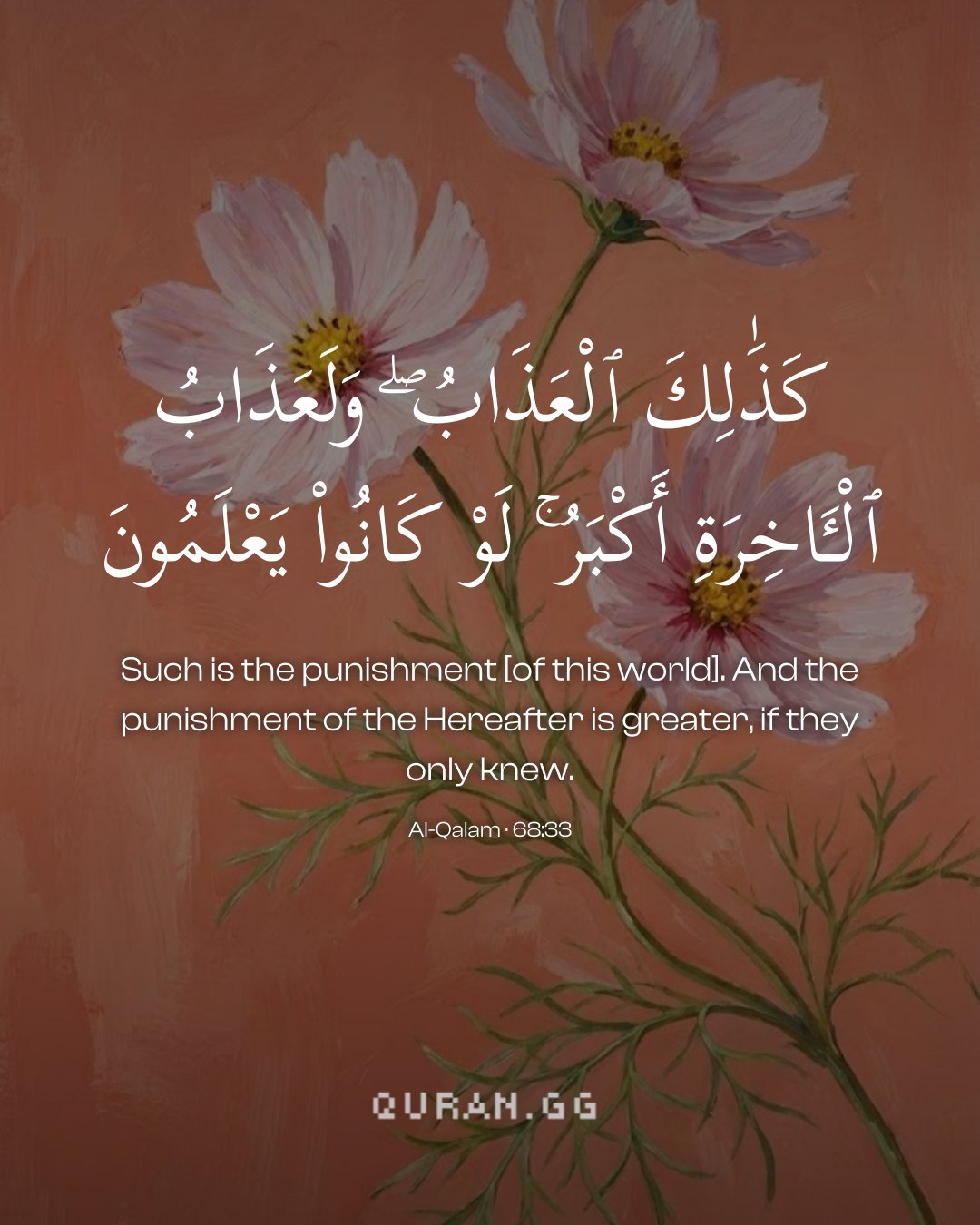
Continue reading the tafsir of ayahs 29–41 كَذَٰلِكَ الْعَذَابُ (In this way the punishment comes. And, of course, the punishment of the Hereafter is even greater, if they but realize!....68:33). After a brief reference to the famine faced by the Makkans and a detailed account of the People of the Garden whose garden was burnt as a punishment, the present verse sets down a general rule. When a Divine punishment visits, it visits in this way, and this kind of punishment in the mortal world does not serve as an expiation for the punishment in the Hereafter. The punishment of the Hereafter is greater and more severe.
The following verses give a description of the reward of the righteous, followed by refutation of another false claim of the pagans of Makkah. They denied that Resurrection will ever occur. They thought the story of Resurrection and accountability is fiction. Even if that does happen, they thought, they will get the same type of blessings and wealth as they have in this world. Several verses respond to their false belief. In verse [ 35] Allah poses the rhetorical question to the disbelievers: 'Shall We make the obedient like the sinners? [ 35] This is a strange sort of assertion for which they have no authority, nor proof nor any celestial book. Nor is there any promise from Allah that they will get the same type of blessings.
A Rational Proof of Resurrection
These verses give a solid proof to the necessity of the Day of Judgment, because accountability, rewarding the righteous and punishing the evil are all rationally necessary. It is witnessed by every person in this mortal world, and no one can deny, that the wicked, the evil, the unjust, the thieves and the bandits generally lead a comfortable and enjoyable life in the mortal world. A thief or a bandit sometimes in one night gains so much of wealth that a righteous person might not gain as much in his entire life. The former has no fear of Allah or the Hereafter, nor does he have any sense of shame. He fulfills his selfish desires as he likes - by hook or by crook. The latter fears Allah, and if he does not have that, his sense of shame among his brotherhood overwhelms him. In short, in the mortal world the wicked and the evil ones seem to be successful, and the good people seem to be unsuccessful. If there does not arise an occasion where fair play and justice is established - where the good people would be rewarded and the evil ones would be punished? It would be meaningless to refer to evil as evil. There would be no reason to stop a person from fulfilling his selfish desires and doing the evil acts. On the other hand, justice will have no meaning or significance. How will the believers in God's existence respond to the following question: Where is God's justice?
One may argue that a criminal is apprehended, he is exposed to disgrace and is punished. This distinguishes the innocent persons from the evil ones right here in this world. Laws and statutes of a government’ s establish standards of justice and fair play. But this is incorrect, because it is not possible for a government to keep an eye on every one, everywhere and in all circumstances. Wherever it does happen, it is not an easy task to gather the necessary judicial evidence, so that the guilty person may be convicted and punished. And even if the judicial evidence could be gathered, there are several escape doors through which the guilty person could get away, such as force, bribery, intercession and pressure. If we review the punishment history of the present-day governments and courts, it would appear that nowadays only those people are punished who are fools, brainless and helpless or without support. They are not cunning enough to find a loophole in the legal system, or an escape route, nor do they have enough money to pay for bribery, nor do they have an influential person to back them or intercede on their behalf or they cannot use these things because of their foolishness. The rest of the criminals are moving freely.
Whatever a man earns in this world is apparently from farming or industry or other such pursuits. But, in fact, it is all given to him by the grace of God. If one considers it a gift from God and sets apart a portion of it for other subjects of God, Almighty God will bless his earnings. On the contrary, one who considers his earnings the result purely of his own talents and who is not, therefore, prepared to give others their dues, will find that his earnings will be of no avail. This is a strict law of God. In some cases, it manifests itself in this world, but in the Hereafter it will manifest itself for all, and none shall be exempt from it.
Uthmani text of the Madinah mushaf (King Fahd Complex). Translation: Saheeh International. Tafsir via Quran.com.