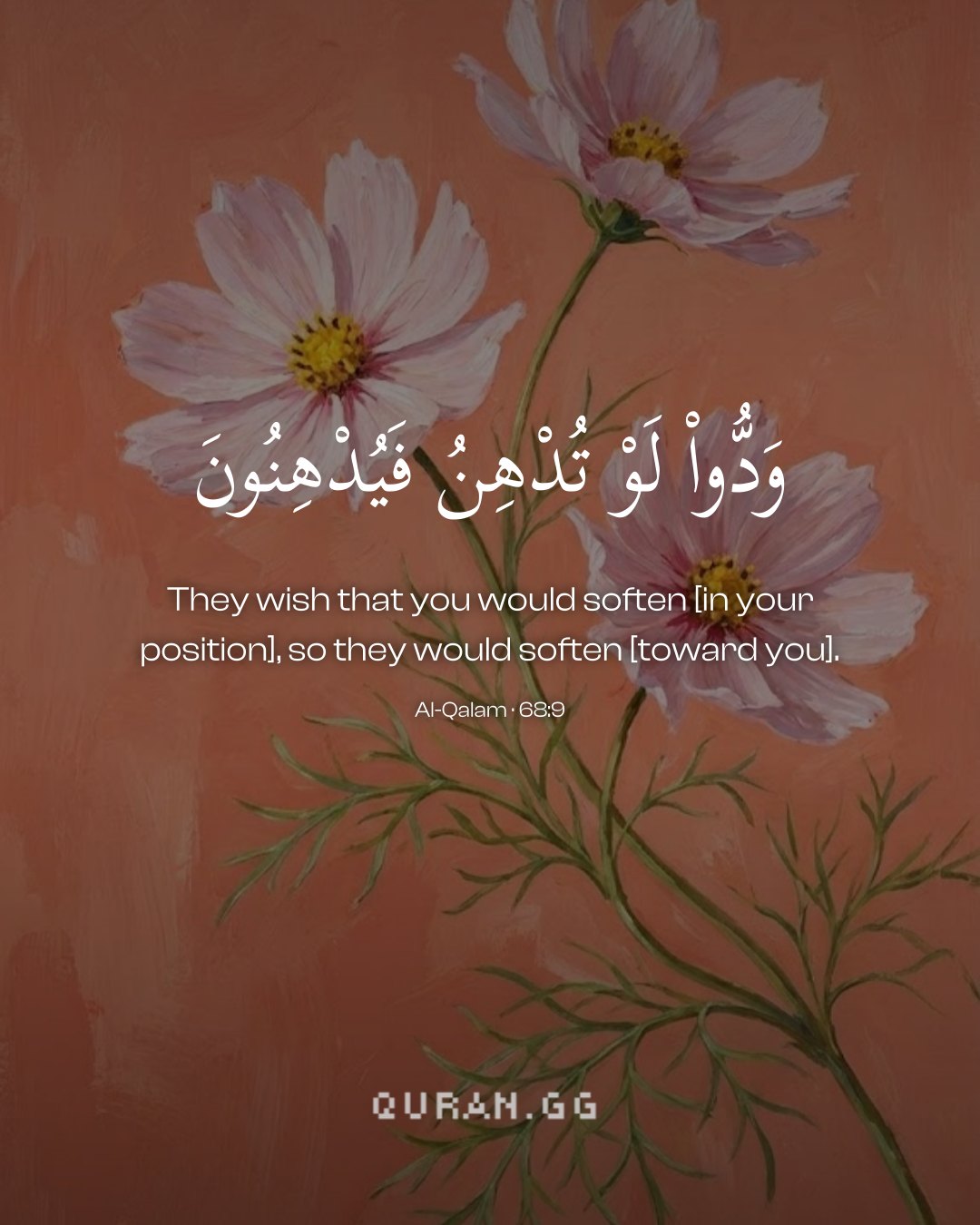
(So, do not obey the deniers. They wish that you should compromise with them, so they (too) would compromise with you.) Ibn `Abbas said, "That you would permit them (their idolatry) and they also would permit you (to practice your religion)." Mujahid said,
وَدُّواْ لَوْ تُدْهِنُ فَيُدْهِنُونَ
(They wish that you should compromise with them, so they (too) would compromise with you.) "This means that you should be quiet about their gods and abandon the truth that you are upon." Then Allah says,
فَلَا تُطِعِ الْمُكَذِّبِينَ وَدُّوا لَوْ تُدْهِنُ فَيُدْهِنُونَ (So, do not obey those who reject [ the true faith ]. They wish that you become flexible [ in your faith ], and they will become flexible [ in their hostile attitude.]....68:8-9]. The interpretation of this verse as adopted in this translation is based on the interpretation of Sayyidna Ibn ` Abbas ؓ as reported by Qurtubi.
Ruling
This verse indicates that any such compromise with the unbelievers is tantamount to mudahanah fid-din, flexibility in religion, and this is forbidden. [ Mazhari ]. Such a pact of leniency in matters of religion is not permissible, unless compelled by necessity.
Tazkirul Quran
Maulana Wahiduddin KhanOn ayahs 4–15
Having a sublime character means rising above the standard of others’ behaviour. It should not be the believer’s way to deal badly with those who are not good to him, while giving fair treatment to those who are good to him. On the contrary, he should do good to everybody, even though others may not do the same for him. The character of the Prophet was of the latter type, which proves that he was a man of principle. He was not a product of circumstances, but of his own high principles. His sublime character was consistent with his claim to be a prophet.
Uthmani text of the Madinah mushaf (King Fahd Complex). Translation: Saheeh International. Tafsir via Quran.com.