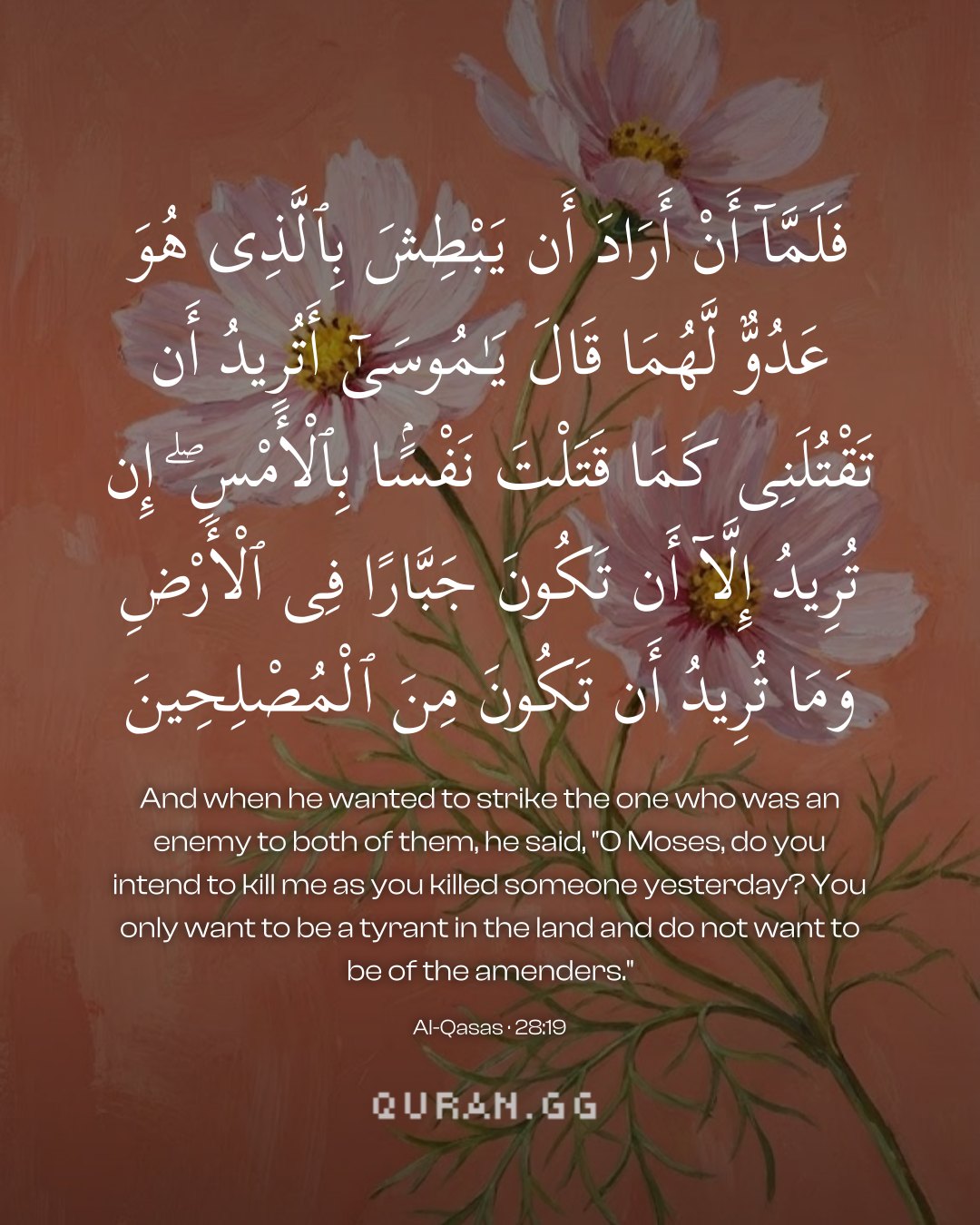
فَلَمَّآ أَنْ أَرَادَ أَن يَبْطِشَ بِٱلَّذِى هُوَ عَدُوٌّ لَّهُمَا قَالَ يَـٰمُوسَىٰٓ أَتُرِيدُ أَن تَقْتُلَنِى كَمَا قَتَلْتَ نَفْسًۢا بِٱلْأَمْسِ ۖ إِن تُرِيدُ إِلَّآ أَن تَكُونَ جَبَّارًا فِى ٱلْأَرْضِ وَمَا تُرِيدُ أَن تَكُونَ مِنَ ٱلْمُصْلِحِينَ ١٩
And when he wanted to strike the one who was an enemy to both of them, he said, "O Moses, do you intend to kill me as you killed someone yesterday? You only want to be a tyrant in the land and do not want to be of the amenders."
How the Secret of this Killing became known
Allah tells us that when Musa killed that Coptic,
فِى الْمَدِينَةِ خَآئِفاً
(he became afraid in the city) meaning, of the consequences of his action,
يَتَرَقَّبُ
(looking about) means, turning around and watching out, waiting for the consequences of his action to befall him. He went out and about, and saw the man who sought his help the day before, fighting with another Coptic. When Musa passed by him, he called for his help again, against this other Coptic. Musa said to him:
إِنَّكَ لَغَوِىٌّ مُّبِينٌ
(Verily, you are a plain misleader!) meaning, `you obviously lead people astray and are very evil.' Then Musa intended to attack that Coptic, but the Israelite -- because of his own cowardice and weakness -- thought that Musa wanted to hit him because of what he had said, so he said, in self-defence --
يمُوسَى أَتُرِيدُ أَن تَقْتُلَنِى كَمَا قَتَلْتَ نَفْساً بِالاٌّمْسِ
(O Musa! Is it your intention to kill me as you killed a man yesterday) Nobody except him and Musa, peace be upon him, knew about it, but when the other Coptic heard this, he took the news to Fir`awn's gate and told him about it. So Fir`awn came to know of it, and he became very angry and resolved to kill Musa, so he sent people after him to bring him to him.
قَالَ رَبِّ بِمَا أَنْعَمْتَ عَلَيَّ فَلَنْ أَكُونَ ظَهِيرًا لِّلْمُجْرِمِينَ (He [ Musa ] said, "0 my Lord, since You have favoured me, I will never be a supporter to the sinners." -28:17). When Allah Ta’ ala pardoned this slip of Sayyidna Musa (علیہ السلام) he said in gratitude to Allah Ta` ala that he would never again help a criminal. The second incident of the quarrel had proved that the Isra'ili in whose defense Musa (علیہ السلام) had involved himself in the brawl was quarrelsome. Therefore, by declaring him a criminal he vowed not to help such a person again. Sayyidna Ibn ` Abbas ؓ while explaining this verse, has maintained that the word 'criminals' stands here for infidels. Qatadah has also interpreted the verse in almost the same way. On the basis of these commentaries it seems that actually the Isra'ili, whom Sayyidna Musa (علیہ السلام) had defended, was not a Muslim but he helped him considering that he was an oppressed person.
Continue reading the tafsir of ayahs 17–21 This incident happened in the capital of Egypt before Moses received prophethood. One day, he saw an Egyptian and an Israelite fighting with each other. The Israelite called upon Moses (who was an Israelite himself) to help him. Moses wanted to separate them, but the Egyptian turned on Moses who in self-defence, gave him a blow. Accidentally, the blow led to the death of the Egyptian. The Egyptians at that time were committing atrocities on the Israelites on a large scale. In this context, had Moses viewed the matter from the communal point of view, he would have treated it as a heroic feat and boasted about it. But, on the contrary, he was very sorry about the Egyptian’s death. He immediately turned towards God and prayed for His forgiveness. ‘I will never be a helper of the guilty’ means, ‘I will not support anybody without investigating the matter.’ A person’s apparently belonging to an oppressed community and his soliciting support by accusing another person of oppression are not enough to prove that the latter is really an oppressor and that the former (the complainant) is really the oppressed person. Therefore, the right approach on such occasions is for the matter to be properly investigated and support should be extended to a complainant only when, on impartial investigation, his being oppressed has been established.
Uthmani text of the Madinah mushaf (King Fahd Complex). Translation: Saheeh International. Tafsir via Quran.com.