Surah Al-Qasas Ayah 58 (28:58) — Meaning & Tafsir | Quran.GG

Surah Al-Qasas, Ayah 58

28:58 · Meaning and tafsir

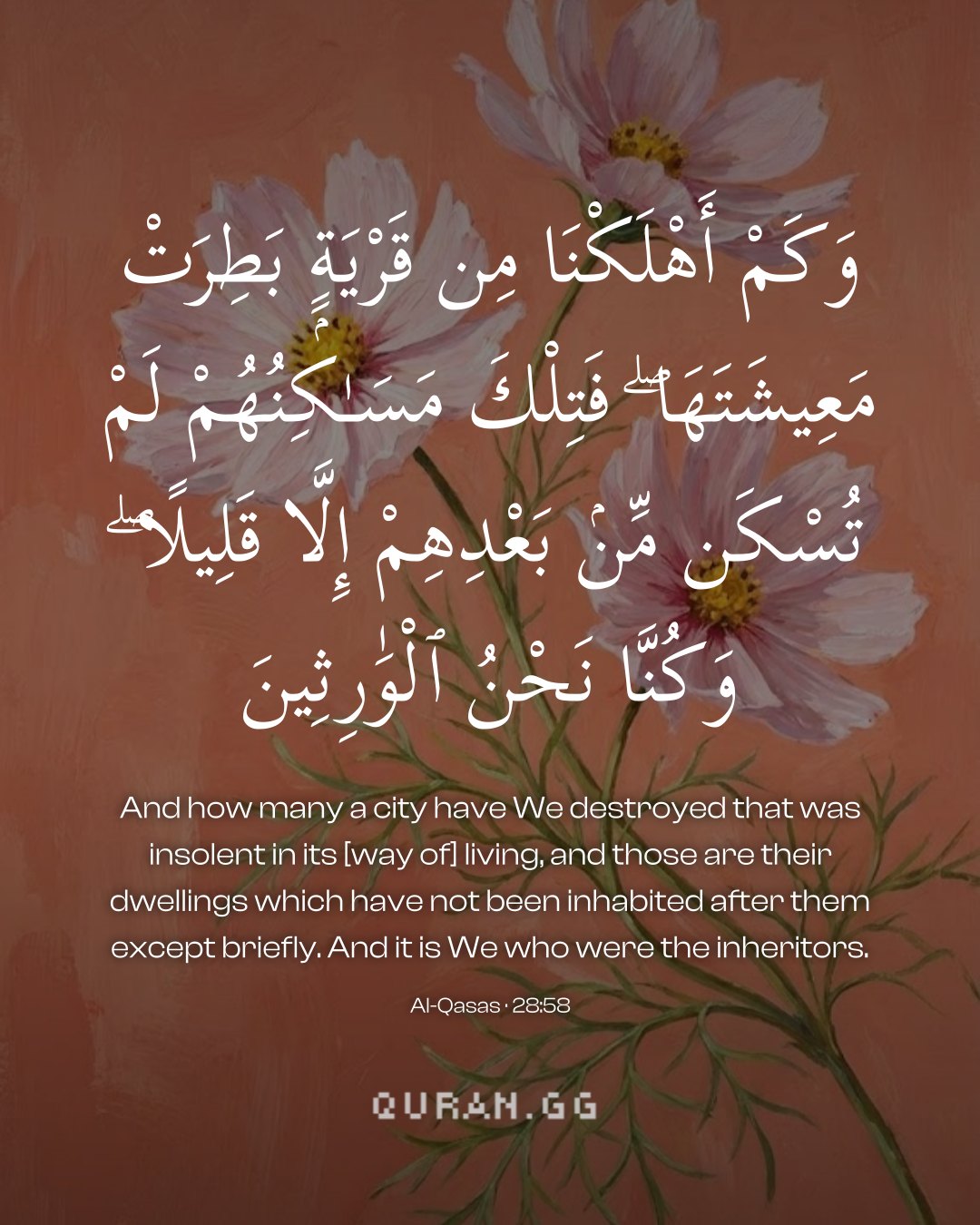
وَكَمْ أَهْلَكْنَا مِن قَرْيَةٍۭ بَطِرَتْ مَعِيشَتَهَا ۖ فَتِلْكَ مَسَـٰكِنُهُمْ لَمْ تُسْكَن مِّنۢ بَعْدِهِمْ إِلَّا قَلِيلًا ۖ وَكُنَّا نَحْنُ ٱلْوَٰرِثِينَ ٥٨

And how many a city have We destroyed that was insolent in its [way of] living, and those are their dwellings which have not been inhabited after them except briefly. And it is We who were the inheritors.

Surah Al-Qasas 28:58 in Arabic with its translation: “And how many a city have We destroyed that was insolent in its [way of] living, and those are their dwellings…”

Make something with this ayah

Turn it into a video for Stories, Reels or TikTok, recited by the reciter you pick, or an image on a background you choose. Free, in your browser.

Download this image

Tafsir Ibn Kathir (abridged)

The Destruction of Towns, which are not destroyed until Evidence is established against Them

Referring to the people of Makkah, Allah says:

وَكَمْ أَهْلَكْنَا مِن قَرْيَةٍ بَطِرَتْ مَعِيشَتَهَا

(And how many a town have We destroyed, which was thankless for its means of livelihood!) They were arrogant transgressors who denied Allah's blessing of giving them ample provision. This is like the Ayah, o

وَضَرَبَ اللَّهُ مَثَلاً قَرْيَةً كَانَتْ ءَامِنَةً مُّطْمَئِنَّةً يَأْتِيهَا رِزْقُهَا رَغَدًا مِّن كُلِّ مَكَانٍ

(And Allah puts forward the example of a township, that dwelt secure and well-content: its provision coming to it in abundance from every place) until:

فَأَخَذَهُمُ الْعَذَابُ وَهُمْ ظَـلِمُونَ

(So the torment overtook them while they were wrongdoers.) (16:112-113) Allah said:

فَتِلْكَ مَسَـكِنُهُمْ لَمْ تُسْكَن مِّن بَعْدِهِمْ إِلاَّ قَلِيلاً

(And those are their dwellings, which have not been inhabited after them except a little.) Their land became empty and desolate, and you can see nothing but their dwellings.

وَكُنَّا نَحْنُ الْوَرِثِينَ

(And verily, We have been the heirs.) Their towns became ruins, with none remaining. Then Allah tells us of His justice and that He does not destroy anyone unjustly; on the contrary, He destroys those whom He destroys after establishing proof against them. So, he says:

وَمَا كَانَ رَبُّكَ مُهْلِكَ الْقُرَى حَتَّى يَبْعَثَ فِى أُمِّهَا

(And never will your Lord destroy the towns until He sends to their mother town) i.e., Makkah --

رَسُولاً يَتْلُو عَلَيْهِمْ ءَايَـتِنَا

(a Messenger reciting to them Our Ayat.) This indicates that the Unlettered Prophet, Muhammad was sent from the Mother of Cities as a Messenger to all cities and towns, Arab and non-Arab alike. This is like the Ayat:

لِّتُنذِرَ أُمَّ الْقُرَى وَمَنْ حَوْلَهَا

(so that you may warn the Mother of Towns and all those around it) (6:92).

قُلْ يَأَيُّهَا النَّاسُ إِنِّى رَسُولُ اللَّهِ إِلَيْكُمْ جَمِيعًا

(Say: "O mankind! Verily, I am sent to you all as the Messenger of Allah.") (7:158),

لاٌّنذِرَكُمْ بِهِ وَمَن بَلَغَ

(That I may therewith warn you and whomsoever it may reach.) (6:19)

وَمَن يَكْفُرْ بِهِ مِنَ الاٌّحْزَابِ فَالنَّارُ مَوْعِدُهُ

(but those of the sects that reject it, the Fire will be their promised meeting place.) (11:17).

وَإِن مِّن قَرْيَةٍ إِلاَّ نَحْنُ مُهْلِكُوهَا قَبْلَ يَوْمِ الْقِيَـمَةِ أَوْ مُعَذِّبُوهَا عَذَابًا شَدِيدًا

(And there is not a town but We shall destroy it before the Day of Resurrection, or punish it with a severe torment.) (17:58). Allah tells us that He will destroy every town before the Day of Resurrection, as He says:

وَمَا كُنَّا مُعَذِّبِينَ حَتَّى نَبْعَثَ رَسُولاً

(And We never punish until We have sent a Messenger.) (17:15). Allah has sent the Unlettered Prophet to all the towns (all of mankind), because he has been sent to the Mother of Cities, their source to which they all return. It was recorded in the Two Sahihs that the Prophet said:

«بُعِثْتُ إِلَى الْأَحْمَرِ وَالْأَسْوَد»

(I have been sent to the red and the black.) Prophethood ended with him, and there is no Prophet or Messenger to come after him, but his way will remain as long as night and day remain, until the Day of Resurrection.

Ma'arif al-Qur'an

The second reply to their excuse is given in the next verse وَكَمْ أَهْلَكْنَا مِن قَرْ‌يَةٍ بَطِرَ‌تْ مَعِيشَتَهَا (And how many a town have We destroyed that were over-proud of their means of living. - 28:58). In this reply it is stressed that they should recall the plight of other infidel people of the world, how their habitations, strong forts, and all means of their protection were destroyed, because of their infidelity and rejection of the truth. at they should actually fear is their infidelity and associating others with Allah, which is the real cause of destruction. How foolish and ill informed they were that they feared faith and not the denial of truth and infidelity.

The third reply was given in the following verse: وَمَا أُوتِيتُم مِّن شَيْءٍ فَمَتَاعُ الْحَيَاةِ الدُّنْيَا (And whatever thing you are given is the enjoyment of the worldly life - 28:60). Here it is explained that just in case they did get involved in some sort of trouble as a result of accepting faith, it would last only for a few days. Just as mundane wealth and comfort is temporary and would last for a short time only, worldly troubles are also transient and short-lived. Therefore, the wisdom lies in that one should seek and care for the comfort and happiness that is lasting. If one has to suffer trouble for a short time for the sake of permanent and everlasting wealth and comfort, it is well worth it.

لَمْ تُسْكَن مِّن بَعْدِهِمْ إِلَّا قَلِيلًا (Which were never inhabited after them except a few - 28:56). The habitations of the earlier people, which were destroyed by the Divine torment, still lie uninhabited, with the exception of a few. If the exemption ` except a few' is taken for those living there and the places destroyed, as Zajjaj has construed it, then the meaning would be that those places could never get inhabited, except a few that are inhabited. But Sayyidna Ibn ` Abbas ؓ has given another explanation of the verse. According to his interpretation, the exemption is not for the place and houses, but for the time. Thus the meaning would be that even if someone lives there, it is for a short time, like travelers, who cannot be regarded as permanent residents.

Tazkirul Quran

When a man’s interests are linked with a system, he starts thinking that whatever benefits he receives are derived solely from that system. Man generally looks to his immediate gains of the present and is unmindful of potential gains in the future. This was the time of the ancient polytheists of Makkah. They had installed in the Ka‘bah deities worshipped by all the tribes of Arabia. In this way, they had captured the religious leadership of the whole country. Moreover, the offerings to these deities constituted their main source of income. But it was a system marked by narrow-mindedness. Now the Prophet Muhammad was inviting them to accept a religion which was to bestow upon them the leadership of the whole world, yet these polytheists ignored it in favour of a religion which had nothing to offer except mere tribal leadership of the country.

Uthmani text of the Madinah mushaf (King Fahd Complex). Translation: Saheeh International. Tafsir via Quran.com.