Surah Al-Qasas Ayah 60 (28:60) — Meaning & Tafsir | Quran.GG

Surah Al-Qasas, Ayah 60

28:60 · Meaning and tafsir

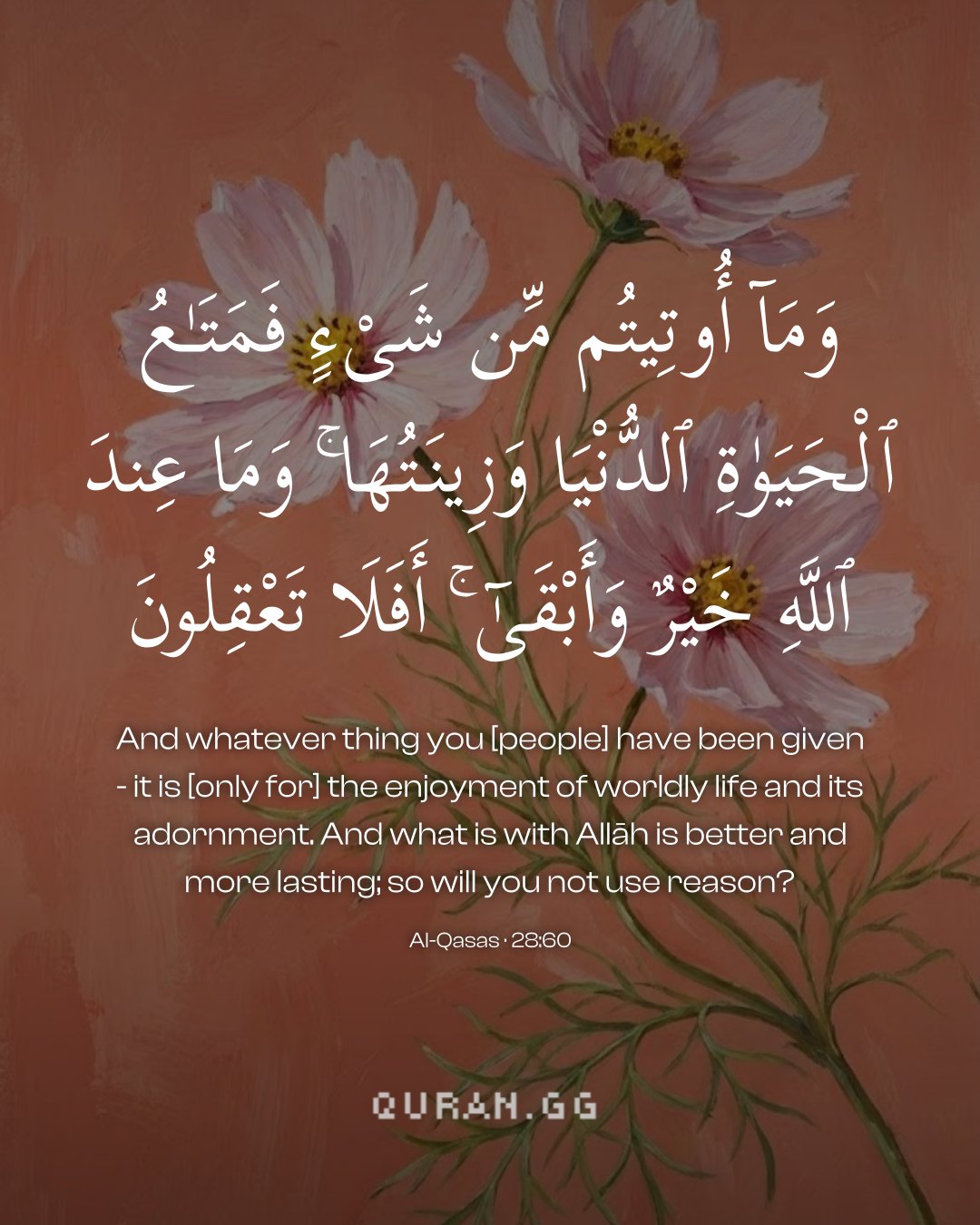
وَمَآ أُوتِيتُم مِّن شَىْءٍ فَمَتَـٰعُ ٱلْحَيَوٰةِ ٱلدُّنْيَا وَزِينَتُهَا ۚ وَمَا عِندَ ٱللَّهِ خَيْرٌ وَأَبْقَىٰٓ ۚ أَفَلَا تَعْقِلُونَ ٦٠

And whatever thing you [people] have been given - it is [only for] the enjoyment of worldly life and its adornment. And what is with Allāh is better and more lasting; so will you not use reason?

Surah Al-Qasas 28:60 in Arabic with its translation: “And whatever thing you [people] have been given - it is [only for] the enjoyment of worldly life and its…”

Make something with this ayah

Turn it into a video for Stories, Reels or TikTok, recited by the reciter you pick, or an image on a background you choose. Free, in your browser.

Download this image

Tafsir Ibn Kathir (abridged)

This World is transient and the One Whose concern is this World is not equal to the One Whose concern is the Hereafter

Allah tells us about the insignificance of this world and its contemptible adornments which are nothing in comparison to the great and lasting delights which Allah prepared for His righteous servants in the Hereafter. As Allah says:

مَا عِندَكُمْ يَنفَدُ وَمَا عِندَ اللَّهِ بَاقٍ

(Whatever is with you, will be exhausted, and whatever is with Allah will remain) (16:96).

وَمَا عِندَ اللَّهِ خَيْرٌ لِّلأَبْرَارِ

(and that which is with Allah is the best for the most righteous.) (3:198)

وَمَا الْحَيَوةُ الدُّنْيَا فِى الاٌّخِرَةِ إِلاَّ مَتَـعٌ

(whereas the life of this world as compared with the Hereafter is but a brief passing enjoyment.) (13:26)

بَلْ تُؤْثِرُونَ الْحَيَوةَ الدُّنْيَا - وَالاٌّخِرَةُ خَيْرٌ وَأَبْقَى

(Nay, you prefer the life of this world. Although the Hereafter is better and more lasting.) (87:16-17). The Messenger of Allah ﷺ said:

«وَاللهِ مَا الْحَيَاةُ الدُّنْيَا فِي الْآخِرَةِ إِلَّا كَمَا يَغْمِسُ أَحَدُكُمْ إِصْبَعَهُ فِي الْيَمِّ، فَلْيَنْظُرْ مَاذَا يَرْجِعُ إِلَيْه»

(By Allah, the life of this world in comparison to the Hereafter is as if one of you were to dip his finger in the sea; let him see what comes back to him. ) Allah's saying:

أَفَلاَ تَعْقِلُونَ

(Have you then no sense) means, do those who prefer this world to the Hereafter have no sense

أَفَمَن وَعَدْنَـهُ وَعْداً حَسَناً فَهُوَ لاَقِيهِ كَمَن مَّتَّعْنَاهُ مَتَـعَ الْحَيَوةِ الدُّنْيَا ثُمَّ هُوَ يَوْمَ الْقِيَـمَةِ مِنَ الْمُحْضَرِينَ

(Is he whom We have promised an excellent promise -- which he will find true -- like him whom We have made to enjoy the luxuries of the life of the world, then on the Day of Resurrection, he will be among those brought up) Is the one who believes in the reward which Allah has promised in return for righteous deeds, which he will undoubtedly attain, like one who disbelieves in the meeting with Allah and in His promises and threats He is only enjoying a few days in this life,

ثُمَّ هُوَ يَوْمَ الْقِيَـمَةِ مِنَ الْمُحْضَرِينَ

(then on the Day of Resurrection, he will be among those brought up.) Mujahid and Qatadah said: "He will be among those who are punished." It was said that this was revealed concerning the Messenger of Allah ﷺ and Abu Jahl, or that it was revealed concerning Hamzah and Ali, and Abu Jahl. Both views were narrated from Mujahid. The apparent meaning is that it is more general than that. This is like the Ayah where Allah describes a believer in Paradise looking out at his companion who is in Hell, and saying:

وَلَوْلاَ نِعْمَةُ رَبِّى لَكُنتُ مِنَ الْمُحْضَرِينَ

(Had it not been for the grace of my Lord, I would certainly have been among those brought forth (to Hell).) (37:57) And Allah says:

وَلَقَدْ عَلِمَتِ الجِنَّةُ إِنَّهُمْ لَمُحْضَرُونَ

(but the Jinn know well that they have indeed to appear (before Him)) (37:158).

Ma'arif al-Qur'an

وَمَا عِندَ اللَّـهِ خَيْرٌ‌ وَأَبْقَىٰ (And that which is with Allah is much better and far more lasting - 28:60). That is the mundane wealth and comforts are all mortal. But the recompense one would get in the Hereafter for the good deeds done in the world is much superior and everlasting as compared to the temporary worldly wealth and comforts. The best of comforts of this world are no match to the bounties of the Hereafter. Then, no matter how attractive mundane comforts are, they are but temporary. As against that, the bounties of the Hereafter will last forever. There is no doubt that anyone having some sense would prefer the better comforts and the ones that will last forever, rather than the short-lived temporary ones.

The sign of prudence is that one does not involve himself too much in worldly matters and cares more for the Hereafter

Imam Shafi` i (رح) has said that if a person bequeaths his wealth and property to be given to the wisest men, then the beneficiaries of such a will are those busy in worshipping and obeying Allah Ta` ala, because what they are doing is the demand of wisdom, and no doubt they are the wisest among worldly people. This ruling is also mentioned in Ad-Durr-al-Mukhtar, the famous book of Hanafi school. See its chapter on 'wasiyyah'.

Tazkirul Quran

In the world, if anyone achieves material stability, he develops a superiority complex, though history has repeatedly taught that the material stability of any person or any community (nation) is not permanent. Whenever a community (nation) ignored the Truth, it was destroyed, despite all its pomp and glory. In the peninsula of Arabia, various communities or nations had come into prominence before Islam, for example, the ‘Ad, Thamud, Saba’, Madyan, and Lot’s people, etc. Everyone of them indulged in ill-founded pride, but their pride was nullified by the times, and finally they became nothing but stories of the past. The ruins of these communities spreading far and wide diminished the glory of human beings. In spite of this, in the times of the Prophet Muhammad, the great ones among his contemporaries rejected him, as if the events of the past had no lesson of interest to them.

Uthmani text of the Madinah mushaf (King Fahd Complex). Translation: Saheeh International. Tafsir via Quran.com.