Surah Al-Qasas Ayah 83 (28:83) — Meaning & Tafsir | Quran.GG

Surah Al-Qasas, Ayah 83

28:83 · Meaning and tafsir

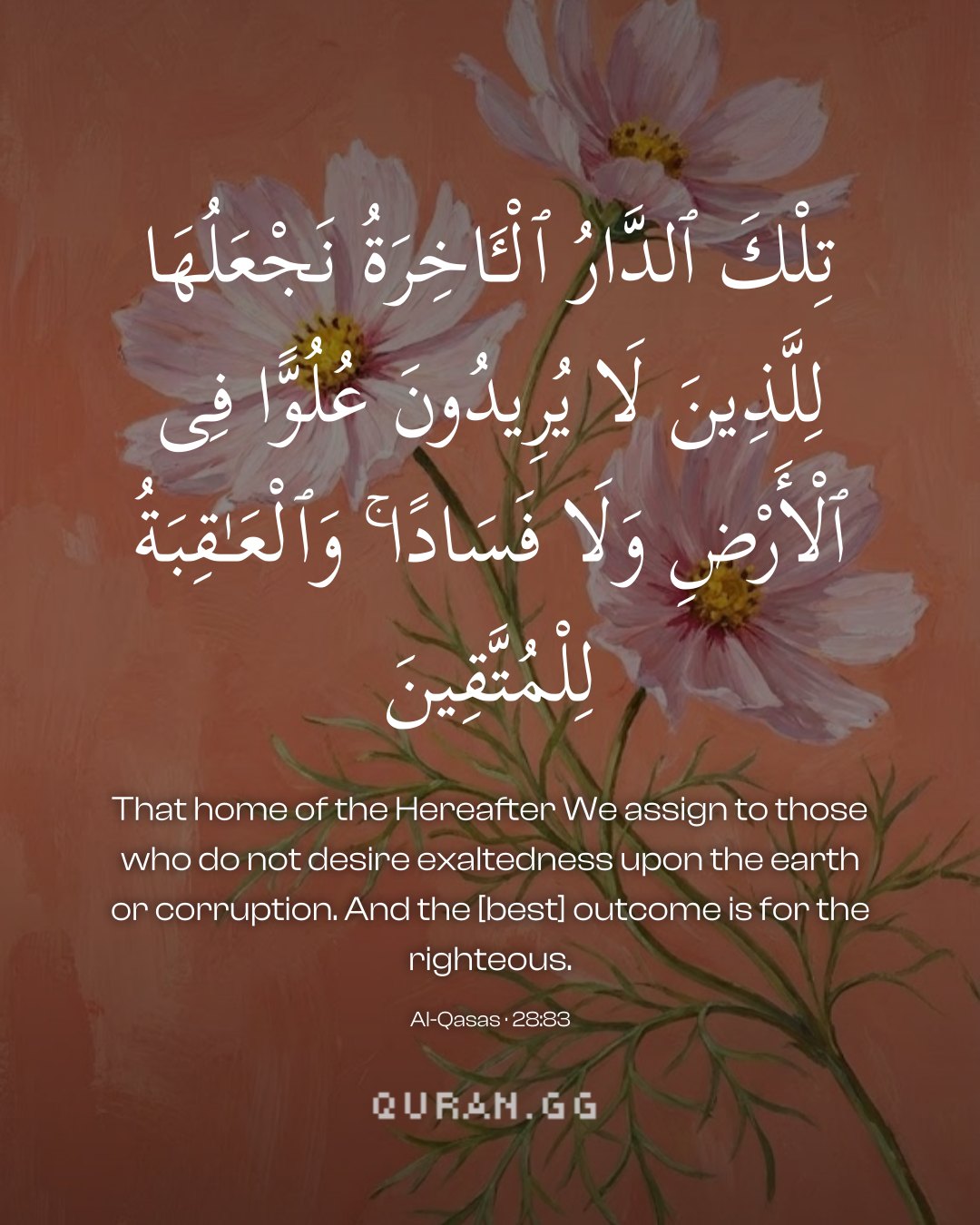
تِلْكَ ٱلدَّارُ ٱلْـَٔاخِرَةُ نَجْعَلُهَا لِلَّذِينَ لَا يُرِيدُونَ عُلُوًّا فِى ٱلْأَرْضِ وَلَا فَسَادًا ۚ وَٱلْعَـٰقِبَةُ لِلْمُتَّقِينَ ٨٣

That home of the Hereafter We assign to those who do not desire exaltedness upon the earth or corruption. And the [best] outcome is for the righteous.

Surah Al-Qasas 28:83 in Arabic with its translation: “That home of the Hereafter We assign to those who do not desire exaltedness upon the earth or corruption. And…”

Make something with this ayah

Turn it into a video for Stories, Reels or TikTok, recited by the reciter you pick, or an image on a background you choose. Free, in your browser.

Download this image

Tafsir Ibn Kathir (abridged)

The Blessings of the Hereafter for the humble Believers

Allah tells us that He has made the home of the Hereafter, and its eternal delights which will never change or fade away, for His believing, humble servants who do not rebel against the truth with pride and oppression in the land. They do not exalt themselves above the creatures of Allah, arrogantly oppressing them and spreading corruption among them. `Ikrimah said that this phrase referred to haughtiness and arrogance. Ibn Jurayj said:

لاَ يُرِيدُونَ عُلُوّاً فِى الاٌّرْضِ

(those who do not want to exalt themselves in the land) "Arrogance and tyranny,

وَلاَ فَسَاداً

(nor cause corruption) committing sins." Ibn Jarir recorded that `Ali said, "If a man wants the straps of his sandals to be better than the straps of his companion's sandals, then he is one of those referred to in the Ayah,

تِلْكَ الدَّارُ الاٌّخِرَةُ نَجْعَلُهَا لِلَّذِينَ لاَ يُرِيدُونَ عُلُوّاً فِى الاٌّرْضِ وَلاَ فَسَاداً وَالْعَـقِبَةُ لِلْمُتَّقِينَ

(That is the home of the Hereafter, We shall assign to those who do not want to exalt themselves in the land nor cause corruption. And the good end is for those who have Taqwa.) This is understood to mean that if his intention is to show off and appear better than others, then that is to be condemned, as it was reported in the Sahih that the Prophet said:

«إِنَّهُ أُوحِيَ إِلَيَّ أَنْ تَوَاضَعُوا حَتَّى لَا يَفْخَرَ أَحَدٌ عَلَى أَحَدٍ وَلَا يَبْغِي أَحَدٌ عَلَى أَحَد»

(It has been revealed to me that you should be humble to the extent that none of you boasts to others or mistreats others. ) But if a person simply likes to look good, then there is nothing wrong with that. It was recorded that a man said: "O Messenger of Allah, I like to have my garment looking good and my shoes looking good -- is this a kind of arrogance" The Prophet said:

«لَا، إِنَّ اللهَ جَمِيلٌ يُحِبُّ الْجَمَال»

(No, for Allah is beautiful and loves beauty...) And Allah says:

مَن جَآءَ بِالْحَسَنَةِ

(Whosoever brings good,) meaning, on the Day of Resurrection,

فَلَهُ خَيْرٌ مِّنْهَا

(he shall have the better thereof;) meaning, the reward of Allah is better than the good deeds of His servant -- how can it not be, when Allah has multiplied it many times over This is the position of generosity. Then Allah says:

وَمَن جَآءَ بِالسَّيِّئَةِ فَلاَ يُجْزَى الَّذِينَ عَمِلُواْ السَّيِّئَاتِ إِلاَّ مَا كَانُواْ يَعْمَلُونَ

(and whosoever brings evil, then those who do evil deeds will only be requited for what they used to do.) This is like the Ayah,

وَمَن جَآءَ بِالسَّيِّئَةِ فَكُبَّتْ وُجُوهُهُمْ فِى النَّارِ هَلْ تُجْزَوْنَ إِلاَّ مَا كُنتُمْ تَعْمَلُونَ

(And whoever brings an evil deed, they will be cast down on their faces in the Fire. (And it will be said to them) "Are you being recompensed anything except what you used to do") (27: 90). This is the postition of generosity and justice.

Ma'arif al-Qur'an

Commentary

لِلَّذِينَ لَا يُرِ‌يدُونَ عُلُوًّا فِي الْأَرْ‌ضِ وَلَا فَسَادًا (We assigned it to those who intend neither haughtiness on earth nor mischief. - 28:83). This verse tells us that only those will achieve salvation and success in the Hereafter who do not intend any mischief, nor are indulged in عُلُوًّا ` Uluww in this world. عُلُوًّا ` Uluww means pride or conceit, that is, to present oneself as superior before others, and to look down upon others and treat them in an insulting manner. Mischief is used here for oppression. (Sufyan Ath-Thauri). Some commentators have observed that every sin is a 'mischief in the world', because the nuisance of the sin curtails the blessings of the world. This verse tells us that those who intend to do cruelty and feel proud, or commit sin have no share in the Hereafter.

Special Note

Arrogance and conceit as condemned in this verse, is the behavior in which one shows off as being superior, and looks down upon others. Otherwise to strive for oneself a good dress, a good house, and good food, when it is not intended to show off, is no sin, as reported in a hadith in Sahih Muslim.

Firm intention to commit a sin is also sin

It is clarified in this verse that the intention for mischief and pride will debar one from the share of Hereafter. It is, therefore, clear that the firm intention of a sin is as much a sin. (Ruh) However, if one changes his mind for fear of Allah, then a reward is noted in his record instead of sin. But if he fails to act on that sin, due to reasons beyond his control, while he had firm intention to act upon it, then the sin stays against his name, and will be recorded as such. (Ghazzali)

The last verse وَالْعَاقِبَةُ لِلْمُتَّقِينَ (And the (best) end is for the God-fearing - 28:83) elaborates that it is not enough to abstain from mischief and pride to get the share of the Hereafter, but following the righteous path is as much a requirement. To follow all the religious obligations is also essential for the salvation in the Hereafter.

Tazkirul Quran

According to the Bible, Moses cursed Korah for his evil deeds, and God caused him, his companions and his treasure to be swallowed up by the earth. This was visibly demonstrated by God as an example to clarify what the final result would be of leaving off the worship of God and adopting the worship of wealth. The amenities of the world are in fact given as a trial of human beings. These are provided to man, by the will of God in greater or lesser quantities. It is the duty of man to be patient if he receives fewer amenities and to be grateful if he receives more. This is the only way to the salvation and success of man.

Uthmani text of the Madinah mushaf (King Fahd Complex). Translation: Saheeh International. Tafsir via Quran.com.