Allah mentioned the final destination of those foremost in faith, the nearest to Him, He next mentioned the end of those on the right, the righteous believers. Maymun bin Mihran said that those on the right side are lesser in rank than the foremost in faith. Allah said,
وَأَصْحَـبُ الْيَمِينِ مَآ أَصْحَـبُ الْيَمِينِ
(And those on the right -- how (fortunate) will be those on the right) who are those on the right, what is their condition and what will their final destination be like Allah next answers this question by saying,
فِى سِدْرٍ مَّخْضُودٍ
((they will be) among Sidr Makhdud.) Ibn `Abbas, `Ikrimah, Mujahid, Ibn Al-Ahwas, Qasamah bin Zuhayr, As-Safr bin Nusayr, Al-Hasan, Qatadah, `Abdullah bin Kathir, As-Suddi, Abu Hazrah and several others said, "The kind without thorns." And from Ibn `Abbas: "It is the one that is laden with fruits." This is also reported from `Ikrimah and Mujahid. Similar was also said by Qatadah as we mentioned. So it is the one with a full load of fruits without thorns. So it appears that both meanings apply here. The lote tree, of this life is thorny and carries few fruits. In the Hereafter, it is the opposite; it does not have thorns and carries plenty of fruit, the weight of which strains its trunk. `Utbah bin `Abd As-Sulami said, "I was sitting with Allah's Messenger ﷺ, when a bedouin came and said, `O Messenger of Allah! Have you heard about the tree that has more thorns than any other being in Paradise' Meaning the Talh tree. So Allah's Messenger ﷺ said:
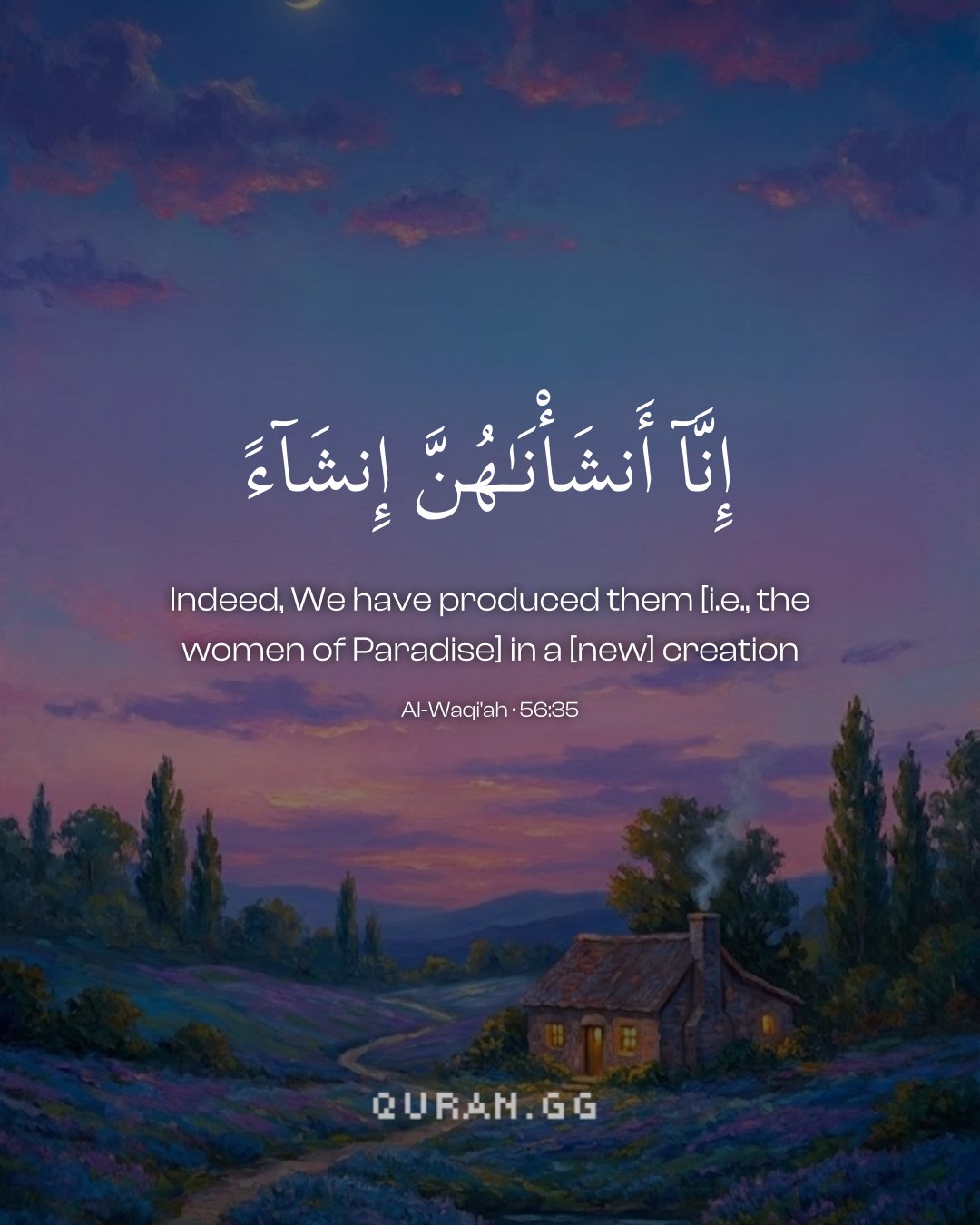
إِنَّا أَنشَأْنَاهُنَّ إِنشَاءً (Surely We have created those [ females ] a fresh creation...56:35) The word insha' means 'to create'. The pronoun هُنَّ hunna refers to the women of Paradise, although there is no mention of them in the immediately preceding verses. However, they have been mentioned in connection with 'the Foremost' in distantly foregoing verses [ 22-23]. If the word firash in the foregoing verse (34) refers to the women of Paradise, the antecedent of the pronoun is quite obvious. Likewise, the mention of beds, couches, thrones and other delightful items gives the pronoun the context to refer to women. The meaning of the verse is: 'We have created the Paradisiacal women in a special way, that is, the houris are created without being born biologically, and the women of this world who will enter the Paradise will also be reshaped in a way that the women who were ugly, dark-coloured or old in this world will be made beautiful, young and graceful.' It is recorded in Tirmidhi and Baihaqi on the authority of Sayyidna Anas that the Holy Prophet ﷺ said in explanation of Verse 35 that the women who were old, blear eyed, with gray hair and ugly features in the world will be made beautiful and young in this new creation. Baihaqi also reports from Sayyidah ` A'ishah ؓ that an old lady asked the Messenger of Allah ﷺ to pray to Allah that she may enter Paradise. The Messenger of Allah ﷺ said in a humorous way: لَا تَدخُلُ الجَنَّۃُ عَجُوزُ "Old ladies will not enter Paradise." Hearing this the old lady got very sad, and according to some narrations, started weeping. The Messenger of Allah ﷺ then explained that she would not be old when she would enter Paradise; she would be transformed into a young beautiful woman. Then the Holy Prophet ﷺ recited this verse 35. [ Mazhari ]
Tazkirul Quran
Maulana Wahiduddin KhanOn ayahs 26–39
The group at the forefront (as-sabiqun) will comprise of those who, immediately accept the Truth when it appears before them, and surrender themselves to it without hesitation. According to the Prophet’s wife, ‘A’ishah, the Prophet said, ‘Do you know, on the Day of Judgement, who will be the first to find a place in the protective shade of God?’ People said that God and His Prophet knew best. Then he said, ‘It will be those to whom Truth was presented and they accepted it. When Truth was demanded of them, they gave it. They gave the same decision with regard to others as they did with regard to themselves.’ (Tafsir ibn Kathir). In the early period of the call for Truth, for those who came forward and embraced Islam, it was a discovery. The generation coming after them, regarded Islam as a legacy. It is this difference between discovery and legacy which raises the status of first group over that of the second group. Naturally, the second group is larger in number than the first group. In the Hereafter, there will be ordinary rewards for the second group while, for the first group, there will be royal rewards.
Uthmani text of the Madinah mushaf (King Fahd Complex). Translation: Saheeh International. Tafsir via Quran.com.