The Battle of Uhud
According to the majority of scholars, these Ayat are describing the battle of Uhud, as Ibn `Abbas, Al-Hasan, Qatadah, As-Suddi and others said. The battle of Uhud occurred on a Saturday, in the month of Shawwal on the third year of Hijrah. `Ikrimah said that Uhud occurred in the middle of the month of Shawwal, and Allah knows best.
The Reason Behind the Battle of Uhud
The idolators suffered many casualties among their noble men at the battle of Badr. The caravan that Abu Sufyan led (before Badr) returned safely to Makkah, prompting the remaining Makkan leaders and the children of those who were killed at Badr to demand from Abu Sufyan to, "Spend this money on fighting Muhammad!" Consequently, they spent the money from the caravan on warfare expenses and mobilized their forces including the Ahabish tribes (tribes living around the city). They gathered three thousand soldiers and marched until they camped near Uhud facing Al-Madinah. The Messenger of Allah ﷺ led the Friday prayer and when he finished with it, he performed the funeral prayer for a man from Bani An-Najjar called Malik bin `Amr. The Prophet then asked the Muslims for advice, if they should march to meet the disbelievers, or fortify themselves in Al-Madinah. `Abdullah bin Ubayy (the chief hypocrite) advised that they should remain in Al-Madinah, saying that if the disbelievers lay siege to Al-Madinah, the siege would be greatly disadvantageous to them. He added that if they decide to attack Al-Madinah, its men would face off with them, while women and children could throw rocks at them from above their heads; and if they decide to return to Makkah, they would return with failure. However, some companions who did not attend the battle of Badr advised that the Muslims should go out to Uhud to meet the disbelievers.
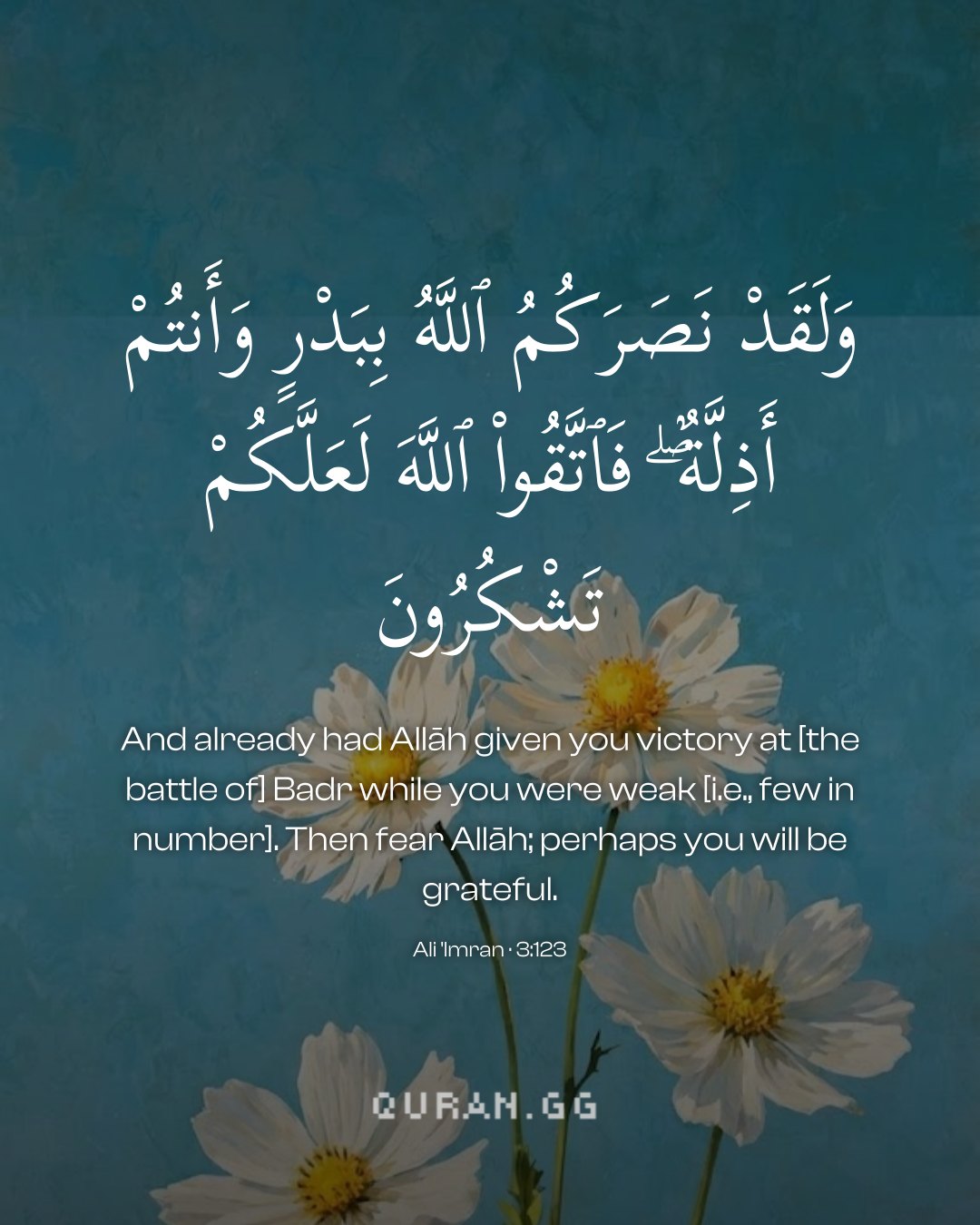
Continue reading the tafsir of ayahs 121–123 وَلَقَدْ نَصَرَكُمُ اللَّـهُ بِبَدْرٍ وَأَنتُمْ أَذِلَّةٌ
And Allah certainly supported you at Badr when you were weak. (123)
Badr : Location and Importance
Badr is located about eighty miles south-west of Madinah and used to be a halting-place while travelling between Makkah and Madinah, before the modern Tariq al-Hijrah was commissioned into service which by passes it.
At that time, Badr was known for its abundance of water, something very important in the desert zones of Arabia. The first armed encounter between believers and disbelievers came to pass at this spot on Friday, Ramadan al-Mubarak, Hijrah year 2 which fell on March 11, 624 A.D. On a superficial view, this battle appears to be a local tribal war, but the truth is that it has charted a revolutionary course in the history of the world, therefore, the Holy Qur'an calls it Yawm al-Furgan یوم الفرقان (a day of distinction). According to Professor Philip Hitti, this was Islam's first clear victory.
The expression وَأَنتُمْ أَذِلَّةٌ translated as 'when you were weak' means that 'you were, at that time, few in numbers and materials'. According to strong and authentic narrations, the number of Muslims was 313. This 'army' had two horses and seventy camels. On these, they took their turns while riding.
The verse ends with the statement: فَاتَّقُوا اللَّـهَ لَعَلَّكُمْ تَشْكُرُونَ (So, fear Allah, that you may be grateful). This may remind one of the many places in the Holy Qur'an where Taqwa (fear of Allah) and Sabr (patience) have been prescribed as a security shield against the machinations of the hypocrites and the harmful effects of hostile enemies. Right here, in these two behaviour models, there lies the secret of an entire organized struggle, and clear victory, that comes in its wake. As mentioned elsewhere, Taqwa and Sabr have not been mentioned here, in conjunction. Instead, Taqwa has been considered sufficient for, in reality, Taqwa is such a comprehensive human attribute that صبر Sabr too gets to be included therein.
The existence of love in the hearts of true believers for the People of the Book and the lack of love in the hearts of the latter for the believers shows who really subscribes to the truth and who does not. God is all mercy and justice. God is the Creator and Sustainer of all human beings, so whoever finds God in the real sense of the word, will open his heart to all God’s creatures. For him all human beings equally become the family of God. Then he begins to like for everyone what he likes for himself. But those who have not found God in the real sense of the word, those who have not subordinated their will to the will of God and who live only on the plane of the self, regard life’s possessions as paramount, both at the personal and the communal level. This mentality makes them inimical to anyone who appears to be against their interests—who is not, in short, a member of their own community. In spite of believing in God, they tend to forget that this world was made by God, and that no strategy can be effective here without God’s approval.
Uthmani text of the Madinah mushaf (King Fahd Complex). Translation: Saheeh International. Tafsir via Quran.com.