Ma'arif al-Qur'an
Mufti Muhammad Shafi
Race towards forgiveness, towards Paradise:
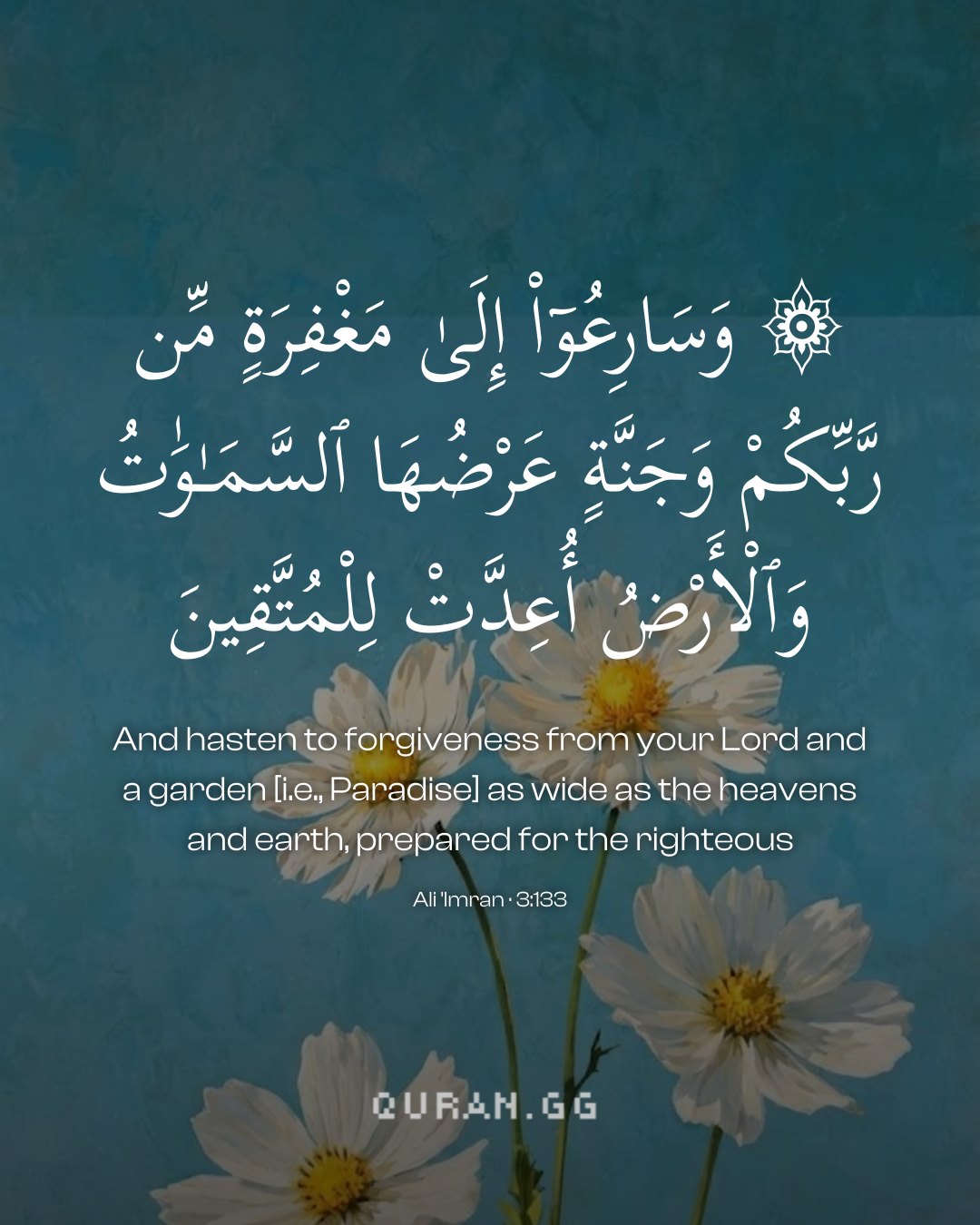
The first command was: 'Obey the Messenger'. (132) The second command is: 'Race one another towards Forgiveness from your Lord and towards Paradise.' (133) Here, Forgiveness stands for the means of obtaining forgiveness, that is, good deeds which bring forth forgiveness. There are several exegetic views reported from the blessed Companions and their immediate successors. Though expressed differently, they convey the same theme. Out of the noble Companions and their successors, may Allah be pleased with them all, Sayyidna ` Ali ؓ explained it as the fulfillment of obligations', Ibn ` Abbas ؓ as 'Islam', Abu al-'Aliyah ؓ as 'Hijrah', Anas ibn Malik ؓ as 'al-Takbir al-Uula (the first call of Allahu Akbar in salah) ', Said ibn Jubayr ؓ as 'perfection of obedience', Dahhak ؓ as 'Jihad' and ` Ikrimah ؓ as 'Taubah (repentance) '. The outcome of all these sayings is that Forgiveness covers all good deeds which become the means of obtaining Divine forgiveness.
At this point two things need our attention. First comes the resolution of an apparent contradiction which may be felt when one notices that the present verse carries a command to race one another towards Forgiveness and Paradise, while through another verse: لَا تَتَمَنَّوْا مَا فَضَّلَ اللَّـهُ بِهِ بَعْضَكُمْ عَلَىٰ بَعْضٍ (And do not covet something by which Allah has made some of you excel some others - 4:32), the very seeking of other merits and ranks has been prohibited.
The answer is that فضایٔل fada'il (merits, ranks, virtues) are of two kinds. The first kind relates to that which cannot be achieved by man, being beyond one's power and control. We can call these 'non-electable.' For example, colour or beauty or birth in a morally high family cannot be chosen and acquired. The other kind is something man can achieve by effort. These can be called voluntary or 'electable'. So, the reason why the effort to acquire non-electable merits, even its very desire, has been prohibited for the simple reason that they have been given to His created beings by Allah Almighty Himself in His infinite wisdom. It is something beyond human effort. Why run after them? All such efforts will lead to nothing but envy and malice. Let him who has been given a particular colour of his skin keep desiring to have some other colour. What is he going to get out of his desire? Nothing. However, there is a vast range of merit worthy deeds. One could, and would, make his mark there. That is why we have been asked to accelerate our efforts in that direction. This is not something restricted to one verse. The exhortation appears in several verses. Somewhere it is said: فَاسْتَبِقُوا الْخَيْرَاتِ (Try to get ahead of one another in good deeds - 2:148, 5:48). Elsewhere, it is said: فَلْيَتَنَافَسِ الْمُتَنَافِسُونَ (And in this, then, aspire the aspirers.) (83:26)
Let us consider the advice of the sage who said: 'If one has a natural or physical handicap which is beyond his power to correct, he should remain contended (with his handicap) and unaffected by the achievements of others. He should go on doing what he does. For, if he were to pine over his handicap and envy the achievements of others, he would be unable to perform to his capability, and ultimately, he would end up doing nothing or very little.'
The second point worth considering is that Allah Almighty has mentioned 'Forgiveness' first and the 'Paradise' after it. May be, this is to suggest that entry into Paradise is impossible without Divine Forgiveness. The reason is obvious. Man may spend a life-time doing good and abstaining from the evils. Still the aggregate of his good deeds cannot pay the price of Paradise. What will take him to Paradise is only Forgiveness of His Lord, and His grace. The Holy Prophet ﷺ has said:
سَدِّدُوا وَقَارِبُوا وَأَبْشِرُوا فَإِنَّهُ لَا يُدْخِلُ أَحَدًا الْجَنَّةَ عَمَلُهُ قَالُوا وَلَا أَنْتَ يَا رَسُولَ اللَّهِ قَالَ وَلَا أَنَا إِلَّا أَنْ يَتَغَمَّدَنِي اللَّهُ
Strive to be straight and true, take the middle course and seek glad tidings (of Allah's grace), for one's deeds shall not take anyone into the Paradise'. People said: 'Not even yours, 0 Messenger of Allah?' He said: 'Not even mine, unless it is that Allah covers me up with His mercy.' (al-Targhib wa al-Tarhib, with reference to al-Bukhari and Muslim).
In short, our deeds are not the price of Paradise. But, as is the customary practice of Allah, He does bestow His grace upon a servant who does what is good. In fact, one who is given the very ability to do good deeds is really given the signal that Allah is pleased with him. So, let none of us be tardy in the performance of what is good. Since Divine forgiveness is the primary factor in one's entry into the Paradise, the text takes this importance into consideration and does not present forgiveness in the absolute sense. It has, rather, elected to say: مَغْفِرَةٍ مِّن رَّبِّكُمْ (Forgiveness from your Lord.). By doing so, the text highlights Allah's attribute as the Lord, showing thereby His added grace and mercy for His servants.
The second object towards which man is being asked to hasten is Paradise. It has been said here that the Paradise is as wide as whole of the heavens and the earth. Since human mind cannot conceive any greater vastness than that of the heavens and the earth within the confines of his experience, the Paradise has been likened to them. This is a manner of saying that Paradise is very vast, so vast that it can accommodate the entire heavens and the earth in its vastness.
When the width of the Paradise is so great who can imagine its length which should be even greater?
All the above discussion is based on the assumption that the Arabic word عرض ) ’ ard) means 'width'. However, there is another possible interpretation adopted by some commentators. According to them the word "ard' is also used in the meaning of 'price'. If the word is taken here in this sense, the verse would mean that Paradise is not an ordinary commodity; the entire heavens and the earth are its price.
With such an object of unimaginable worth and magnitude, what else should one do but hasten towards it.
Al-Itazi in his 'al-Tafsir al-Kabir’ explains this point as follows:
قال ابو مسلم : ان العرض ھنا ما یعرض من الثمن فی مقابلۃ المبیع ای ثمنھا لو بیعت کثمن السماوات والارض و المراد بذلک عظم مقدارھا و جلالۃ خطرھا و انہ لا یساویھا شیٔ وان عظم۔
Abu Muslim says that ` al-ard' in this verse means that which is offered against the object of sale as its price. In other words, if a price were to be put on Paradise, the heavens and the earth together with whatever is in them will be its price. The purpose is to demonstrate the most exalted status of the Paradise which remains unmatched by anything in its greatness.
Another statement about the Paradise is given in the end by: اُعِدَّتْ لِلْمُتَّقِينَ (It has been prepared for the God-fearing.) This tells us that Paradise has already been created. Clear indicators in the Qur'an and Hadith seem to suggest the existence of Paradise on the seventh heaven which is its surface.
Uthmani text of the Madinah mushaf (King Fahd Complex). Translation: Saheeh International. Tafsir via Quran.com.