The Rumor that the Prophet was Killed at Uhud
When Muslims suffered defeat in battle at Uhud and some of them were killed, Shaytan shouted, "Muhammad ﷺ has been killed." Ibn Qami'ah went back to the idolators and claimed, "I have killed Muhammad." Some Muslims believed this rumor and thought that the Messenger of Allah ﷺ had been killed, claiming that this could happen, for Allah narrated that this occurred to many Prophets before. Therefore, the Muslims' resolve was weakened and they did not actively participate in battle. This is why Allah sent down to His Messenger His statement,
وَمَا مُحَمَّدٌ إِلاَّ رَسُولٌ قَدْ خَلَتْ مِن قَبْلِهِ الرُّسُلُ
Continue reading the tafsir of ayahs 144–148Ma'arif al-Qur'an
Mufti Muhammad Shafi
The need to learn that crucial lesson has been taken up in the second verse as well. In order to teach steadfastness under calamities and hardships, it has been said that the death of every human being lies written with Allah Almighty. Fixed is its date, the day and the time. Death cannot come to take one away before that, nor could one continue to live after that. If so, getting scared about a certain death means nothing.
Now, towards the end, there comes an admonition about one of the apparent causes of this incident. As stated earlier, the Companions who were posted by the Holy Prophet ﷺ as guards on the hill in the rear saw that fellow Muslims were busy collecting spoils following the initial victory. Some of them started thinking about the fact of victory following which there was no need for them to stay at their post. If so, they concluded, why should they too not go in there and take part in the collection of spoils? So, they moved away from where they were ordered to be. Thereupon, it was said:
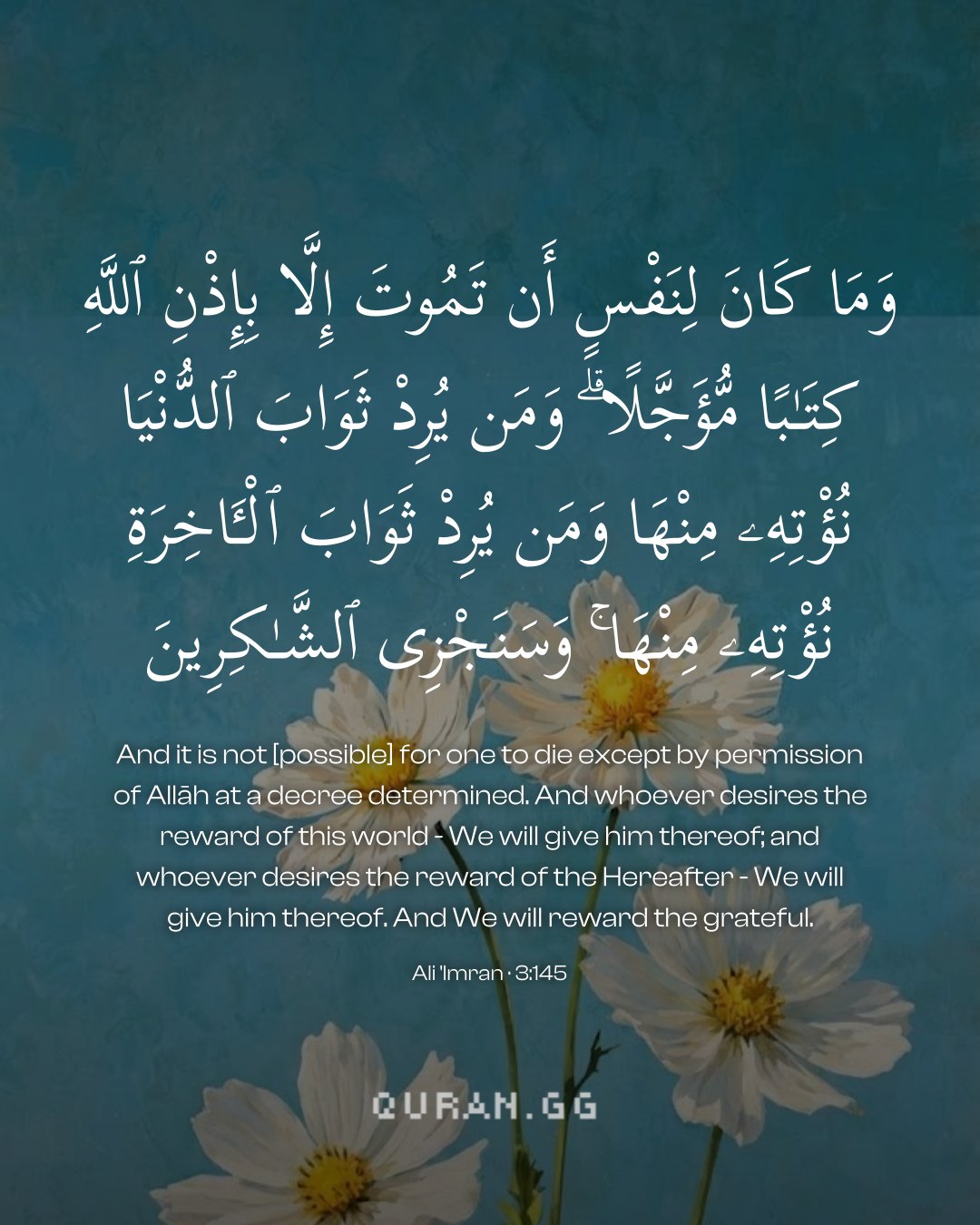
وَمَن يُرِدْ ثَوَابَ الدُّنْيَا نُؤْتِهِ مِنْهَا وَمَن يُرِدْ ثَوَابَ الْآخِرَةِ نُؤْتِهِ مِنْهَا ۚ وَسَنَجْزِي الشَّاكِرِينَ ﴿145﴾
And whoever seeks the return in this world, We shall give him out of it, and whoever seeks the return in the Hereafter, We shall give him out of it. And We shall soon reward the grateful. (145)
Here, it has been hinted that they made a mistake when they abandoned the duty assigned to them by the Holy Prophet ﷺ in order to collect spoils. At this point, let us keep in mind that, in its real sense, the collection of spoils is not the same as the unabashed pursuit of the material which has been condemned in the Shari’ ah of Islam. On the contrary, collecting spoils, depositing it in safe custody and spending it where it must be spent is all a part of Jihad, and for that matter, an act of worship. So, the Companions who took part in this mission never did it for sheer material gain, for they would have been entitled to receive their due share in the spoils of war even if they had not actively participated in the collection of spoils as guaranteed under the Islamic Law. Therefore, it cannot be said that these blessed Companions abandoned their post of duty under the temptation of worldly gains. But, as explained earlier under comments on the first verse (144), even minor mistakes made by major people draw more attention. Even an ordinary deviation from their duty is taken to be serious and they are admonished for that. This applies here as well. Granted that their collecting of spoils could be related with the desire to make worldly gains, at the most in some minor way; and equally granted is the possibility that this small connection had not influenced their hearts; yet, it was to take the morals of the noble Companions ؓ to the highest possible level that this act of theirs was identified as 'the seeking of return in this world' so that even the tiniest speck of worldly temptation fails to find its way into their hearts.
During the battle of Uhud, a cry was raised that the Messenger had been slain. This news seriously depressed certain Muslims. But the real servants of God are those whose religiosity is not based on a human personality. God requires a religiosity that attaches His servants with all their hearts and souls to the one God. A believer is one who follows Islam for the truth of its principles rather than for the support of some human individual. One who enters the fold of Islam in this way, finds it such a blessing that his spirit overflows with feelings of gratitude to God. He begins to regard the Hereafter, and not this world, as his all in all. Life becomes to him a transient thing, for he knows that he is going to be faced with death at any point of time. He is able to discern the universe as a divine workshop, where each happening takes place at God’s will and where God is both the Giver and the Taker.
Uthmani text of the Madinah mushaf (King Fahd Complex). Translation: Saheeh International. Tafsir via Quran.com.