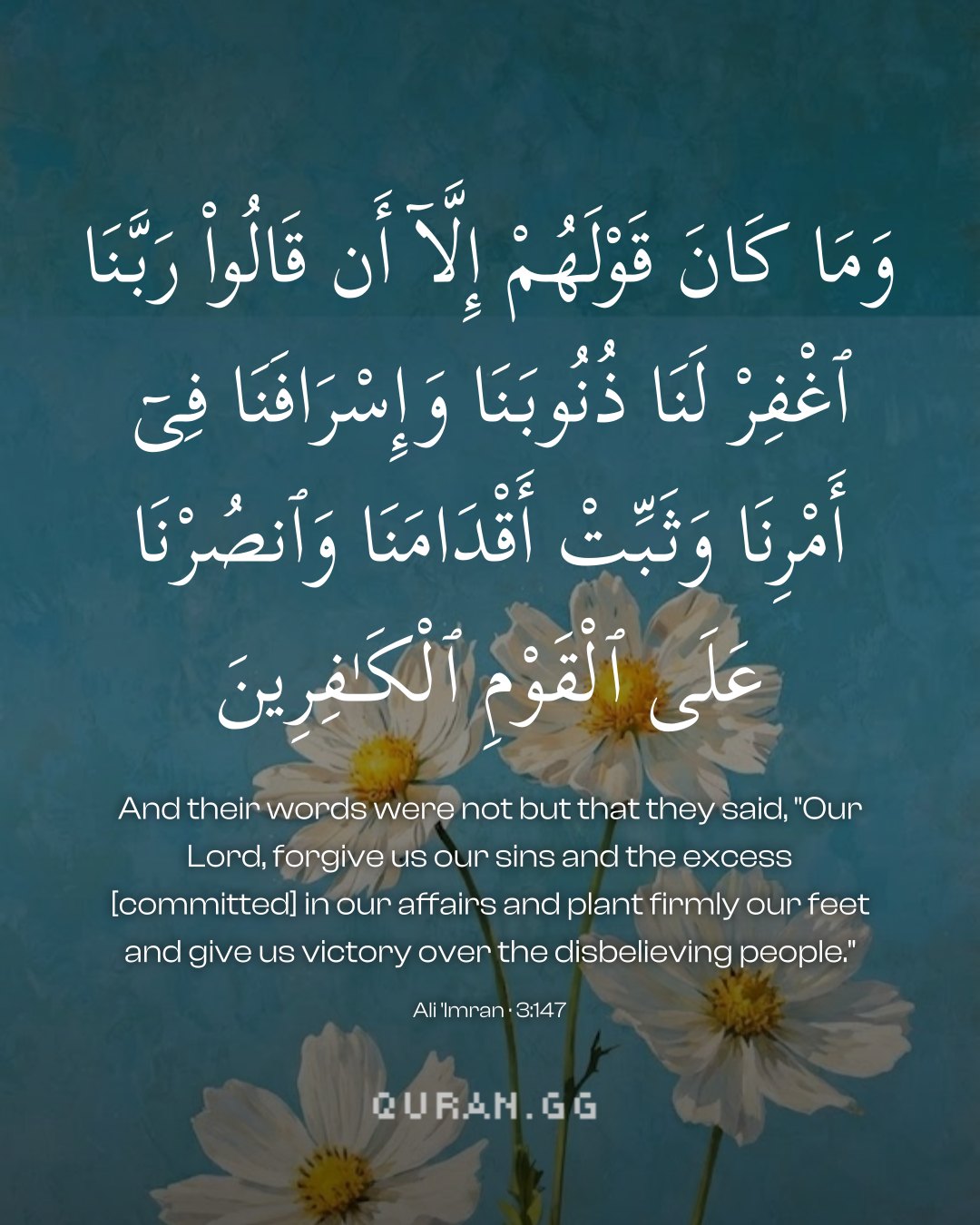
And their words were not but that they said, "Our Lord, forgive us our sins and the excess [committed] in our affairs and plant firmly our feet and give us victory over the disbelieving people."
When Muslims suffered defeat in battle at Uhud and some of them were killed, Shaytan shouted, "Muhammad ﷺ has been killed." Ibn Qami'ah went back to the idolators and claimed, "I have killed Muhammad." Some Muslims believed this rumor and thought that the Messenger of Allah ﷺ had been killed, claiming that this could happen, for Allah narrated that this occurred to many Prophets before. Therefore, the Muslims' resolve was weakened and they did not actively participate in battle. This is why Allah sent down to His Messenger His statement,
Connected with previous verses where Muslims were admonished for some of their shortcomings during the battle of Uhud, the present verses cite examples set by men of Allah from earlier communities showing how steadfast they were on the battlefield, something which should be emulated by the present addressees.
The explanation of some words:
1. رِبِّيُّونَ Ribbiyun): a derivation from Rabb (رَبّ ) like Rabbani (رَبّانی) meaning 'of the رَبّ Rabb or Lord' which has been rendered as men of Allah in the present translation. According to Ruh al-Ma‘ani, here the use of the vowel sound 'i' in place of 'a' is irregular. Some commentators take رِبِّيُّونَ 'Ribbiyun': to mean 'many groups'. In their view, this is derived from the word, 'Ribbah' (رَبّہ) which means 'the group'. Now, as to who is meant here by رِبِّيُّونَ 'Ribbiyun': (men of Allah), it has been reported from Sayyidna ` Abdullah ibn ` Abbas ؓ and Iiasan al-Basri that this refers to ` ulama' (religious scholars) and 'fuqaha' (juriconsults). (Ruh a1-Ma` ani).
During the battle of Uhud, a cry was raised that the Messenger had been slain. This news seriously depressed certain Muslims. But the real servants of God are those whose religiosity is not based on a human personality. God requires a religiosity that attaches His servants with all their hearts and souls to the one God. A believer is one who follows Islam for the truth of its principles rather than for the support of some human individual. One who enters the fold of Islam in this way, finds it such a blessing that his spirit overflows with feelings of gratitude to God. He begins to regard the Hereafter, and not this world, as his all in all. Life becomes to him a transient thing, for he knows that he is going to be faced with death at any point of time. He is able to discern the universe as a divine workshop, where each happening takes place at God’s will and where God is both the Giver and the Taker.
Uthmani text of the Madinah mushaf (King Fahd Complex). Translation: Saheeh International. Tafsir via Quran.com.