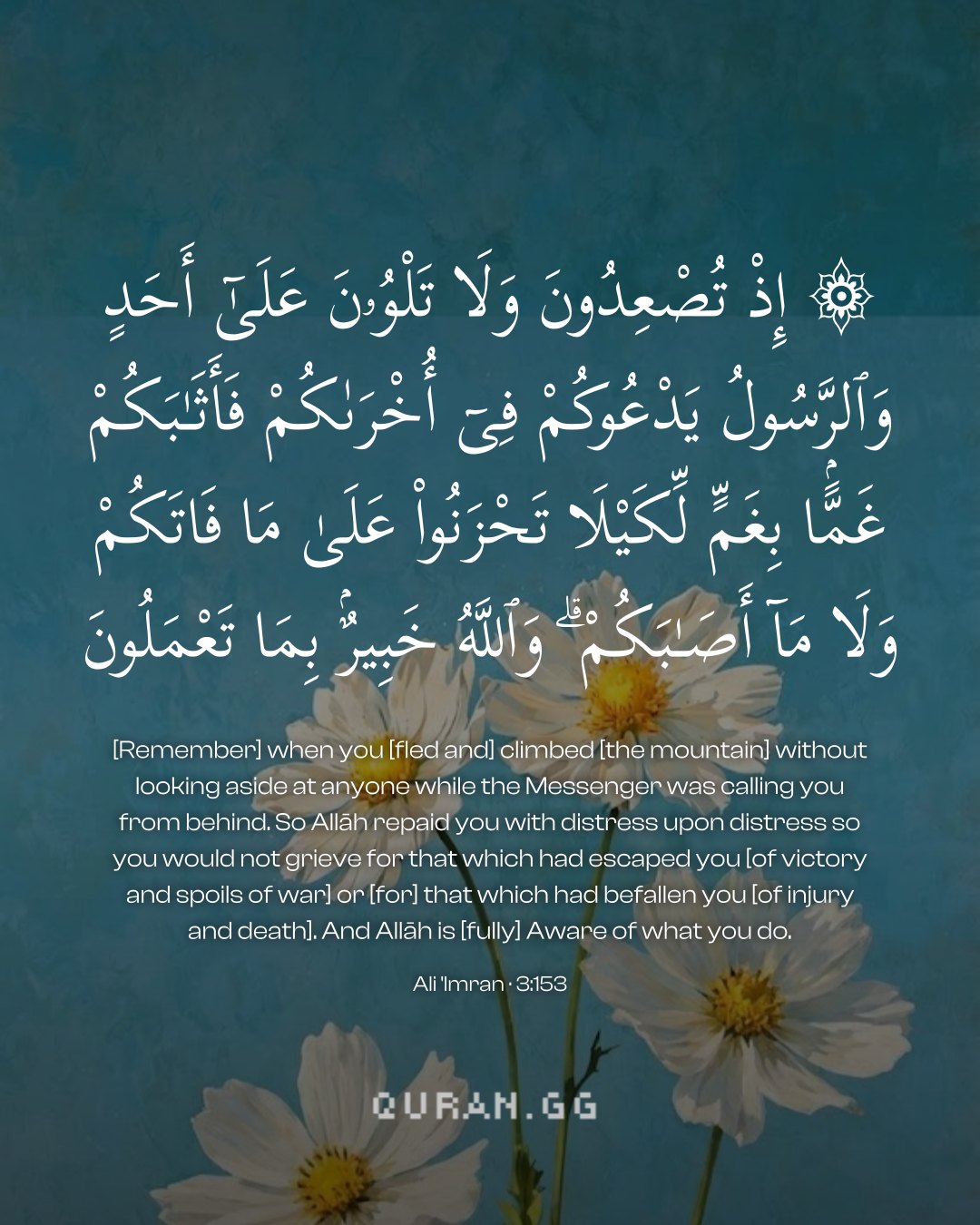
[Remember] when you [fled and] climbed [the mountain] without looking aside at anyone while the Messenger was calling you from behind. So Allāh repaid you with distress upon distress so you would not grieve for that which had escaped you [of victory and spoils of war] or [for] that which had befallen you [of injury and death]. And Allāh is [fully] Aware of what you do.
The Prohibition of Obeying the Disbelievers; the Cause of Defeat at Uhud
Allah warns His believing servants against obeying the disbelievers and hypocrites, because such obedience leads to utter destruction in this life and the Hereafter. This is why Allah said,
These verses form part of the several previous verses relating to the battle of Uhud. The first verse here mentions the sorrows of the sahabah, the noble Companions ؓ of the Holy Prophet ﷺ . The long succeeding verse describes the antidote. The third verse reiterates that the form of defeat they faced was no punishment. It was a test to separate the true and sincere Muslims from the hypocrites. Finally comes the repeated proclamation that the mistake made by the noble Companions has been forgiven.
Commentary :
In the first verse here, the Holy Qur'an describes the exit of the Companions from the battlefield, their inability to come back even when called by the Holy Prophet in person, the consequent grief that afflicted him because of their conduct and, later on, the incidence of the Companions feeling sorry for the sorrow they brought on their master. According to hadith narrations, when Sayyidna Ka'b ibn Malik ؓ called out to them, Muslims heard his call and reassembled.
The author of Ruh al-Ma'ani resolves this by saying that the first call came from the Messenger of Allah himself which could not be heard by the Companions and they kept going the way they were going. That was the time when Sayyidna Ka'b ibn Malik ؓ called. Every-body heard him and reassembled.
In Bay-an al-Qur'an, Maulana Ashraf Thanavi (رح) has said that the real reason for this confusion was the news that the Holy Prophet ﷺ has fallen a martyr on the battlefield. When he called, there was obviously no refutation of the news with the call. Even if his voice can be taken to have reached the retreating Companions, the possibility remains that it was not recognized. Finally, when Sayyidna Ka'b ibn Malik ؓ called out, his call included a refutation of this news mentioning the fact that the Messenger of Allah ﷺ was alive. On hearing this, everybody took a sigh of relief and reassembled. As far as the displeasure of Allah and the sorrow of His Messenger ﷺ are concerned, these can be explained by saying - if they had stayed unagitated and firm, they could have recognized the calling voice.
Tazkirul Quran
Maulana Wahiduddin Khan
When believers show steadfastness at crucial moments, God sends His special succour, that is, He strikes terror into the hearts of those who deny the truth. Any person or group who adheres to anything other than the true divine religion is standing in fact on quicksand. For, there is no other real base to build on in this world except the truth revealed by God. As such, whenever one has proved to be standing firmly on the ground of God’s religion, the ranks of those who deny the truth begin to show signs of disarray. Lacking sound arguments, those who deny the truth, unlike the believers, suffer from feelings of uncertainty and inferiority. This lack of conviction finally leads to their downfall. They are ultimately defeated at the hands of true believers. But in the case of the Muslims, their weakness and defeat are traceable solely to their disunity arising from dissension. Yet unity cannot come about in a society solely on the basis of uniformity of opinion. It takes united action also, even in the face of divisive opinions, to ensure total cohesiveness within a community. Only when a community thinks on this level can it remain united and powerful. When people start breaking up into factions, just because of disagreements, the resulting weakness will most certainly lead to defeat.
Uthmani text of the Madinah mushaf (King Fahd Complex). Translation: Saheeh International. Tafsir via Quran.com.