Surah Ali 'Imran Ayah 156 (3:156) — Meaning & Tafsir | Quran.GG

Surah Ali 'Imran, Ayah 156

3:156 · Meaning and tafsir

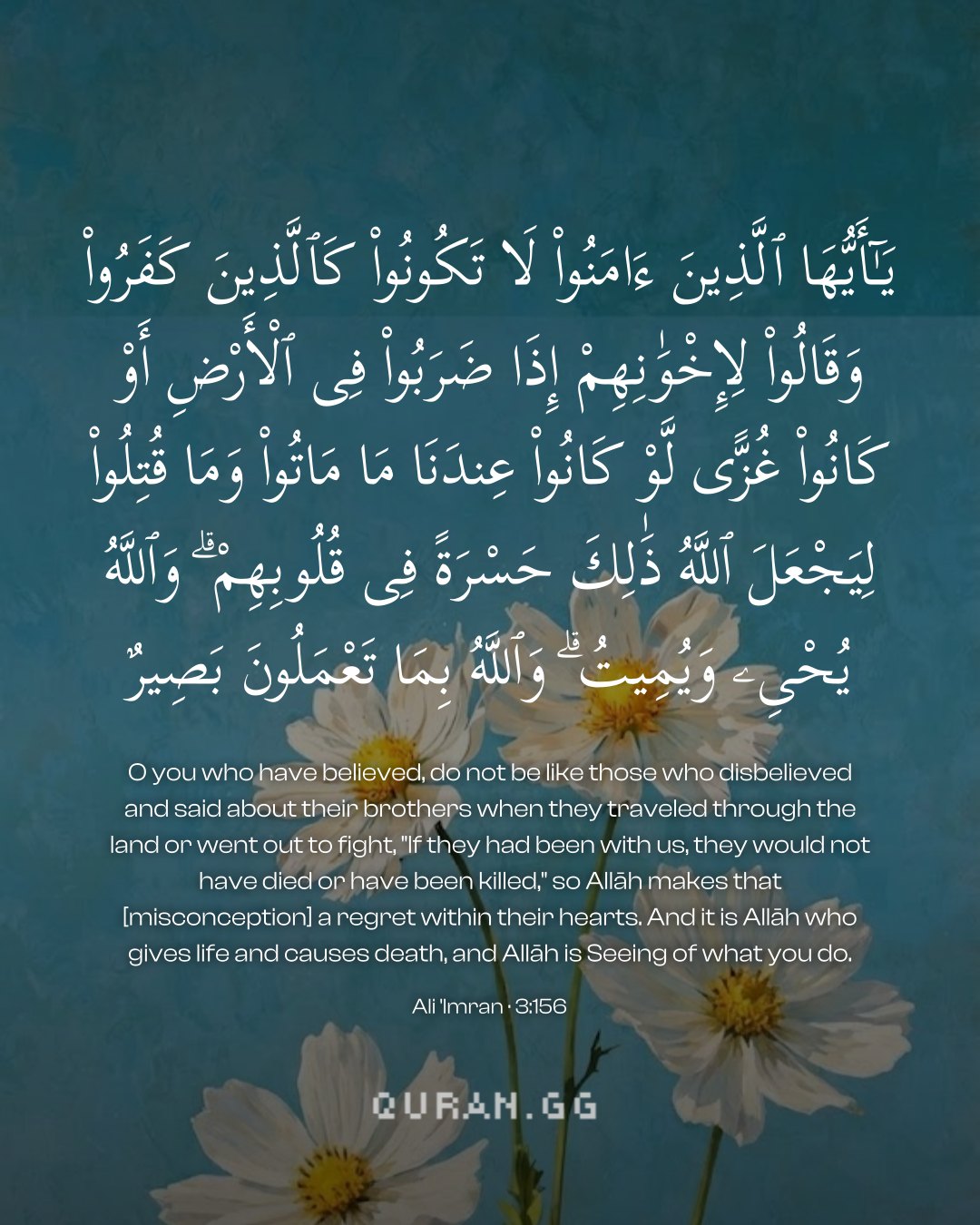
يَـٰٓأَيُّهَا ٱلَّذِينَ ءَامَنُوا۟ لَا تَكُونُوا۟ كَٱلَّذِينَ كَفَرُوا۟ وَقَالُوا۟ لِإِخْوَٰنِهِمْ إِذَا ضَرَبُوا۟ فِى ٱلْأَرْضِ أَوْ كَانُوا۟ غُزًّى لَّوْ كَانُوا۟ عِندَنَا مَا مَاتُوا۟ وَمَا قُتِلُوا۟ لِيَجْعَلَ ٱللَّهُ ذَٰلِكَ حَسْرَةً فِى قُلُوبِهِمْ ۗ وَٱللَّهُ يُحْىِۦ وَيُمِيتُ ۗ وَٱللَّهُ بِمَا تَعْمَلُونَ بَصِيرٌ ١٥٦

O you who have believed, do not be like those who disbelieved and said about their brothers when they traveled through the land or went out to fight, "If they had been with us, they would not have died or have been killed," so Allāh makes that [misconception] a regret within their hearts. And it is Allāh who gives life and causes death, and Allāh is Seeing of what you do.

Surah Ali 'Imran 3:156 in Arabic with its translation: “O you who have believed, do not be like those who disbelieved and said about their brothers when they…”

Make something with this ayah

Turn it into a video for Stories, Reels or TikTok, recited by the reciter you pick, or an image on a background you choose. Free, in your browser.

Download this image

Tafsir Ibn Kathir (abridged)

Prohibiting the Ideas of the Disbeleivers about Death and Predestination

Allah forbids His believing servants from the disbelievers' false creed, seen in their statement about those who died in battle and during travel; "Had they abandoned these trips, they would not have met their demise." Allah said,

يأَيُّهَا الَّذِينَ ءَامَنُواْ لاَ تَكُونُواْ كَالَّذِينَ كَفَرُواْ وَقَالُواْ لإِخْوَنِهِمْ

(O you who believe! Be not like those who disbelieve (hypocrites) and who say to their brethren), about their dead brethren,

إِذَا ضَرَبُواْ فِى الاٌّرْضِ

(when they travel through the earth) for the purpose of trading and otherwise,

أَوْ كَانُواْ غُزًّى

(or go out to fight), participating in battles,

لَّوْ كَانُواْ عِنْدَنَا

("If they had stayed with us,") in our area,

مَا مَاتُواْ وَمَا قُتِلُواْ

("they would not have died or been killed,") they would not have died while traveling or been killed in battle. Allah's statement,

لِيَجْعَلَ اللَّهُ ذَلِكَ حَسْرَةً فِى قُلُوبِهِمْ

(so that Allah may make it a cause of regret in their hearts. ) means, Allah creates this evil thought in their hearts so that their sadness and the grief they feel for their loss would increase. Allah refuted them by saying,

وَاللَّهُ يُحْيىِ وَيُمِيتُ

(It is Allah that gives life and causes death.) for the creation is under Allah's power, and the decision is His Alone. No one lives or dies except by Allah's leave, and no one's life is increased or decreased except by His decree.

وَاللَّهُ بِمَا تَعْمَلُونَ بَصِيرٌ

(And Allah is All-Seer of what you do,) for His knowledge and vision encompasses all His creation and none of their affairs ever escapes Him. Allah's statement,

وَلَئِنْ قُتِلْتُمْ فِى سَبِيلِ اللَّهِ أَوْ مُتُّمْ لَمَغْفِرَةٌ مِّنَ اللَّهِ وَرَحْمَةٌ خَيْرٌ مِّمَّا يَجْمَعُونَ

(And if you are killed or die in the way of Allah, forgiveness and mercy from Allah are far better than all that they amass.) 3:157, indicating that death and martyrdom in Allah's cause are a means of earning Allah's mercy, forgiveness and pleasure. This, indeed, is better than remaining in this life with its short lived delights. Furthermore, whoever dies or is killed will return to Allah, the Exalted and Most Honored, and He will reward him if he has done good deeds, or will punish him for his evil deeds. Allah said,

وَلَئِنْ مُّتُّمْ أَوْ قُتِلْتُمْ لإِلَى الله تُحْشَرُونَ

(And whether you die or are killed, verily, unto Allah you shall be gathered.) 3:158.

Ma'arif al-Qur'an

The saying of the hypocrites in verse 156 here is an extension of what was cited in verse 154 earlier: لَوْ كَانَ لَنَا مِنَ الْأَمْرِ‌ شَيْءٌ مَّا قُتِلْنَا هَاهُنَا :"If we had any say in the matter, we would have not been killed here." Since there were chances that sincere Muslims may be affected by such doubt-creating devices used by hypocrites, Muslims were asked through these verses to remain unconcerned with such sayings and doings and adhere to the belief that the span of life and the time of death are ordained by Allah alone.

Tazkirul Quran

On the occasion of Uhud, ‘Abdullah ibn Ubayy counselled that the defence of Madinah should be undertaken within the walls, instead of the Muslims boldly coming out to meet the enemy. The Prophet, however, at the instance of some other sincere Muslims, went out of the city to meet the enemy, posting his men strategically on Mount Uhud. The battle began well for the Muslims, but turned to near defeat because of the disobedience of a band of fifty archers who had been given the task of guarding a certain pass. Seeing the imminent Muslim victory, they abandoned their posts, attracted by the prospects of booty. When this victory turned into defeat, the hypocrites who had deserted the Muslims even before the battle started, on the pretext that their counsel had not been accepted by the Prophet, began to say that, had their words been heeded, this calamity could have been averted. But death is decreed by God and comes regardless of circumstances. No precautionary measure can save one from death. Such happenings, whatever their apparent reason, are wrought by God, in order that His true believers may turn to Him in repentance and become worthy of further blessings from Him. Such happenings also serve to reveal the truth about those who are not the true servants of God. When the fifty archers posted at the Mount Uhud pass saw that the Muslims had won the battle, a large number of them insisted on going in pursuit of booty. Although ‘Abdullah ibn Jubayr and a few other companions pointed out that it was against the orders of the Prophet, they deserted their posts, leaving behind eleven men. Satan thus made inroads by using the dissension already evident among them. However, when they admitted their error, they were forgiven by God, and after the initial setback, God’s succour came to them too. The Almighty struck terror into the hearts of their enemies, which resulted in their retreat, although they were just a few miles from Madinah. Had God’s succour not come, there was nothing to stop them from forcing their entry into Madinah and uprooting the nascent tree of Islam.

Continue reading the tafsir of ayahs 155–157

Uthmani text of the Madinah mushaf (King Fahd Complex). Translation: Saheeh International. Tafsir via Quran.com.