Among the Qualities of Our Prophet Muhammad are Mercy and Kindness
Allah addresses His Messenger and reminds him and the believers of the favor that He has made his heart and words soft for his Ummah, those who follow his command and refrain from what he prohibits.
فَبِمَا رَحْمَةٍ مِّنَ اللَّهِ لِنتَ لَهُمْ
(And by the mercy of Allah, you dealt with them gently) 3:159. meaning, who would have made you this kind, if it was not Allah's mercy for you and them. Qatadah said that,
فَبِمَا رَحْمَةٍ مِّنَ اللَّهِ لِنتَ لَهُمْ
(And by the mercy of Allah, you dealt with them gently) means, "With Allah's mercy you became this kind." Al-Hasan Al-Basri said that this, indeed, is the description of the behavior that Allah sent Muhammad with. This Ayah is similar to Allah's statement,
Continue reading the tafsir of ayahs 159–164 Commentary:
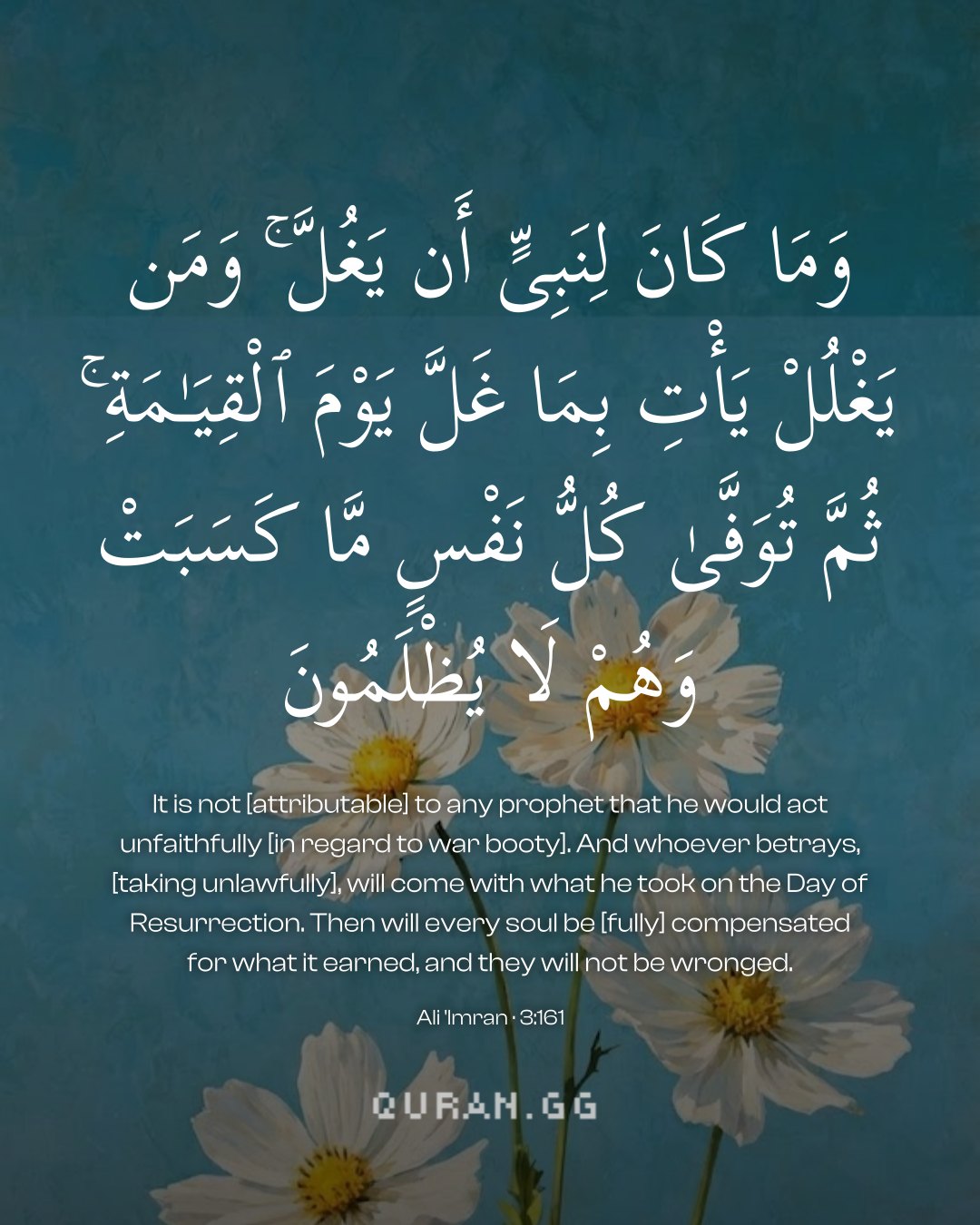
The verse مَا كَانَ لِنَبِيٍّ أَن يَغُلَّ translated as, 'And it is not (conceivable) for a prophet to misappropriate the spoils - 161', has a particular back-ground of its revelation. As a corollary, the problem of 'Ghulul', that is, misappropriation in the spoils, comes into focus.
Misappropriation in the spoils: A sin which cannot be ascribed to any prophet by any stretch of imagination:
The background, as narrated by al-Tirmidhi, is that a sheet was found missing from the spoils collected in the battle of Badr. Some people said that the sheet may have been, perhaps, taken by the Holy Prophet ﷺ . If those who said that were hypocrites, the source speaks for itself. May be, this came from a less-initiated
Muslim thinking that the Holy Prophet ﷺ had the right to do that. Thereupon, this verse was revealed which said that ghulul is a great sin to be punished severely on Doomsday and that the very thought of linking this sin to a prophet is an ugly audacity, .for prophets are free of all sins (: معصوم ma` sum).
The word, ghulul غُلُل is also used in the absolute sense for خیانہ khiyanah, a breach of trust, (misappropriation, pilferage and stealing). This is also applied particularly to misappropriation in the spoils as the crime of stealing from the spoils is far more serious as compared to common thefts and filching since spoils belong to the whole Muslim army as a matter of right. So, whoever steals from it steals from hundreds and thousands of people. Even if there comes the thought of making amends at some later stage, it would be very difficult to give back to everyone what was due to be given, or seek their forgiveness for the injustice done. This is contrary to other types of thefts where the owner of the stolen property is known. In this case, there is the chance that one may repent, if Allah gives the ability to do so, and that which was stolen could be returned back to the owner, or one could, at the least, exonerate himself from the blame by seeking forgiveness from him. This is illustrated by what happened at one of the battles fought by Muslims. Someone who had secretly withheld a portion of wool from the spoils thought about it after the distribution of the spoils was over. He brought it before the Holy Prophet ﷺ hoping to return it. But he, inspite of being 'mercy for the worlds' and far more generous to his community than fathers and mothers could ever dream to be for their children, he returned it back to him saying: How can I distribute it over the whole army now? Now it is you who would present yourself with it on the Day of Doom.
Therefore, the punishment for ghulul or misappropriation is more severe as compared to common thefts. What else could be more severe for the misappropriator when he, before the eyes of the whole creation on the plains of resurrection and retribution, will find himself disgraced with what he had stolen all stacked on his neck? A narration from Sayyidna Abu Hurairah ؓ appearing in Al-Bukhari and Muslim reports that the Holy Prophet ﷺ said: 'Watch out, lest I see one of you with a camel loaded round his neck (and the announcement being made that this person had stolen a camel from the spoils). If this person asks me to intercede on his behalf, I shall tell him frankly that I had conveyed what Allah had commanded, now I cannot do anything about it.'
May Allah protect us from this disgrace of the Day we rise again which, according to some narrations, will be so hard on those who face it that they would wish to be sent to the fires of جھنم Jahannam in lieu of this terrible disgrace.
Misappropriation in Waqf properties and government Treasuries comes under Ghulul: غلول
The same rule applies to mosques, religious schools and institu-tions, khanqahs and properties of اوقاف awqaf (endowments) since they represent the contribution of millions of Muslims. If an unfortunate misappropriator was to go about seeking to be forgiven for his evil act, how could he possibly go to each one of those millions. The same rule holds good for public or government treasury بیت المال (Bayt al-Mal) because all citizens of a country have a right in it. One who steals from it steals from everyone. But, the problem is that these very holdings are such that a single owner does not sit over them. The caretakers become negligent. Avenues of pilferage abound. It is in such moneys and properties that a lot of thefts and misappropriations have become rampant all over the world with most people heedless to the evil end that awaits them. They do not realize that this is a terrible burden to haul onto the plains of Resurrection, not to speak of the punishment of Hell that is bound to come as a result of this crime. Then, last but not the least, comes the sad deprivation from the promised intercession of the Messenger of Allah. Let us all seek refuge from such a fate!
The gentle way the Prophet is asked to deal with the believers (in this context those who had disobeyed him in quitting their posts, incurring defeat in the battle) is equally essential in any Muslim leader. Moderation is indispensable for him. This lenient attitude is required not only in normal, daily life but also in dealings between Muslims and non-Muslims, even where, due to the disobedience of certain people, a victory turns into a defeat. Unless the leader shows broad-mindedness and high thinking, a powerful polity cannot be established. Mistakes, however grave their outcome, if committed without any evil intention, are pardonable. The leader, therefore, should overlook this type of error while dealing with people. He should be such a great well-wisher of his people that he should pray to God for their guidance. Indeed, the good leader so values his people that he takes decisions on matters of importance only after consulting them.
Uthmani text of the Madinah mushaf (King Fahd Complex). Translation: Saheeh International. Tafsir via Quran.com.