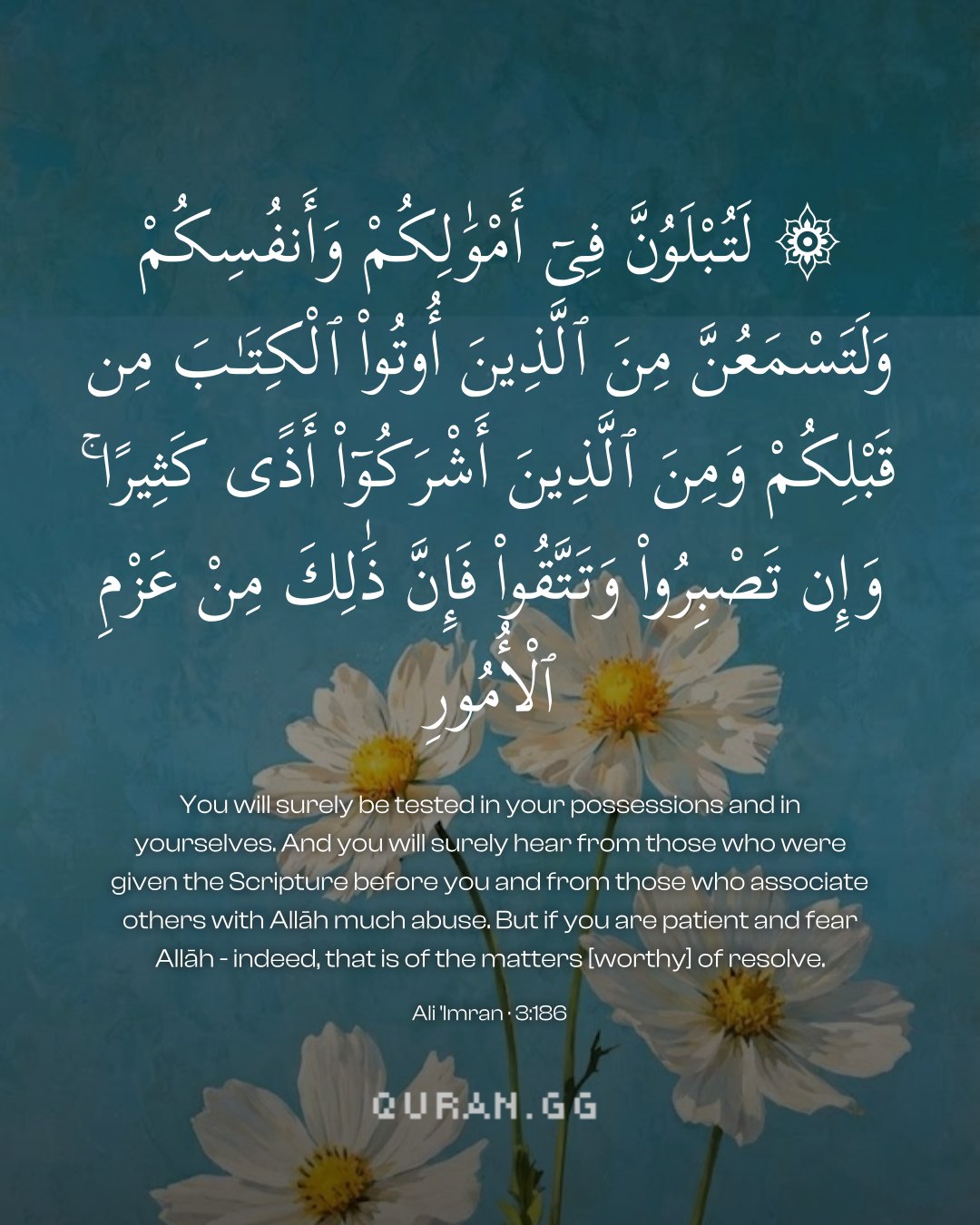
You will surely be tested in your possessions and in yourselves. And you will surely hear from those who were given the Scripture before you and from those who associate others with Allāh much abuse. But if you are patient and fear Allāh - indeed, that is of the matters [worthy] of resolve.
(Whatsoever is on it (the earth) will perish. And the Face of your Lord full of majesty and honor will remain forever) 55:26,27.
Therefore, Allah Alone is the Ever-Living Who never dies, while the Jinn, mankind and angels, including those who carry Allah's Throne, shall die. The Irresistible One and Only, will alone remain for ever and ever, remaining Last, as He was the First. This Ayah comforts all creation, since every soul that exists on the earth shall die. When the term of this life comes to an end and the sons of Adam no longer have any new generations, and thus this world ends, Allah will command that the Day of Resurrection commence. Allah will then recompense the creation for their deeds, whether minor or major, many or few, big or small. Surely, Allah will not deal unjustly with anyone, even the weight of an atom, and this is why He said,
Thoughts of the Hereafter heal all sorrows and remove all doubts
The sixth verse (185) puts a sharp focus on the ultimate reality of things in a situation when sometime somewhere disbelievers come to enjoy ascendency one way or the other and they have all the luxury they can think of in this world. Contrary to this, Muslims have to face some hardships, some difficulties and a certain paucity of worldly means. There is nothing surprising about it and certainly no occasion to be grieved, for no follower of a faith or philosophy can ignore the reality of life that sorrow and happiness in this world are both short-lived. No living creature can escape death. As for the comfort and discomfort experienced in this world, they vanish, more than often, right there with relevant changes in circumstances - or, just in case, no change takes place during the life of this world, it is certain that everything will end with the knock of death. Therefore, worrying about this short-lived cycle of comfort and discomfort should not become the chronic concern of a wise person. One should, rather, have concern for what would happen after death.
A man has to make the journey of faith in a world where he might be hurt in many ways, both by his own people as well as strangers. But under no circumstances should he fall prey to negative thoughts. He should rather confront every difficult situation as it comes and keep going on. He might be even provoked, but nonetheless he should restrain himself. He should bear every setback without resorting to vengeance. There might be many an occasion when his heart, unable to take any more suffering might tell him to break the bonds of God and act as his heart bids him. Still, the fear of God should stop him from taking such a step even then. The demands of religion inevitably require the ultimate sacrifice—which would mean sacrificing one’s life and wealth. In such a situation, one has to uphold religion by making sacrifices for its cause, though that might mean adopting the most difficult of the courses open to one. On the journey of faith, this is a tremendous test of courage and high-mindedness. Indeed, becoming a true believer is a trial which requires patience and piety. One who successfully qualifies in this test is the believer for whom the gates of Paradise will be thrown open in the Hereafter.
Uthmani text of the Madinah mushaf (King Fahd Complex). Translation: Saheeh International. Tafsir via Quran.com.