Allah's Love is Attained by Following the Messenger
This honorable Ayah judges against those who claim to love Allah, yet do not follow the way of Muhammad . Such people are not true in their claim until they follow the Shari`ah (Law) of Muhammad and his religion in all his statements, actions and conditions. It is recorded in the Sahih that the Messenger of Allah ﷺ said,
«مَنْ عَمِلَ عَمَلًا لَيْسَ عَلَيْهِ أَمْرُنَا فَهُوَ رَد»
(Whoever commits an act that does not conform with our matter (religion), then it will be rejected of him.)
This is why Allah said here,
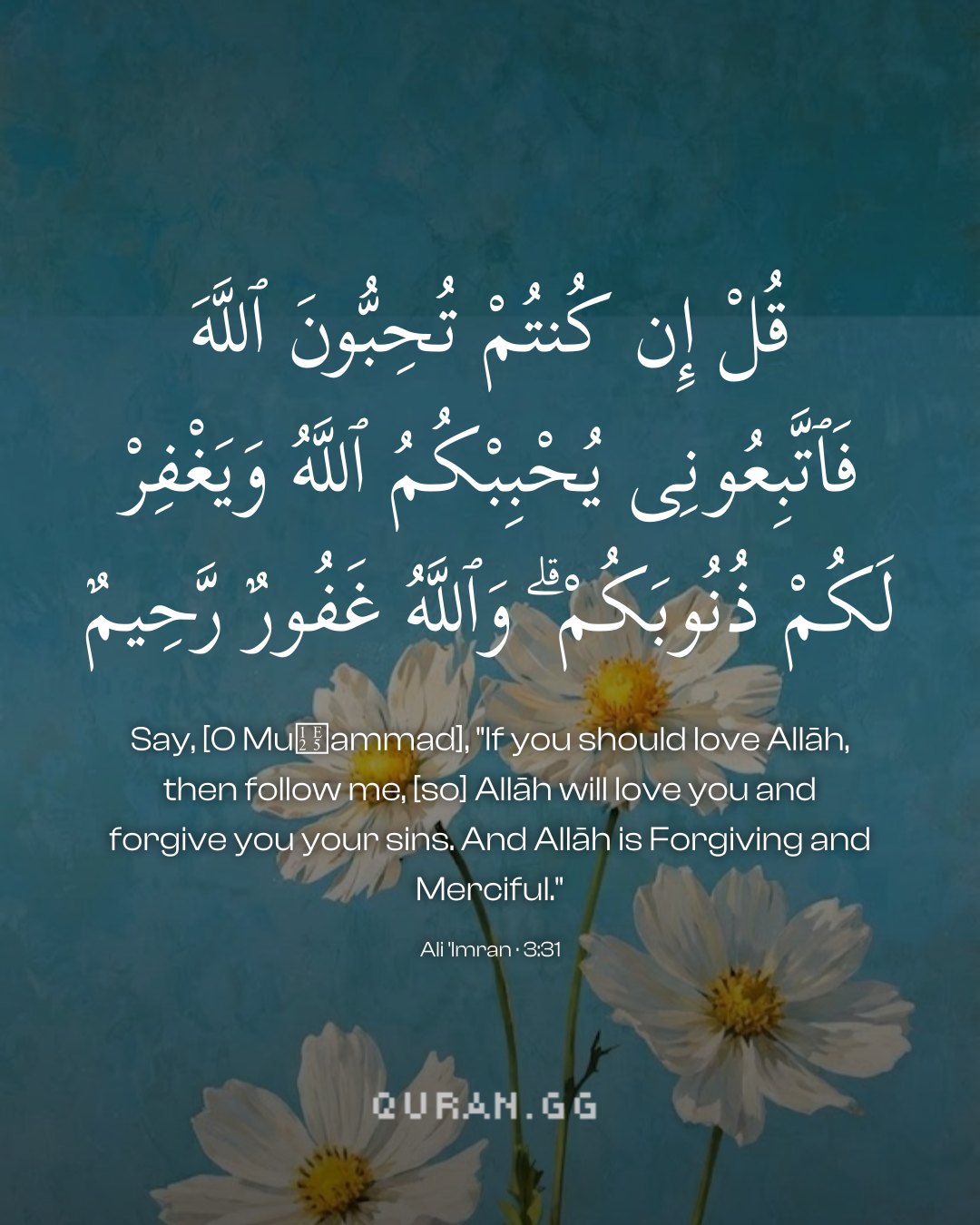
قُلْ إِن كُنتُمْ تُحِبُّونَ اللَّهَ فَاتَّبِعُونِى يُحْبِبْكُمُ اللَّهُ
(Say (O Muhammad to mankind): "If you (really) love Allah, then follow me, Allah will love you...") meaning, what you will earn is much more than what you sought in loving Him, for Allah will love you. Al-Hasan Al-Basri and several scholars among the Salaf commented, "Some people claimed that they love Allah. So Allah tested them with this Ayah;
قُلْ إِن كُنتُمْ تُحِبُّونَ اللَّهَ فَاتَّبِعُونِى يُحْبِبْكُمُ اللَّهُ
(Say (O Muhammad to mankind): "If you (really) love Allah, then follow me, Allah will love you..."). "
Allah then said,
وَيَغْفِرْ لَكُمْ ذُنُوبَكُمْ وَاللَّهُ غَفُورٌ رَّحِيمٌ
("And forgive you your sins. And Allah is Oft-Forgiving, Most Merciful.") meaning, by your following the Messenger , you will earn all this with the blessing of his mission. Allah next commands everyone,
قُلْ أَطِيعُواْ اللَّهَ وَالرَّسُولَ فإِن تَوَلَّوْاْ
(Say: "Obey Allah and the Messenger." But if they turn away) by defying the Prophet)
فَإِنَّ اللَّهَ لاَ يُحِبُّ الْكَـفِرِينَ
(then Allah does not like the disbelievers.) thus, testifying that defiance of the Messenger's way constitutes Kufr. Indeed, Allah does not like whoever does this, even if he claims that he loves Allah and seeks a means of approach to Him, unless, and until, he follows the unlettered Prophet, the Final Messenger from Allah to the two creations: mankind and the Jinn. This is the Prophet who, if the previous Prophets and mighty Messengers were to have been alive during his time, they would have no choice but to follow, obey him, and to abide by his Law. We will mention this fact when we explain the Ayah,
وَإِذْ أَخَذَ اللَّهُ مِيثَـقَ النَّبِيِّيْنَ
(And (remember) when Allah took the Covenant of the Prophets) 3:81, Allah willing.
Sequence
In previous verses, there was affirmation of Allah's Oneness and the condemnation of disbelief in it. Affirmed now is the belief in prophethood as well as the necessity of following the Messenger so that we stand informed that the rejection of prophethood or refusal to obey the Prophet ﷺ is also an act of disbelief (kufr) like the rejection of the Oneness of Allah.
Commentary
Love is something secret. Whether or not a person loves another person, or loves less or more, are questions which cannot be answered precisely. There is no measure or yard-stick to determine the truth of the matter except that one makes an educated guess based on visible conditions and dealings, for love leaves traces and signs which could help in recognizing it as such. Now, in these verses, Allah Almighty tells those who claimed that they loved Allah and hoped to be loved by Him above the real criterion of His love. In other words, if a person living in the world of today claims that he loves his Creator and Master, then, he must test it on the touch-stone of his obedience to the Messenger, that is, match it against the frequency and quality of where and how he has been following him. Once this is done, the genuine and the fake of it will be exposed right there. How much true a person turns out to be in his claim will be visible from how much he makes it a point to follow the noble prophet (علیہ السلام) ، using the guidance brought by him as the guiding force in his life. The same test will show that the weaker a person is in his claim, so equally weak he shall be in his obedience to the Prophet ﷺ .
The Holy Prophet ﷺ has said:
He who obeyed Muhammad ﷺ obeyed Allah and he who disobeyed Muhammad ﷺ disobeyed Allah. (Tafsir Mazhari)
A believer treats all human beings with justice and fairness, without differentiating between Muslims and non-Muslims. But friendship with non-Muslims who are at war with Islam is not lawful. In the eyes of God, it is our intention that matters: when our intention is sincere, God does not take us to task for our actions. The key factor, worthy of consideration in all matters, is the fear of God. One should always give proper thought to one’s behaviour, whatever the issue, because one is accountable to God for everything. Whoever is proved wrong on the divine scale cannot escape punishment. Nothing pertaining to human beings escapes the eyes of God, whether in public or in private. When the veil of the divine test is cast aside, the world of the Hereafter will appear before mankind and the fruits of all man’s actions will be before him. This sight will be so dreadful that all the things of this world which had appeared so pleasing to him, will now be the very things from which he will want to distance himself. What is most important in the eyes of God is whether Islam is implanted in one’s heart or not. A believer is one whose love for God springs from his heart, who loves God truly in his heart of hearts. It is people such as those who deserve God’s love and attention. One who forms such a bond with God is forgiven by Him for his failings. God is hard on the arrogant. But He is gentle with those who adopt modesty as their way of life.
Uthmani text of the Madinah mushaf (King Fahd Complex). Translation: Saheeh International. Tafsir via Quran.com.