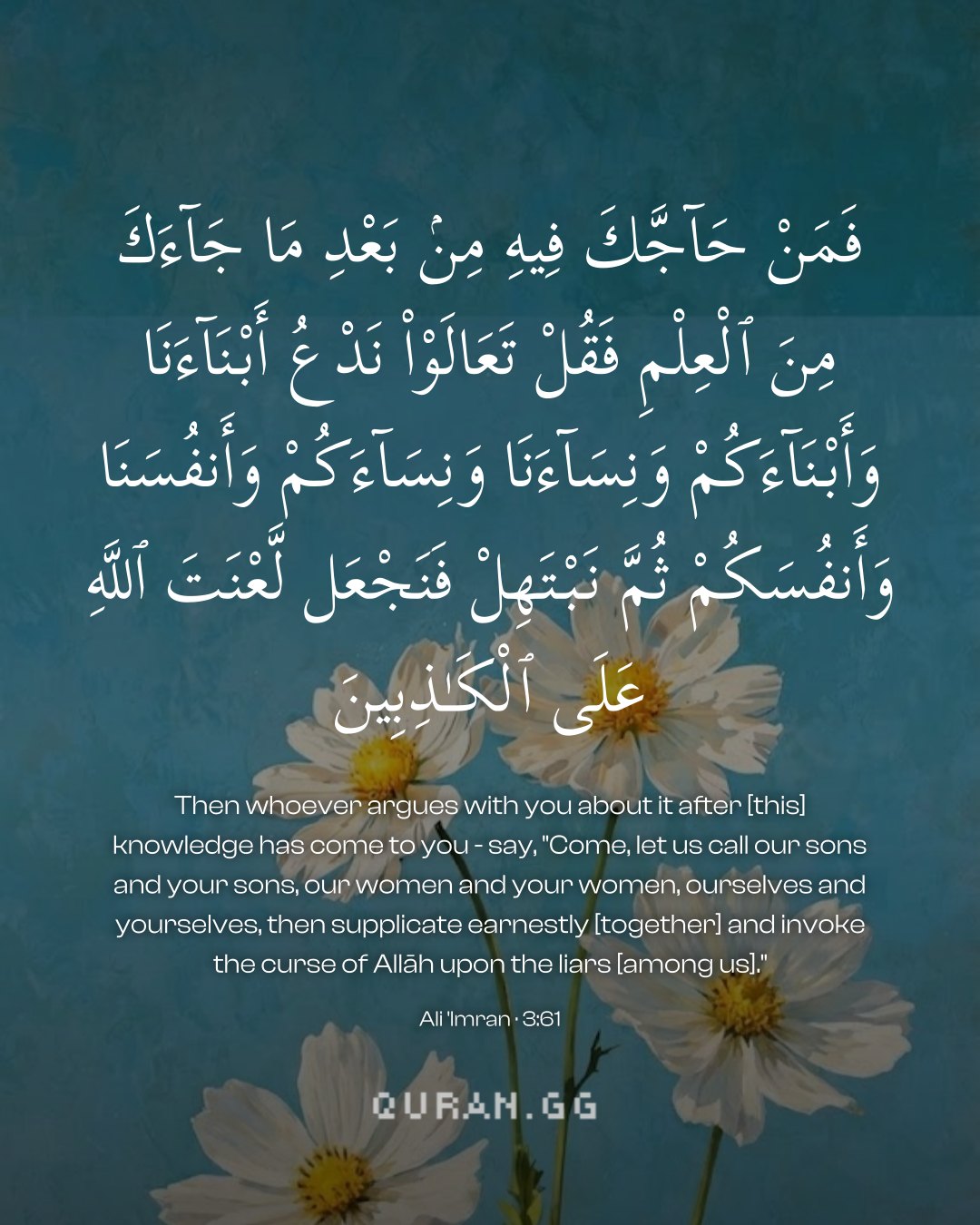
Then whoever argues with you about it after [this] knowledge has come to you - say, "Come, let us call our sons and your sons, our women and your women, ourselves and yourselves, then supplicate earnestly [together] and invoke the curse of Allāh upon the liars [among us]."
(He created him from dust, then (He) said to him: "Be!" and he was.)
Therefore, He Who created Adam without a father or a mother is able to create `Isa, as well, without a father. If the claim is made that `Isa is Allah's son because he was created without a father, then the same claim befits Adam even more. However, since such a claim regarding Adam is obviously false, then making the same claim about `Isa is even more false.
As stated earlier, verse 61 has instructed the Holy Prophet ﷺ to invite his opponents (Christians) to Mubahalah which literally means 'mutual prayer' but in the terminology of Islamic Shari'ah it refers to a particular form of resolving religious disputes. When the argumentations from both sides fail to resolve a religious issue, the parties jointly pray Allah to cast His curse on whichever of the two parties is parties is false. Since curse means 'moving someone far away from the divine mercy', - and moving far away from mercy is being close to divine wrath--therefore, the essence of the meaning is: Wrath be on the liar. As such, whoever is the liar shall face the evil consequences whereupon the truth will become evident before the disbelievers as well. Invocation in this manner is called 'Mubahalah'.
Originally, the Mubahalah can be carried out by the disputants only; they can simply get together and pray. It is not necessary that all their family members are assembled. However, if all the family members participate in the Mubahalah, it becomes more effective. (That is why the Holy Prophet JJ was instructed to invite the family members of both sides).
'Son' includes grandson
In verse 61 the words 'our sons' does not mean 'our' sons as of the loins only. Instead, the sense is general. They may be sons or grandsons, because this is how the word is used in common usage. Therefore, the grandsons of the Holy Prophet ﷺ ، namely Sayyidna Hasan and Sayyidna Husain ؓ as well as Sayyidna ` Ali ؓ the son-in-law of the Holy Prophet ﷺ are all included in the words: 'our sons'.
Sayyidna ` Ali ؓ has another additional reason for being included in the 'sons' of the Holy Prophet ﷺ because he had grown up under the patronage of the Holy Prophet ﷺ who had treated him like his own son.
It is, therefore, evident that Sayyidna ` Ali ؓ is included in the words: 'our sons'. Some Shiites have claimed that since he was not the son of the Holy Prophet ﷺ he could not be referred to by the Holy Prophet ﷺ as 'our son'. Through this notion the Shiites conclude that Sayyidna ` Ali ؓ was included in the words 'ourselves', therefore, he was the immediate successor of the Holy Prophet ﷺ .
The fallacy of this argument is evident from what has been discussed above.
Tazkirul Quran
Maulana Wahiduddin KhanOn ayahs 59–62
The Christians believe that Christ is the son of God, and that he is different from all other human beings. Since his very birth was quite exceptional in that he had no father, how could he be a human being like any other? They hold that his uncommon birth itself shows that he was not the son of man but of God. But this contention can be shown to be invalid by comparing the birth of Christ with the birth of the first man. (All of us, the Christians too, believe that Adam was the first man.) He was not born in the normal way, i.e. having a father and mother, but came into existence directly by God’s command. Then when Adam, born without a father, is not God’s son, how could Jesus Christ, who was also born without a father, be the son of God?
Uthmani text of the Madinah mushaf (King Fahd Complex). Translation: Saheeh International. Tafsir via Quran.com.